This article contains advertising. Our booking links are routed through a partner that adds commission tracking automatically, so if you book through one we earn a commission from the provider, at no extra cost to you. It never affects what we recommend. Affiliate disclosure
For about a week each year, Taipei does something it never does otherwise: it goes quiet. On the afternoon of Lunar New Year’s Eve the traffic thins, the shutters come down on small family restaurants, and many people head home to parents and grandparents in the south. What is left is an oddly peaceful capital — empty boulevards, packed temples, red paper on every door — and a list of things that are open, half-open and firmly shut that catches out visitors every year. That list is most of what you need to know about Chinese New Year in Taipei, and the good news is that it is shorter than it used to be.
This guide covers the 2027 dates, what is open and closed day by day, what to do and eat, how the customs work, how to get around when the whole island is on the move, and whether the holiday is a good time to visit at all. Details were checked in October 2026; event dates for 2027 are announced over the winter, so treat anything we flag as provisional and confirm before you travel.
Chinese New Year 2027 at a glance
| When | What happens |
|---|---|
| Mid-January to early February | Dihua Street’s New Year market; company year-end banquets; the city shops for the holiday |
| Thu 4 February | The official holiday begins; the great exodus from Taipei |
| Fri 5 February — New Year’s Eve | Reunion dinners; many restaurants close; check opening hours for attractions and temples |
| Sat 6 February — New Year’s Day | Year of the Goat begins; temple visits, lion dances, red envelopes |
| Sun 7 February — Day 2 | Married daughters visit their parents’ homes |
| Mon 8 – Wed 10 February | Holiday continues; reopening dates vary from business to business |
| Thu 11 February | Back to work |
| Sat 20 February — Lantern Festival | The fifteenth day, which ends the New Year season: Pingxi’s sky lanterns and the lantern shows |
The official holiday runs for seven days, from Thursday 4 to Wednesday 10 February 2027, with no make-up working days. It includes the day before New Year’s Eve, which became a public holiday under a 2025 change to the rules, and two extra weekday holidays because New Year’s Day and the day after fall on a weekend. For the rest of the year’s events, see our Taipei festivals calendar.
What’s open and what’s closed
This is the question that matters most, and the answer has improved. A decade ago much of Taipei shut for most of the week. Today the big attractions close only on New Year’s Eve, and the city keeps running — with gaps.
| New Year’s Eve (Fri 5) | New Year’s Day onwards | |
|---|---|---|
| National Palace Museum, Taipei Zoo, Maokong Gondola, Children’s Amusement Park | Closed | Open, and busy |
| Chiang Kai-shek Memorial Hall | Open | Open |
| Taipei 101 and the big malls | Usually open; check hours on the day | Open |
| MRT and city buses | Running | Running |
| Temples | Open; check the temple’s holiday hours | Open; check the temple’s holiday hours |
| Night markets | Thin — many stalls off | Open, with some stalls missing for a few days |
| Chain restaurants and food courts | Mostly open, some closing early | Open |
| Family-run restaurants and small shops | Closed | Many closed for several days, some the whole week |
| Convenience stores | Most stay open | Most stay open |
| Banks and government offices | Closed | Government offices closed until Thu 11 Feb; banks usually follow, so check your bank |
| Clinics | Mostly closed | Mostly closed; hospital emergency departments open |
Treat that table as the pattern, not a guarantee: individual museums and attractions publish their holiday hours in January, and they change from year to year. Check each place’s own site before you set off.
The restaurant problem, and how to beat it
The biggest adjustment for visitors is food. The small, family-run places that make Taipei such a good city to eat in — the beef noodle shops, the dumpling counters, the breakfast joints — are exactly the ones that close, typically from New Year’s Eve for anywhere between three days and the whole week. Some that stay open add a holiday surcharge. What stays open:
- Chain restaurants, including most of the big dumpling and hot pot chains — expect queues.
- Department-store food courts, in Xinyi, the East District and around Taipei Main.
- Hotel restaurants, many of which run New Year buffets — book ahead.
- Night markets: many stay open through the holiday, but some close on New Year’s Eve (Liaoning Street and Shuangcheng Street do), so check each market’s notice. See our night markets guide.
- Convenience stores, which will never let you starve. Our guide to Taiwan’s convenience stores explains how much more they offer than snacks.
If a particular restaurant is the reason for your trip, message it or check its social media for holiday opening days, which most post a few weeks ahead.
Money and practical closures
Banks close for the whole seven days, so exchange money beforehand or rely on ATMs, which keep working, and on cards, which are accepted widely in malls and chains but not in markets. Our guide to money in Taipei covers the details. Hospital emergency departments stay open; for anything less urgent, see our guide to healthcare and pharmacies.
Before the holiday: Dihua Street and the New Year rush
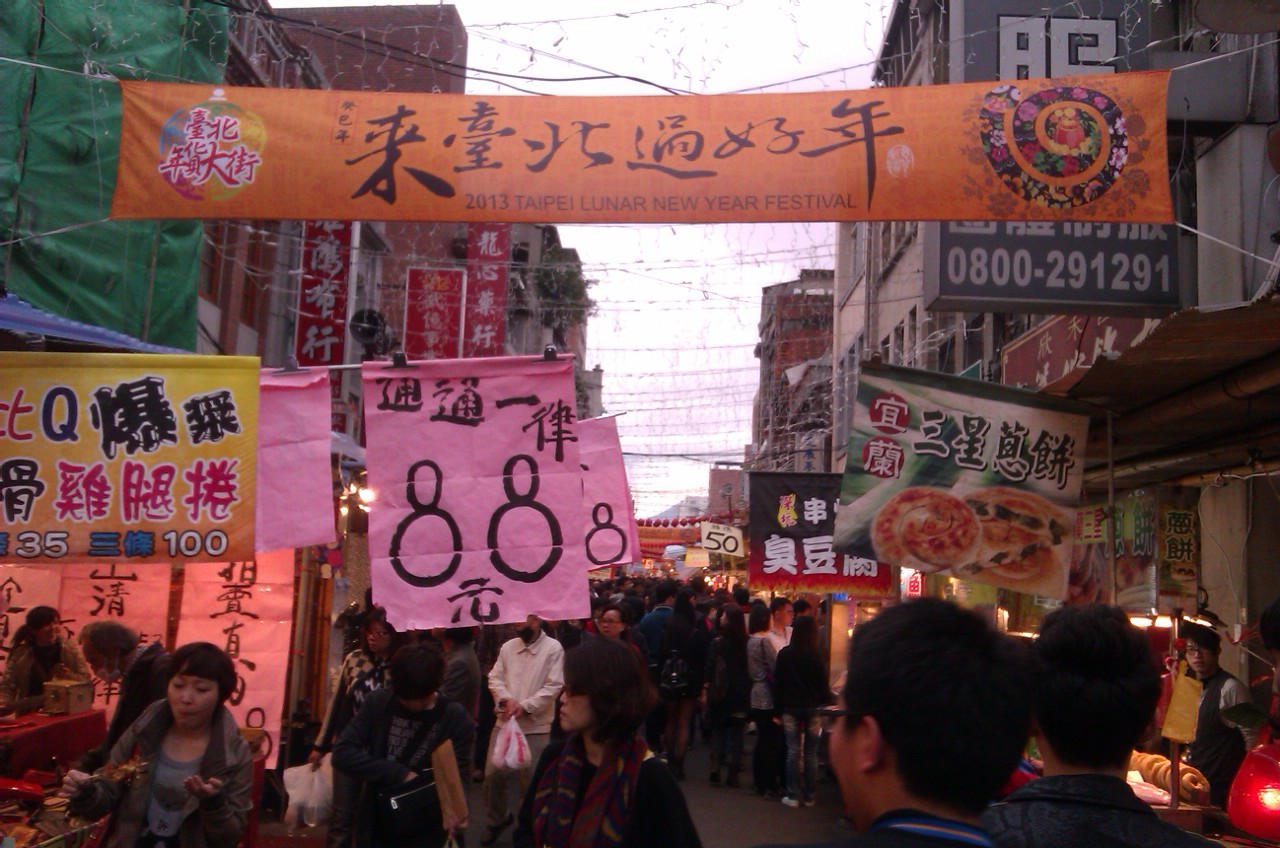
The two or three weeks before New Year are one of the best times to be in Taipei. The whole city is shopping, cleaning and preparing, and nowhere shows it better than Dihua Street in Dadaocheng, whose dried-goods merchants have supplied the city’s New Year tables for more than a century. For the New Year market (年貨大街), the street closes to traffic and fills with stalls handing out free tastings of dried mango, candied lotus root, nuts, beef jerky and mullet roe (烏魚子), the luxurious salted delicacy that is a fixture of New Year gift-giving.
In 2026 the market ran from 31 January to 15 February, ahead of that year’s holiday. Check travel.taipei for the 2027 dates before you plan your visit. Weekday afternoons are busy; weekend evenings are shoulder to shoulder. Nearest MRT: Beimen, about six minutes’ walk. Our guide to Taipei neighbourhoods covers Dadaocheng the rest of the year.
The season’s other pre-holiday ritual is the weiya (尾牙), the company year-end banquet held in the weeks before the New Year. Firms book out restaurant function rooms and hotel ballrooms for loud, cheerful dinners with speeches, karaoke and a lottery of prizes for staff, and on a January evening you will hear them before you see them. It is one reason why popular restaurants are harder to book than usual in the run-up to the holiday.
This is also when you will see spring couplets (春聯) — red paper strips with auspicious verses — going up on every door, and the character 春 or 福 hung upside down, because “upside down” (倒) sounds like “arrived”. Stalls in the market and in Wanhua sell them, along with red envelopes; they make good, cheap souvenirs.
New Year’s Eve
New Year’s Eve is a family night. Across Taiwan, families gather for the reunion dinner, which the Taiwanese call 圍爐 (wéi lú), “gathering around the stove”, because it is so often a hot pot. Restaurants that take reunion-dinner bookings are fully booked weeks or months ahead; most others close early or do not open at all. Streets empty by late afternoon.
For a visitor, the Eve is the quietest night of the year in Taipei and the one most likely to leave you hungry. Plan dinner in advance — a hotel buffet, a big chain restaurant, a food court — or embrace it and buy a convenience-store feast. After dinner, families traditionally stay up late (守歲, “guarding the year”), and children receive their first red envelopes.
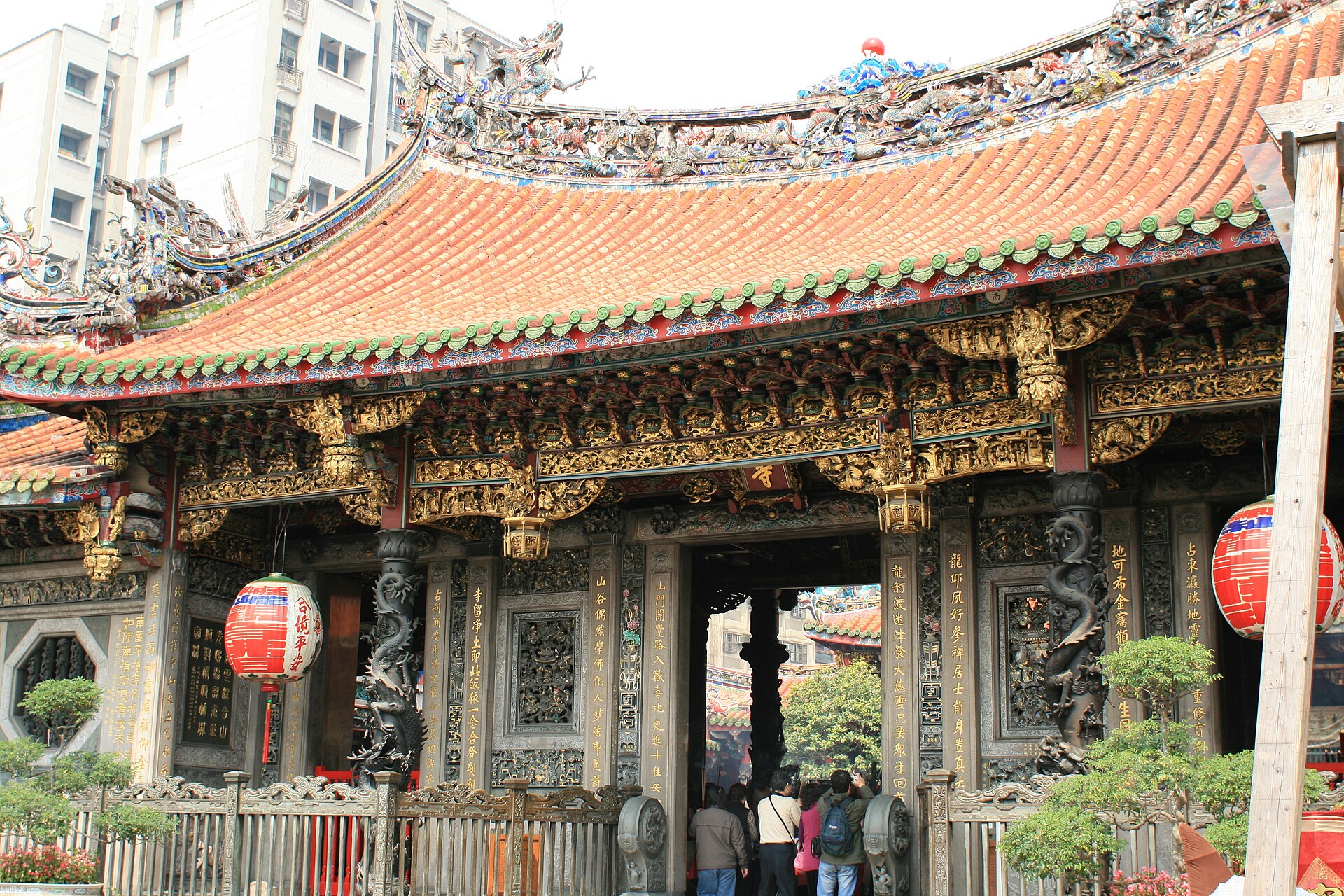
Around midnight, the temples are where many people welcome the new year, so check a temple’s holiday hours before you plan a late visit. At Longshan Temple visitors pray with joined hands rather than burning incense, as the temple keeps the lighting of the Guanyin burner for its staff. It is loud, crowded and wonderful, and a good place for a visitor to see the New Year arrive. Fireworks and firecrackers go off across the city, though far less than in the past.
New Year’s Day and the days after
The first days of the year are for visiting temples and family, and for the red envelope.
- Day 1 (Sat 6 February) — temple visits to pray for the year ahead, draw fortune sticks and light lamps for good luck. Longshan Temple, the Xia Hai City God Temple in Dadaocheng and Baoan Temple in Dalongdong are all spectacular. Many families avoid sweeping, cleaning or washing hair today, so as not to wash away the good luck.
- Day 2 (Sun 7 February) — married daughters traditionally return to their parents’ homes. Attractions and roads are busy.
- Days 3 to 5 — more visiting, more outings, and gradually more businesses reopening. Many shops and restaurants restart on the fifth or sixth day with a small ceremony and a string of firecrackers.
Lion dances
Lion and dragon dances turn up at temples, shopping streets and hotels over the first days of the year, bringing luck to businesses with a clash of drums and cymbals. They are rarely advertised far ahead. Hotels and venues usually announce theirs close to the day, so check their own channels and travel.taipei’s event listings in January, and listen out for drums.
Things to do in Taipei over the holiday
Once you have accepted that some things will be closed, the holiday is an excellent time to be a visitor. The city is emptier than at any other time of year, the roads are quiet, and the atmosphere is festive.
- Temple-hop on the first days. Our temples guide suggests a route; our guide to religion in Taipei explains what you are seeing.
- Visit the big museums and attractions from New Year’s Day onwards — the National Palace Museum, Taipei Zoo and the Maokong Gondola are open, although they are busy with families. Go early.
- Climb Elephant Mountain for the view over a quiet city — see our Elephant Mountain guide — or head up into Yangmingshan, where the early cherry blossoms may be out.
- Walk the empty boulevards. Zhongzheng’s monuments and Da’an’s lanes are at their most peaceful on the first mornings of the year.
- Shop the sales. Department stores run New Year promotions and sell lucky bags (福袋) with mystery contents.
- Soak. February is prime hot spring season; Beitou is busy but open. Book private baths in advance.
Day trips are trickier. The famous ones — Jiufen, Shifen, Yehliu — are overrun during the holiday, with queues for buses and trains to match. If you want to leave the city, go early in the morning, choose quieter alternatives, or wait until the week after.
What to eat
New Year food in Taiwan is all about symbolism, usually through a pun. A few dishes you will meet:
- Whole fish (魚) — because yú sounds like “surplus”, as in the New Year wish 年年有餘, “abundance year after year”. Traditionally some is left uneaten.
- Nian gao (年糕) — sticky rice cake, whose name sounds like “higher every year”.
- Turnip cake (菜頭粿) — chhài-thâu in Taiwanese sounds like “good fortune”.
- Fa gao (發糕) — a steamed, split-topped cake for prosperity.
- Long-year vegetable (長年菜) — mustard greens eaten whole, uncut, for a long life.
- Buddha Jumps Over the Wall (佛跳牆) — an extravagant, slow-cooked soup of dried seafood and meats, the centrepiece of many reunion dinners.
- Mullet roe (烏魚子) — salted and dried, sliced thin with raw garlic and radish. An acquired taste and a prestigious gift.
- Hot pot — the reunion dinner in many homes, hence 圍爐.
- Sweet snacks — candied fruits and nuts from Dihua Street, offered to every visitor from a special tray.
For more on Taiwanese food through the year, see our Taipei food guide.
Customs and etiquette for visitors
You are not expected to know the traditions, and nobody will mind if you get them wrong. But a few are worth knowing, especially if you are invited into a Taiwanese home.
Red envelopes
Red envelopes (紅包, hóngbāo) of money are given by older and married relatives to children and unmarried younger relatives, and by employers to staff. As a tourist you are not expected to give any. If you are staying with a family, a red envelope for the children is a warm gesture: use new, crisp notes, an even amount — ideally one ending in 8 — and never an amount involving 4, which sounds like “death”. Hand it over, and receive one, with both hands. Envelopes are sold at convenience stores and stationers.
Greetings
- 新年快樂 (xīn nián kuài lè) — Happy New Year.
- 恭喜發財 (gōng xǐ fā cái) — “Congratulations and be prosperous”, the classic New Year greeting.
- 新年好 (xīn nián hǎo) — a simple, friendly Happy New Year.
Our list of Mandarin phrases for travellers has more.
If you are invited to a home
- Bring a gift: good fruit, a box of pineapple cakes, tea or quality snacks, preferably in an even number and wrapped in red or gold.
- Avoid gifts of clocks, scissors, knives or anything in fours — see our guide to Taipei etiquette for why.
- Wear something bright; avoid head-to-toe black or white, the colours of mourning.
- Expect to be fed — generously and repeatedly.
Taboos some families still keep
Not sweeping or taking out the rubbish on the first day, not breaking crockery (if you do, the thing to say is 碎碎平安, “peace year after year”, a pun on “breaking”), not lending money, not using words like “death” or “illness”, and not cutting your hair during the first days of the year. Practice varies widely; nobody will expect a visitor to follow them.
A holiday plan that works
If your trip overlaps the New Year, here is a shape for the key days that keeps you fed, busy and out of the queues.
| Day | Plan |
|---|---|
| Thu 4 Feb | First day of the holiday. Check the Dihua Street market’s closing date on travel.taipei, stock up on snacks, then have an early dinner — tomorrow is harder. |
| Fri 5 Feb — Eve | Morning at Chiang Kai-shek Memorial Hall and the quiet streets of Zhongzheng. Booked reunion-dinner buffet or a big chain restaurant. Longshan Temple for midnight. |
| Sat 6 Feb — Day 1 | Late start. Temples in Dadaocheng and Dalongdong; keep an ear out for lion-dance drums. Dinner at a food court or night market. |
| Sun 7 Feb — Day 2 | National Palace Museum at opening time, before the families arrive. Shilin’s gardens in the afternoon, a night market in the evening. |
| Mon 8 Feb — Day 3 | Maokong Gondola and a pot of tea in the hills, or Elephant Mountain at sunset. More restaurants are reopening now. |
Getting around during the holiday
Inside Taipei, the holiday is the easiest week of the year to get around: the MRT runs throughout, and the streets are unusually quiet. Taxis are easy to find, although some drivers take the days off.
Travelling around Taiwan is a different story. The whole island moves at once: out of the cities on the days before New Year’s Eve, and back on the last two or three days of the holiday. Trains sell out almost instantly. Taiwan Railways and the high speed rail open special booking windows for the holiday, usually announced in December, and seats go within minutes; freeways jam for hours and some bus fares rise. If you plan to travel around Taiwan in early February 2027, either book the moment sales open or avoid the peak days entirely — see our Taiwan train travel guide for how booking works. The quietest travel days are usually New Year’s Day itself and the day after.
Where to stay
Taipei hotels do not empty out the way the streets do: domestic tourists come to the capital, visitors arrive from abroad, and prices often rise by half or more over the holiday week. Book as early as you can, and check cancellation terms. Hot spring hotels in Beitou and resort towns across Taiwan are the hardest rooms in the country to get. See our guide to where to stay in Taipei.
The Lantern Festival: the end of the season

The New Year season officially ends on the fifteenth day, the Lantern Festival, which falls on Saturday 20 February 2027. It is celebrated with lantern displays across the island and with sweet glutinous rice balls, tangyuan.
- The Taiwan Lantern Festival, the national show, moves to a different county each year. In 2027 it is in Miaoli County, tentatively from 20 February to 7 March — see Miaoli County’s announcement. Miaoli is on the high speed rail and the conventional railway south of Hsinchu.
- The Taipei Lantern Festival is the city’s own, usually running for two or three weeks around the fifteenth day. In 2026 it ran from 25 February to 15 March in Ximending and the Taipei Expo Park; check travel.taipei for 2027.
- Pingxi’s sky lanterns — thousands of paper lanterns released into the night sky in the valley east of Taipei — are the most famous event of all. See our Pingxi Sky Lantern Festival guide.
Is Chinese New Year a good time to visit Taipei?
| Come if… | Avoid it if… |
|---|---|
| You want to see the festival: temples at midnight, red lanterns, lion dances, the New Year market | Eating at small local restaurants is a big part of why you are coming |
| You like a quiet city with empty streets | You plan to travel around Taiwan by train that week |
| Your trip is mostly museums, temples, hikes and big attractions | You want the cheapest possible hotel rates |
| You can stay on for the Lantern Festival two weeks later | You need banks or government services |
Our honest view: the two weeks before the holiday are the sweet spot — the market, the decorations and the anticipation, with everything still open. The holiday week itself is atmospheric and perfectly manageable in Taipei if you plan your meals and stay put. The week after, as businesses reopen and the lantern festivals begin, is excellent too. See our guides to Taipei in January and Taipei in February for the wider season.
Weather and what to pack
Early February is Taipei’s cool, damp season, often in the mid to high teens Celsius, sometimes colder, with grey skies and drizzle more likely than not. Bring layers, a light waterproof and shoes that do not mind rain. It is proper hot spring weather — and, in the hills, the first of the cherry blossom season. See our packing list for the details.
What we would skip
Arriving on New Year’s Eve without a dinner plan. It is the one night of the year when finding a meal in Taipei takes effort.
Round-island train travel during the holiday. Unless you booked the minute sales opened, you will not get a seat — and neither will anyone else.
Jiufen and Shifen on the first days of the year. They are packed with domestic visitors. Go the week after.
Assuming everything is shut. The big sights, the malls, the MRT, the temples and the night markets are all running. With a little planning, it is a lovely week to be in the city.
Related Taipei guides
- Taipei Culture: Traditions, Festivals and Customs
- Taipei Festivals Calendar
- Pingxi Sky Lantern Festival
- Taipei in January
- Taipei in February
- Longshan Temple
- The Best Temples in Taipei
- Religion in Taipei
- Taipei Etiquette
- Taipei Night Markets
- Taiwan Train Travel: HSR vs TRA vs Bus
- Mandarin Phrases for Travellers
Frequently Asked Questions
When is Chinese New Year 2027 in Taipei?
Lunar New Year’s Day is Saturday 6 February 2027, the start of the Year of the Goat, and New Year’s Eve is Friday 5 February. Taiwan’s official holiday runs for seven days, from Thursday 4 to Wednesday 10 February, with no make-up working days.
What is closed in Taipei during Chinese New Year?
On New Year’s Eve, most major attractions — including the National Palace Museum, Taipei Zoo and the Maokong Gondola — close, as do many restaurants. Banks and government offices close for the whole holiday. Many small family-run restaurants and shops close for several days, some for the week. Chiang Kai-shek Memorial Hall, the MRT, malls, temples and convenience stores stay open.
Is the National Palace Museum open during Chinese New Year?
Holiday hours change from year to year. In 2026 it opened on Lunar New Year’s Eve, 16 February, from 09:00 to 16:00. Check the opening calendar on the museum’s website before you go.
Are night markets open during Chinese New Year?
Yes, although many stalls take New Year’s Eve and the first day or two off, so markets are thinner than usual early in the holiday. By the third or fourth day they are close to normal.
Can I find food in Taipei on Chinese New Year’s Eve?
Yes, with planning. Hotel restaurants, big chains and department-store food courts are the safest bets, some closing early; book anything you want to eat. Night markets are thin, and convenience stores are open 24 hours as always.
Is the MRT running during Chinese New Year?
Yes, throughout the holiday. The city is unusually quiet, so it is an easy week to get around Taipei. Intercity trains are a different matter — they sell out.
Is Chinese New Year a good time to visit Taipei?
It can be. The temples, decorations and quiet streets are memorable and the big attractions are open. But many small restaurants close, hotel prices rise, and travel around Taiwan is very hard. The two weeks before the holiday and the week after are the easiest times to enjoy the season.
Where can I see Chinese New Year celebrations in Taipei?
Dihua Street’s New Year market in the weeks before; Longshan Temple, the Xia Hai City God Temple and Baoan Temple over New Year’s Eve and the first days (check each temple’s holiday hours); lion dances at hotels, shopping streets and temples in the first days of the year; and the lantern festivals two weeks later.
When is the Dihua Street New Year market?
In 2026 it ran from 31 January to 15 February, ahead of that year’s holiday. Check travel.taipei for the 2027 dates.
Do I need to give red envelopes as a tourist?
No. If you are staying with a Taiwanese family, a red envelope for their children is a kind gesture: use new notes, an even amount ideally ending in 8, never an amount involving 4, and give it with both hands.
What do you say for Chinese New Year in Taiwan?
新年快樂 (xīn nián kuài lè), “Happy New Year”, or 恭喜發財 (gōng xǐ fā cái), “Congratulations and be prosperous”. Either will be warmly received.
When is the Lantern Festival in 2027?
Saturday 20 February 2027, the fifteenth day of the new year. The national Taiwan Lantern Festival is in Miaoli County, tentatively from 20 February to 7 March. For Taipei’s own lantern events, check travel.taipei; the Pingxi sky lantern dates are published about a month ahead on New Taipei City’s tourism site.
Are hotels in Taipei expensive during Chinese New Year?
Often, yes — rates can rise by half or more over the holiday week, and hot spring hotels are especially hard to book. Reserve early and check the cancellation terms.
The Bottom Line
Chinese New Year in Taipei is less of an obstacle than its reputation suggests, and more of a pleasure. Come in the fortnight before for Dihua Street’s market and the city in full preparation; if you are here for the holiday itself, book New Year’s Eve dinner, spend midnight at Longshan Temple, and use the quiet days that follow for the museums, the hills and the empty streets. Stay put rather than trying to travel round the island.
And if you can, stay two weeks more for the lanterns. The New Year does not really end until the sky over Pingxi fills with them.
Photo Credits
Dihua Street’s New Year market: Taipei Dihua Street 迪化街 年貨大街 – panoramio by The Erica Chang, CC BY 3.0, via Wikimedia Commons.
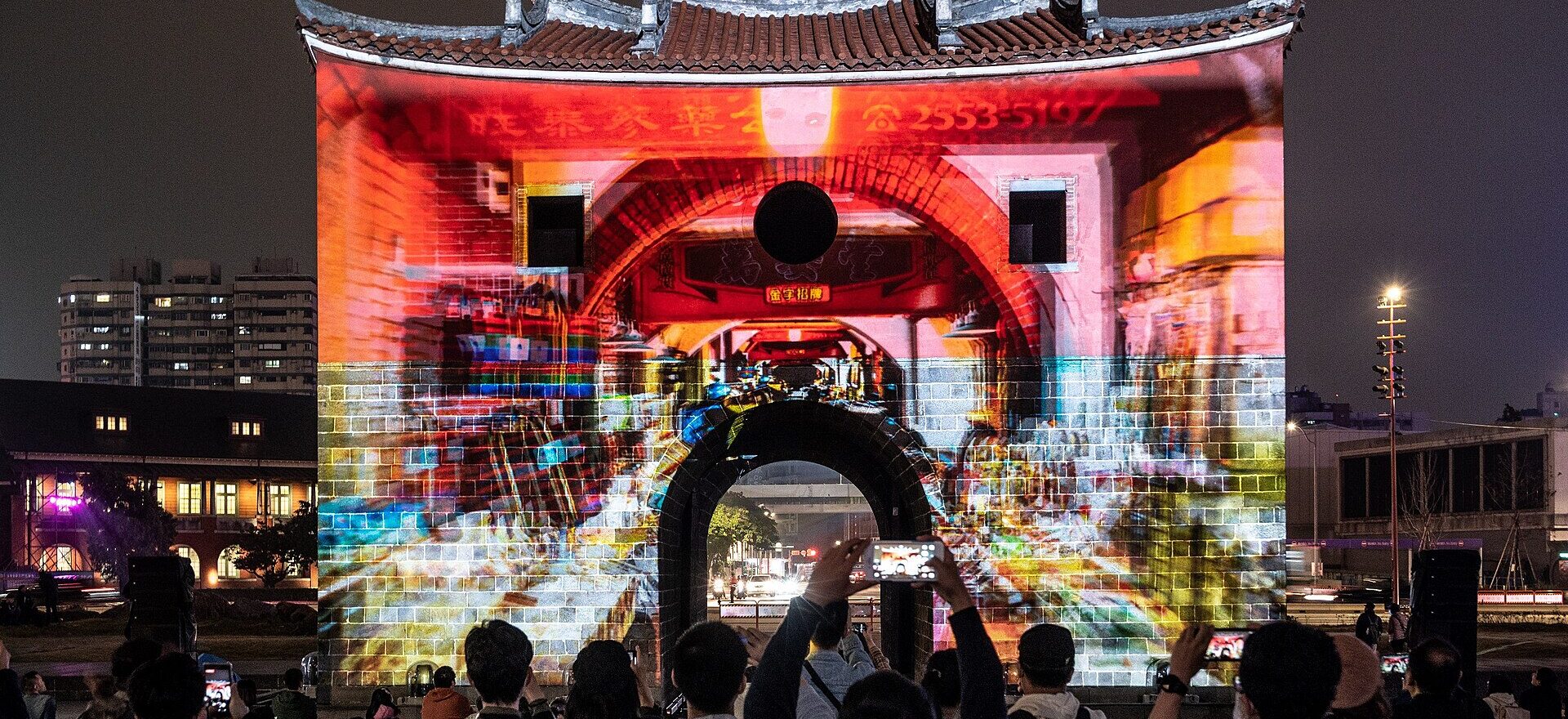
The North Gate at the 2020 Taipei Lantern Festival: North Gate of Taipei City in 2020 Taipei Lantern Festival by 臺北市政府, Attribution, via Wikimedia Commons.
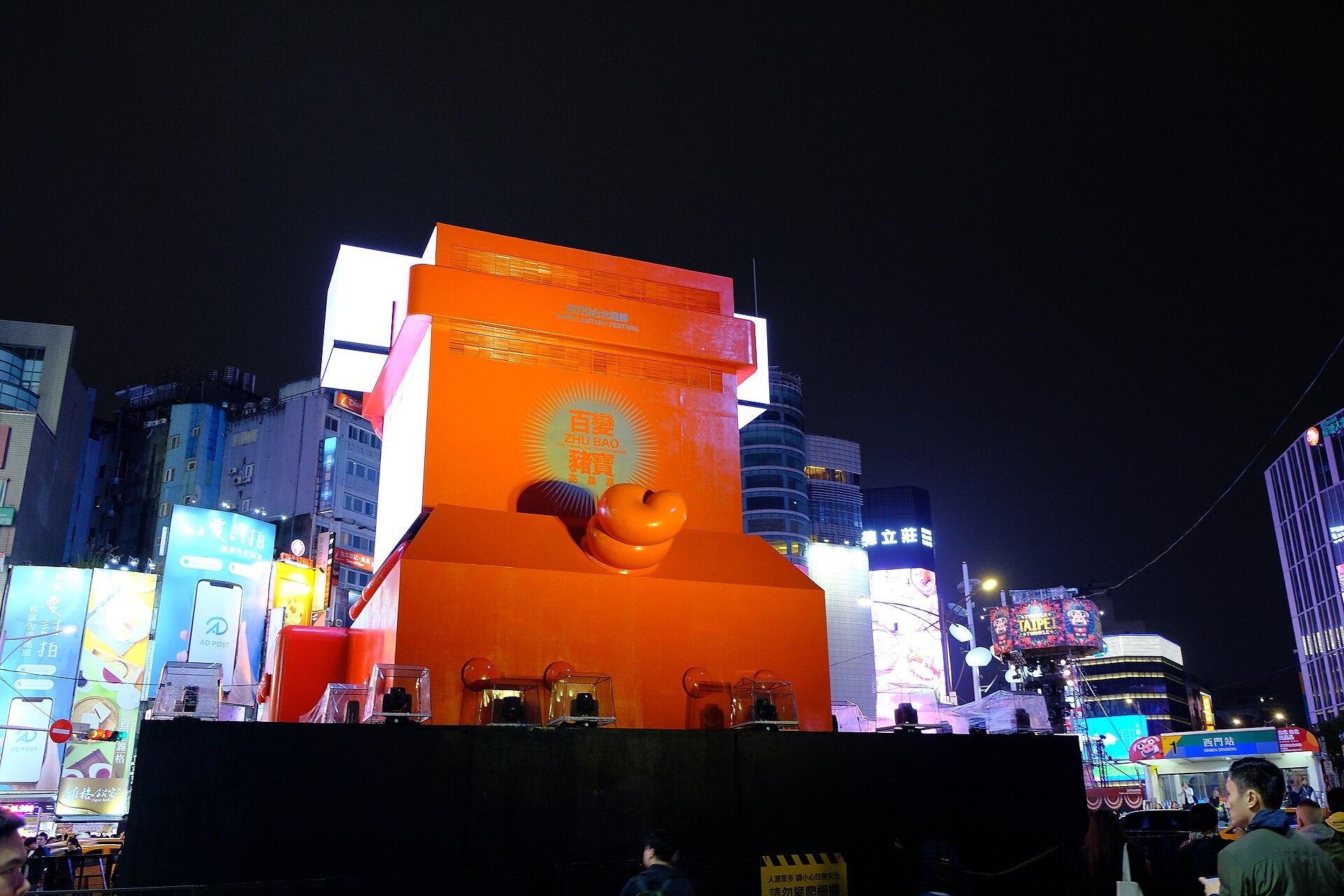
The main lantern at the 2019 Taipei Lantern Festival: 2019 Taipei Lantern Festival X by Taiwankengo, CC BY-SA 4.0, via Wikimedia Commons.
Longshan Temple entrance carvings: 2008-03-08 Bangka Lungshan Temple 01 by bizmac, CC BY 2.0, via Wikimedia Commons.