This article contains advertising. Our booking links are routed through a partner that adds commission tracking automatically, so if you book through one we earn a commission from the provider, at no extra cost to you. It never affects what we recommend. Affiliate disclosure
At six in the morning, before the tour groups and before most of the city is awake, Longshan Temple is already full. Volunteers in grey robes lead the chanting, elderly women arrange plates of fruit and packets of biscuits on the offering tables, and the smoke from a hundred sticks of incense drifts out over Bangka Park, where men who slept on the benches are folding their blankets. Round the corner, a lane of herbalists is hosing down its pavement and hanging out bundles of fresh leaves, and the first congee shops are ladling out breakfast. It is no exaggeration to call Wanhua Taipei‘s birthplace, and it is still the part of the city where the past is most visibly going about its daily business — devout, crowded, cheap, a little rough, and far more interesting than its reputation.
This guide is for exploring the district as a whole: how Wanhua grew and why it looks the way it does, the temples beyond Longshan, Bopiliao and the other historic streets, the morning markets and the night markets, the herbal lane and the fortune tellers, what and where to eat, the Qingshan King festival that takes over the streets every winter, an honest word on safety, and a route that joins it all together. Longshan Temple, Ximending and Huaxi Street each have their own detailed guides, linked below; this page is the map that ties them together. Details were checked in September 2026; treat prices as the right order of magnitude. For how Wanhua fits into the rest of the city, see our overview of Taipei neighbourhoods.
Wanhua at a glance
| The short version | |
|---|---|
| Where | The south-west of central Taipei, between the old city walls and the Tamsui River |
| Nearest MRT | Longshan Temple (Blue Line), Exit 1, for the temple and the old core; Ximen (Blue and Green lines), Exit 6, for Ximending |
| Time needed | Half a day for the temples, Bopiliao and the markets; a full day with Ximending and a night market |
| Best times | Early morning for the temples and markets; after dark for the night markets; late November for the Qingshan King festival |
| Entry | The temples, Bopiliao and the markets are all free |
| Do not miss | Longshan Temple at morning prayers, Bopiliao, Qingshan Temple, the herbal lane, a bowl of pork congee, a night market |
What things cost
| Item | Typical cost (September 2026) |
|---|---|
| MRT from central Taipei | From NT$20 with an EasyCard |
| Longshan, Qingshan and Qingshui temples | Free; donations and offerings are optional |
| Bopiliao Historic Block | Free (occasional special exhibitions charge) |
| A cup of herbal tea from the herbal lane | Small change |
| Congee, gua bao, noodles or a rice bowl at an old stall | Usually well under NT$100 a dish |
| A night-market grazing dinner | Roughly NT$200–400 for several snacks and a drink |
| A fortune-teller reading | Varies widely by teller and method — agree the price first |
From Bangka to Wanhua: how the district grew
Long before there was a Taipei, the Ketagalan people paddled dugout canoes down the Tamsui River to trade with Han Chinese settlers who had come across the strait from Fujian. The landing where they met took its name from those canoes — Bangka (艋舺), in the Taiwanese Hokkien that is still spoken on these streets — and by the early eighteenth century it was a trading town. In 1738 its settlers founded Longshan Temple, and for more than a century Bangka was the most important place in northern Taiwan. Locals still use a saying that sums up the island’s three great ports of the time in order: Tainan first, Lukang second, Bangka third.
Bangka’s prosperity bred rivalry. The settlers were organised by home county in Fujian, and each group had its own temple, guild and territory. In 1853 the tension broke into open fighting, the so-called feud of the upper and lower guilds. The losing side, from Tong’an county, was driven out and resettled downstream at Dadaocheng, taking their City God with them; one of Bangka’s temples was burned to the ground in the process. Over the following decades the river silted up, bigger ships could no longer reach Bangka’s landing, and the trade — and the money — moved down to Dadaocheng, which became the new commercial heart. Our guide to Dadaocheng and Dihua Street tells the rest of that story.
Under Japanese rule the district was renamed in 1920 with the characters 萬華, which in Japanese are read Manka, close to the old name, and in Mandarin Wanhua. Just outside the old west gate of the walled city, the Japanese built Ximending into Taipei’s entertainment district of theatres, cinemas and cafés, with the octagonal Red House, opened in 1908 as a public market, at its heart.
After the war, as the city grew east, Wanhua became the old, crowded, working-class side of Taipei. It had the busiest markets, the cheapest food, the rowdiest temple festivals — and, for much of the second half of the twentieth century, the gambling dens, gangs and licensed brothels that gave it its reputation. The 2010 film Monga, a hugely popular gangster drama named after the district, is set in its 1980s underworld, and parts of it were shot on the old street at Bopiliao. Taipei abolished licensed prostitution in the late 1990s, the gangs are long gone, and since the 2000s restoration projects, young café owners and designers have started to move in. But Wanhua has never been gentrified in the way Da’an or Zhongshan have, and it still has more elderly residents, more street-level poverty and more temples than almost anywhere else in the city. That is exactly why it is worth your time.
How Wanhua is laid out
Wanhua is a big district, but the parts a visitor needs fall into three areas, all within walking distance of one another:
- Old Bangka, around Longshan Temple station — Longshan Temple, Bopiliao, the herbal lane, the Qingshui and Qingshan temples, the morning markets and the three night markets. This is the heart of the district and the focus of most of this guide.
- Ximending, in the north around Ximen station — the pedestrianised youth-culture, shopping and nightlife quarter, with the Red House. It has its own guide.
- The riverside, to the west beyond the flood wall — cycle paths, parks and the Huajiang wetlands, where migrating ducks spend the winter.
From Longshan Temple station to Ximen station is one stop on the Blue Line, or a fifteen-minute walk up Kangding Road or Xiyuan Road, and the walk is much more interesting.
Longshan Temple: where to start
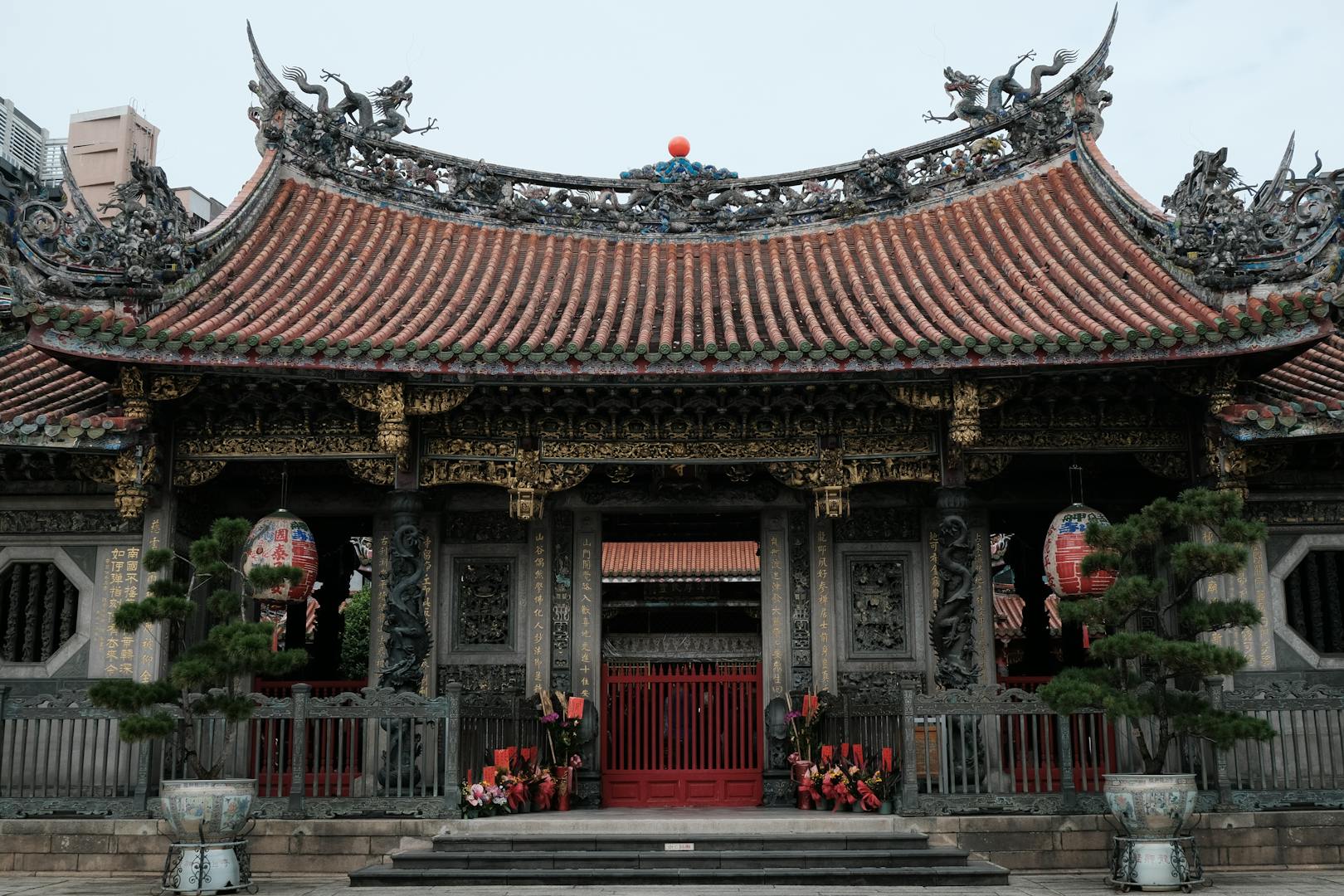
Everyone starts at Longshan Temple, and so should you: it is two minutes from Longshan Temple station, Exit 1, across the square of Bangka Park. Dedicated principally to Guanyin, the goddess of mercy, it also houses scores of other deities — the god of literature for students before exams, Mazu for seafarers, the matchmaker for the lovelorn — and it is busy from dawn until late evening with people who come to pray rather than to look. The carving on its roofs and columns is some of the best in Taiwan. Our Longshan Temple guide covers the temple in detail.
Two practical tips: come early in the morning, when the chanting is under way and the tour groups have not yet arrived, and enter through the right-hand door and leave through the left, as worshippers do. Then walk out of the temple into the streets around it, which is where most visitors turn back and where Wanhua actually begins.
The herbal lane and the fortune tellers
Beside the temple, a narrow lane off Xichang Street is lined with shops selling fresh and dried medicinal herbs: bundles of leaves, roots, stems and flowers stacked in baskets and hanging from hooks, their smell green and bitter and faintly minty. This is Herb Lane (青草巷), and it has supplied the temple neighbourhood for generations; the herbalists will make up mixtures for colds, for the heat, for the liver or for a bath. For a visitor, the thing to do is buy a cup of herbal tea from one of the stalls at the end of the lane. The ordinary green herbal tea (青草茶) is cooling and faintly sweet; the bitter tea (苦茶) is exactly what it says, and locals drink it as a remedy with a certain pride. Try a small cup before you commit to a large one.
Underneath Longshan Temple station, the underground shopping arcade has a row of fortune tellers in little booths, reading palms and faces or casting horoscopes from the date and hour of your birth. It is a real and busy trade, not a tourist show, and most tellers work in Mandarin or Taiwanese, so it helps to bring a friend who speaks one of them. Agree the price before you sit down.
Bopiliao Historic Block
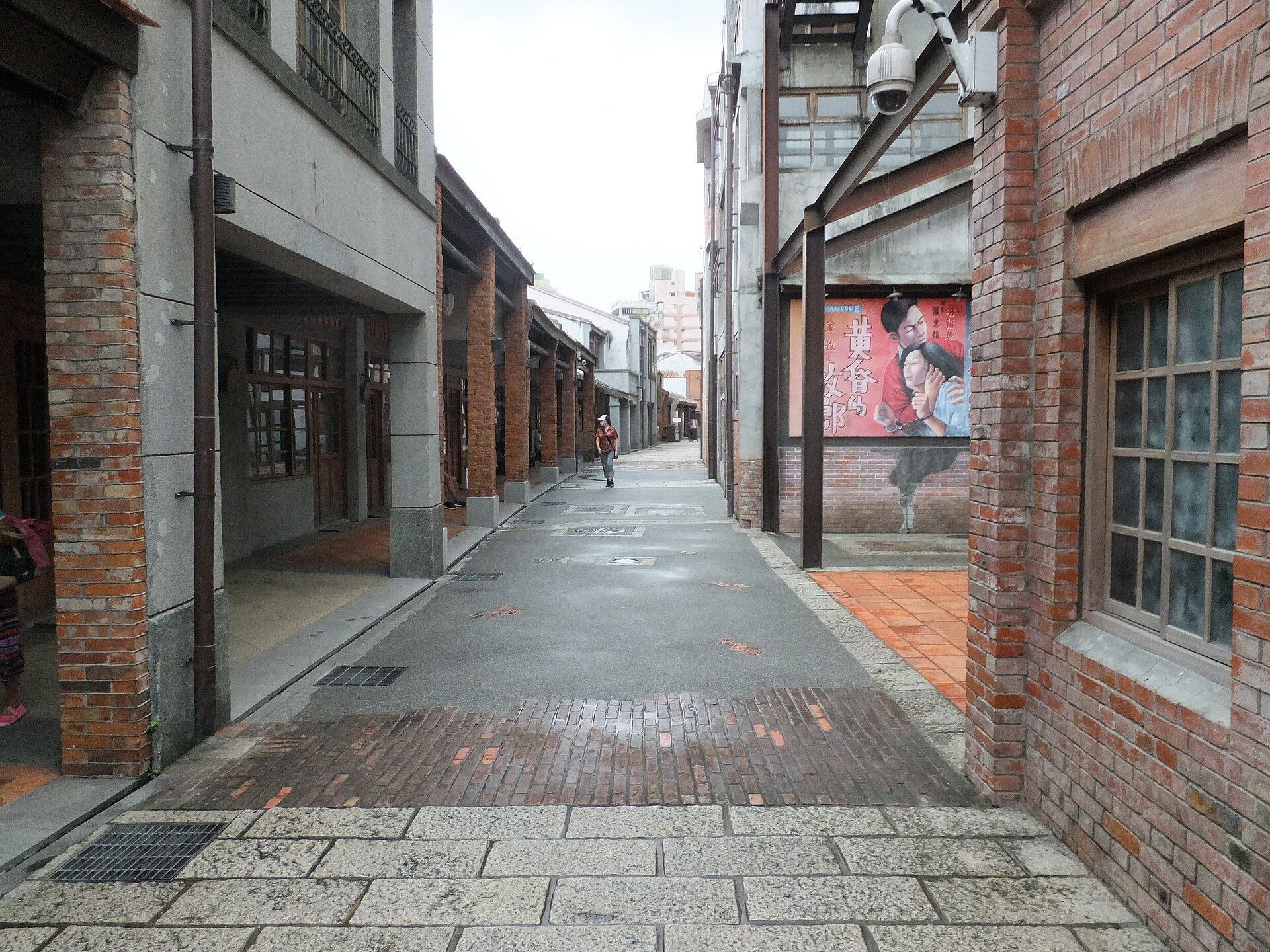
A few minutes east of the temple, between Guangzhou Street and Kangding Road, Bopiliao (剝皮寮) is a restored street of Qing-dynasty and Japanese-era shophouses, with red-brick arcades, old shop signs and wooden shutters. The usual explanation of its odd name, which means something like “the bark-stripping shed”, is that timber shipped over from Fuzhou was stripped of its bark here before sale. For most of the twentieth century it was a slowly decaying row of homes and workshops; in the 2000s the city restored it rather than demolish it, and it is now one of the best-preserved historic streets in Taipei.
Part of the block is the city’s Heritage and Culture Education Center, with small, well-made exhibitions on Bangka’s history, its place names, its architecture and its old businesses, which are good for children as well as adults. Other buildings host changing exhibitions and events. The outdoor street is open from 09:00 to 21:00; the indoor exhibition spaces open from 09:00 to 18:00, Tuesday to Sunday, and are closed on Mondays. Entry is free. Film fans will recognise the street from Monga, and on quiet weekday mornings it can feel almost like a film set — come then if you want photographs without crowds.
Temples beyond Longshan
Wanhua is thick with temples, from roadside shrines to grand halls, and two besides Longshan are worth seeking out even if you only have a morning.
Bangka Qingshan Temple
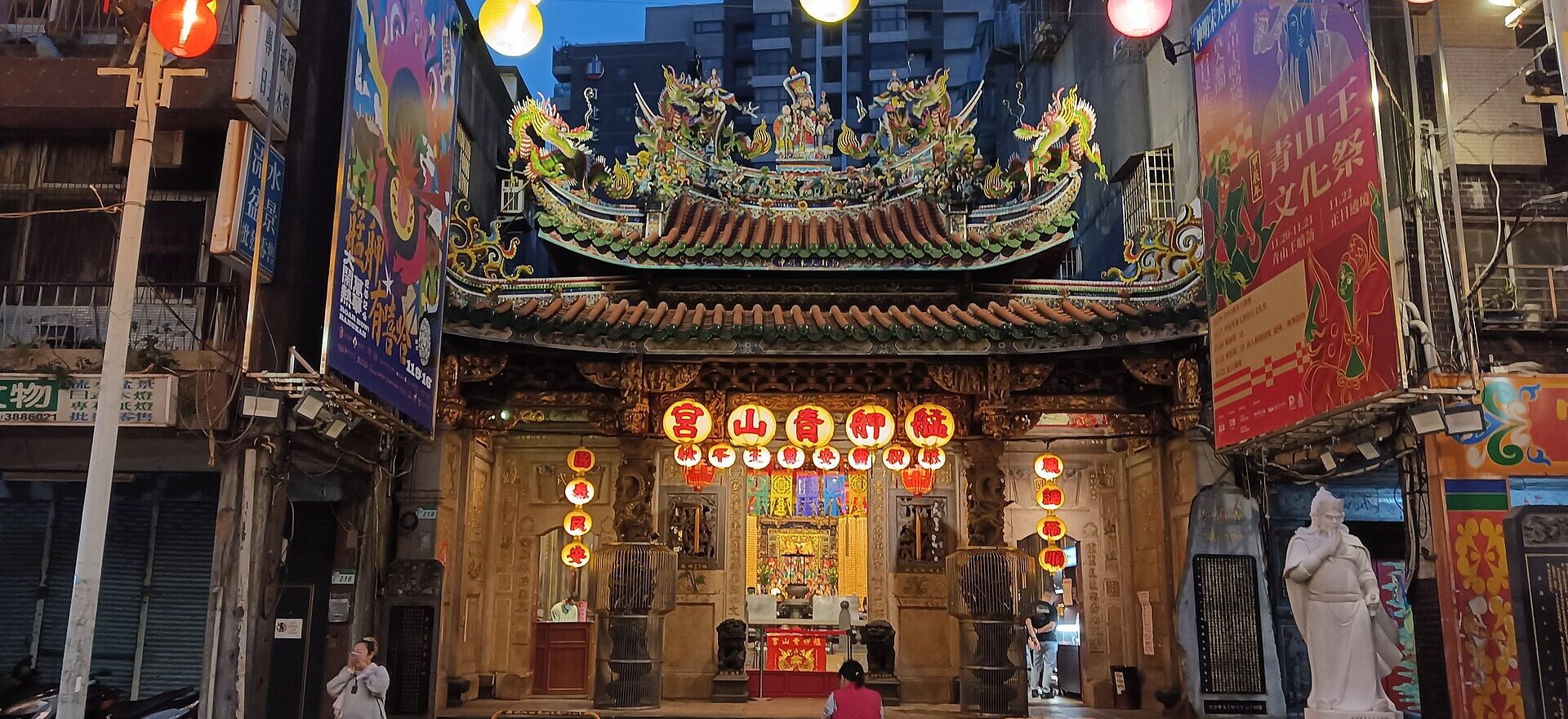
Qingshan Temple (艋舺青山宮), on Guiyang Street a short walk north of Longshan Temple, is one of the most beautiful small temples in the city, with extravagantly carved stone columns, painted beams and a crowded roofline of dragons and figures. It honours the Qingshan King, a god from Hui’an in Fujian who, according to temple tradition, arrived with fishermen in the 1850s and was credited with ending an epidemic that was sweeping Bangka; the temple was built in his honour soon afterwards. Look up in the side halls and the upper floor, where the carving and painting are especially fine.
Qingshui Temple
Qingshui Temple (艋舺清水巖), on Kangding Road, is dedicated to Master Qingshui, a Song-dynasty monk venerated by settlers from Anxi county. Founded in the late eighteenth century, it was burned during the feud of 1853 and rebuilt in 1867, and it is quieter and more austere than Longshan, with fine old stone carving. It makes a calm stop between Bopiliao and Ximending.
The Qingshan King festival
Every winter, Qingshan Temple stages what locals call the Bangka Great Worship (艋舺大拜拜), one of the three great temple festivals of Taipei, together with the City God’s procession in Dadaocheng and the Baosheng festival at Dalongdong. On the twentieth and twenty-first nights of the tenth lunar month, the god goes out on night patrols (暗訪) through the south and north of Wanhua to drive out evil spirits: processions of temple troupes, giant deity figures, drummers and the painted-faced “general” troupes who escort the god, with firecrackers going off at every temple and shrine along the way. On the twenty-second comes the main daytime procession.
In 2026 the night patrols fall on 28 and 29 November and the main procession on 30 November. It is loud, smoky, crowded and utterly absorbing, and it is the best chance in Taipei to see a traditional temple festival at full strength. Bring earplugs, stand well back when the firecrackers are lit, never cut through a procession, and follow the crowd’s lead. The Ministry of the Interior’s Taiwan Religious Culture Map has a page on the festival and its routes, and our Taipei festivals calendar puts it alongside the year’s other events.
Wanhua’s markets: morning and night
Wanhua shops and eats at street level, and its markets are the best way into the everyday life of the district.
Xinfu Market and the morning market
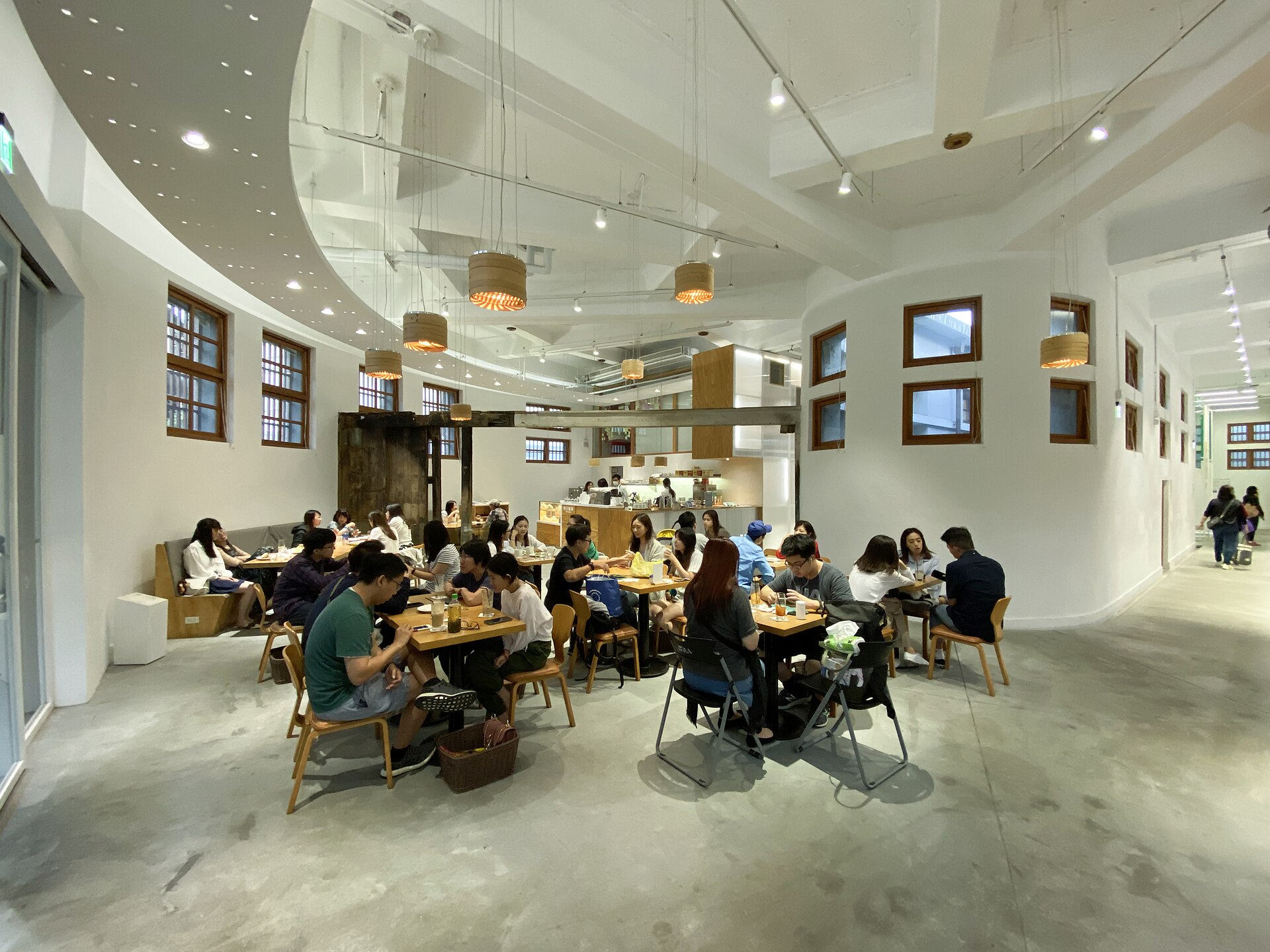
Two minutes from Longshan Temple, Xinfu Market (新富町文化市場) is a small architectural gem: a U-shaped market hall built in 1935, designated a city historic site in 2006 and restored in 2017 as U-mkt, a centre for Taipei’s market culture with exhibitions, a café, cooking classes and events. The building, with its curved courtyard and clerestory windows, is a lovely place to spend half an hour. Next to it, the Dongsanshui Street market is the working traditional market that grew up around the old hall — narrow, covered, busy with vegetables, fish, meat and household goods, and at its most lively from early morning until late morning.
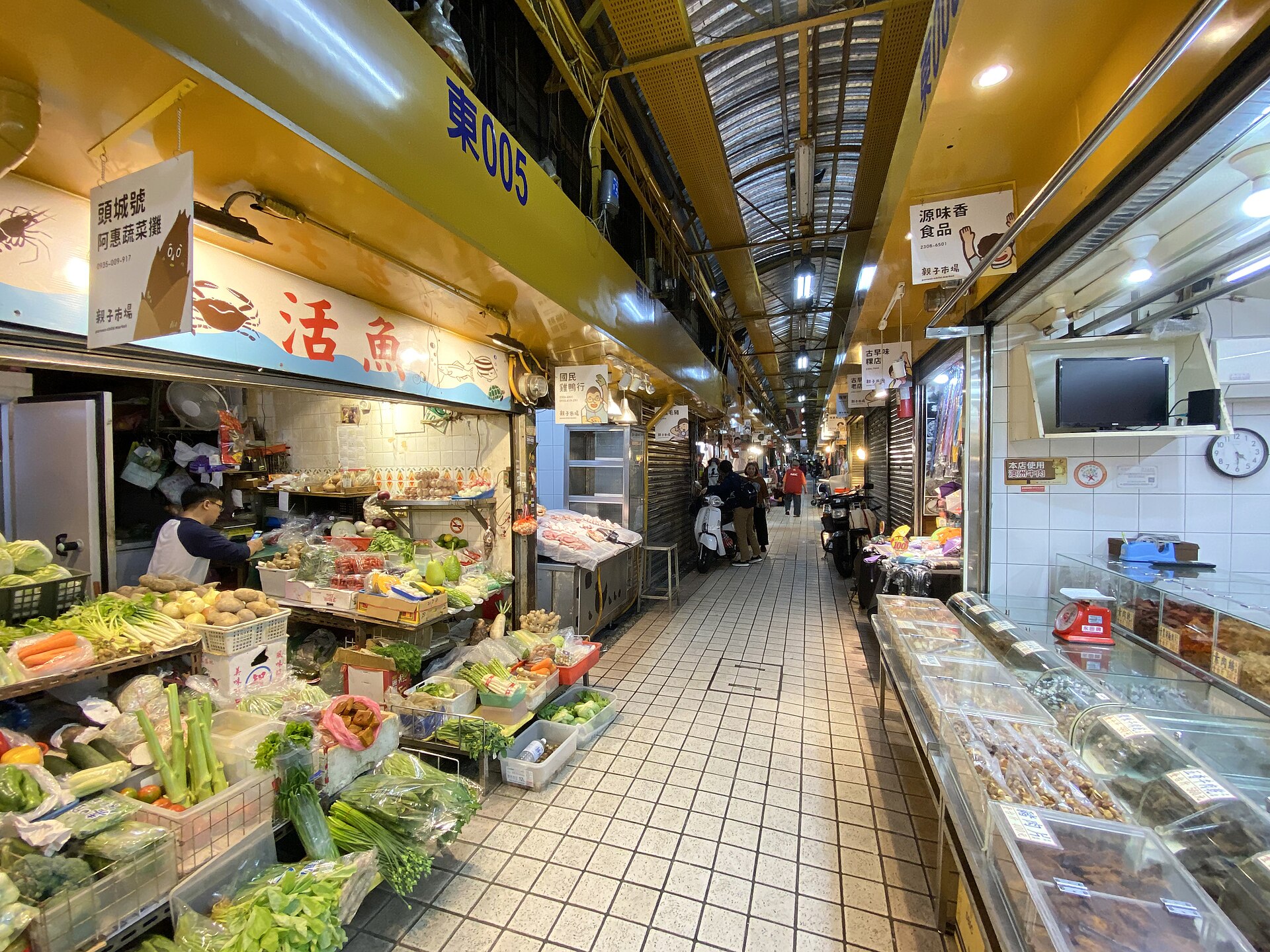
Check before you go: U-mkt is normally closed on Mondays, and its website listed an extended closure for ceiling repairs from mid-August to mid-November 2026. The U-mkt website has the current opening days.
The three night markets
After dark, three night markets run into each other just west of Longshan Temple, and together they make one of the city’s most old-fashioned night-market areas:
- Huaxi Street Night Market — a covered arcade under a Chinese-style gateway, once notorious as “Snake Alley” for the restaurants that killed snakes in front of the customers. The shows have gone; a couple of snake restaurants remain, alongside some of the best old food stalls in the district.
- Guangzhou Street Night Market — the busiest of the three, stretching along Guangzhou Street just west of the temple: grilled seafood, fried chicken, shaved ice, games and cheap clothes, with a mainly local crowd.
- Wuzhou Street Night Market — smaller and quieter, a block away, with long-running stalls for herbal pork rib soup and other classics.
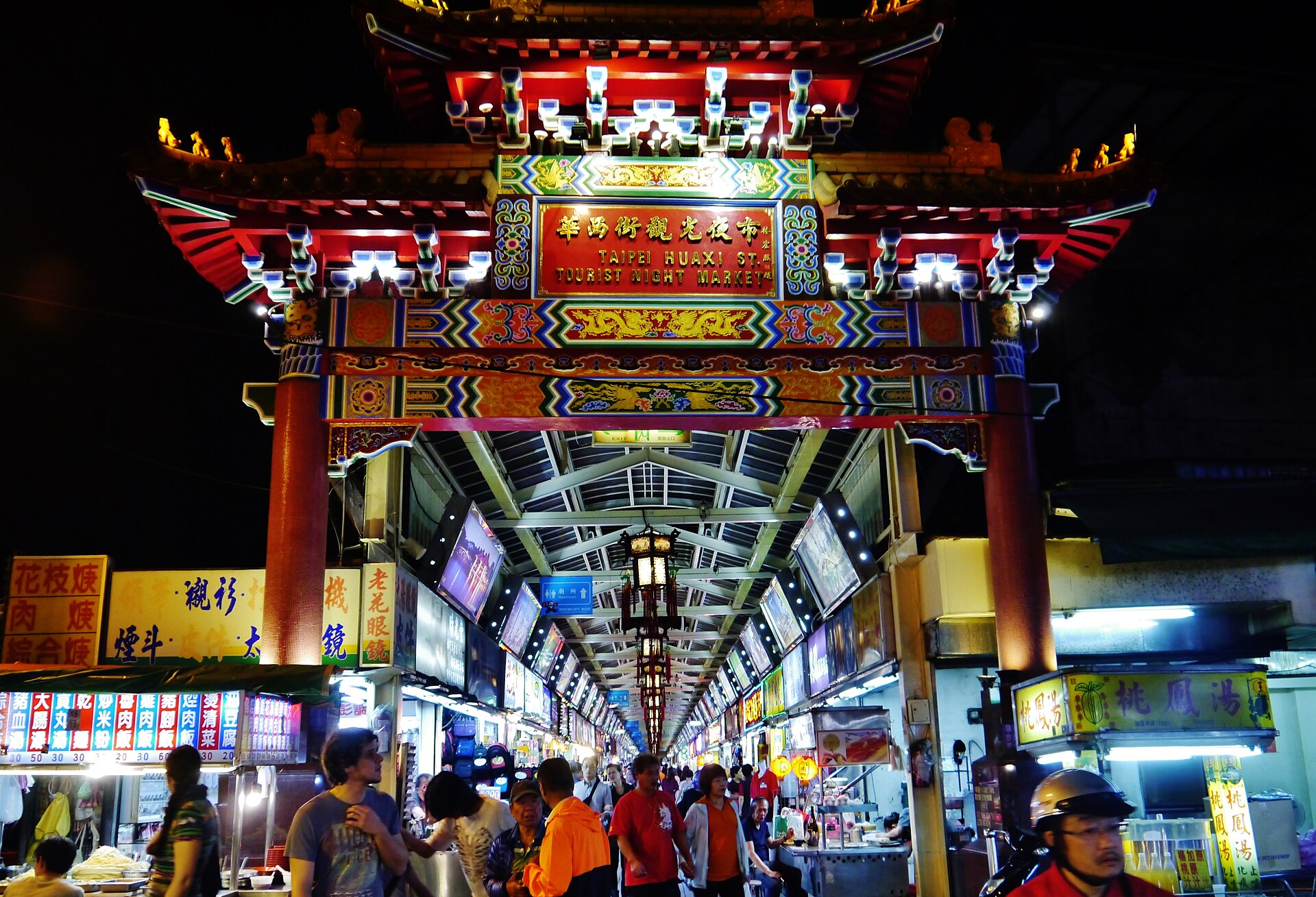
None of them is as famous as Shilin or Raohe, and none needs to be; they are cheaper, less crowded with tourists and very Taipei. Our guide to Taipei’s night markets compares them with the rest of the city’s markets.
What to eat in Wanhua
Wanhua eats old-fashioned Taiwanese food, and eats it early. A lot of the best stalls open at breakfast and are done by mid-afternoon, and many close one day a week, so have a second choice in mind.
- Pork congee and fried pork — a Wanhua breakfast. Zhou’s (周記肉粥) on Guangzhou Street has been serving bowls of thin, savoury pork congee with plates of red-marinated fried pork for decades; go in the morning.
- Squid thick soup — Liang Xi Hao (兩喜號), near Longshan Temple, is known for its squid in a thickened, slightly sweet broth, an old Bangka speciality.
- Braised pork rice — the district’s old eateries serve some of the best in Taipei; Yi Jia Zi (一甲子), on Kangding Road, is famous for slabs of braised pork belly on rice.
- Gua bao (刈包) — the “Taiwanese burger” of braised pork belly, pickled mustard greens, peanut powder and coriander in a folded steamed bun. Yuan Fang (源芳刈包) on Huaxi Street is the best known.
- Steamed minced pork in broth — Xiao Wang (小王煮瓜) on Huaxi Street serves little bowls of pork steamed with pickled cucumber, a comforting old dish, over rice.
- Herbal pork rib soup (藥燉排骨) — the classic winter warmer of the night markets, dark with Chinese herbs.
- Flour-rice noodles — in Ximending, Ay-Chung (阿宗麵線) sells its thick vermicelli with pork intestine to a standing crowd from morning until late.
Several of these have featured on Michelin’s Bib Gourmand list over the years; our Michelin restaurants guide has the current picks, and our Taiwanese street food guide explains the dishes. Prices at all of these are low — most dishes cost well under NT$100 — and almost all are cash only.
Ximending: Wanhua’s northern half
The northern part of Wanhua is Ximending, and it could hardly be more different from the temple streets ten minutes to the south: a pedestrianised grid of youth fashion, sneaker shops, cinemas, tattoo parlours, claw-machine arcades, street performers and bubble tea, busiest in the evening and at weekends. At its edge, the octagonal Red House is a craft and design market by day, and the terrace of bars behind it is the centre of Taipei’s gay nightlife after dark.
Ximending is covered in depth in our Ximending guide, our guide to shopping in Ximending and our LGBTQ+ nightlife guide. For the purposes of a Wanhua day, two things are worth knowing. First, the walk between Longshan Temple and Ximending, up Kangding Road or Xiyuan Road past the Qingshui and Qingshan temples, is the best way to see the district change character block by block. Second, on Ximending’s southern edge, near Ximen station, the site of the Japanese-era Nishi Honganji Buddhist temple has been turned into a small park, where the restored wooden residence of the old temple is now a tea house — a quiet place to sit between the two halves of the district.
Wanhua by the river
Beyond the flood wall on the western edge of the district, the riverside parks along the Tamsui and Xindian rivers are part of the cycle network that runs right round the city. A YouBike from one of the docks near Longshan Temple takes you onto the path, north to Dadaocheng’s wharf for sunset, or south along the water. The Huajiang Wild Duck Nature Park (華江雁鴨自然公園), where the rivers meet, is Taipei’s best-known bird-watching spot in winter, when flocks of migrating ducks rest on the mudflats; bring binoculars and go in the early morning between late autumn and early spring.
A day in Wanhua
This route starts early and takes in the whole district at walking pace. It suits a weekday other than Monday, when Bopiliao’s exhibitions and Xinfu Market are closed.
- 07:00 — Longshan Temple, for the morning chanting. Enter on the right, leave on the left.
- 07:45 — Breakfast of pork congee and fried pork on Guangzhou Street.
- 08:30 — Herb Lane and a cup of herbal tea, then the morning market on Dongsanshui Street and Xinfu Market if it is open.
- 09:30 — Bopiliao, before the crowds, with half an hour in the education centre.
- 10:30 — Qingshui Temple on Kangding Road, then Qingshan Temple on Guiyang Street.
- 11:30 — Lunch: braised pork rice or gua bao.
- 12:30 — Walk north to Ximending, stopping at the Nishi Honganji tea house, then the Red House and the pedestrian streets.
- Evening — back south for the night markets, or continue north on foot through the North Gate to Dadaocheng for sunset at the river.
If you would rather split it, the temples, Bopiliao and the markets make a perfect morning, and Ximending and a night market make a separate evening. For a longer walk through three centuries of the city, start here and carry on to Dadaocheng, as described in our neighbourhoods guide.
Is Wanhua safe?
Yes, with the same everyday sense you would use in any big city — and it is worth saying clearly, because Wanhua’s reputation lags decades behind the reality. Taipei is one of the safest cities in Asia, violent crime against visitors is very rare, and Wanhua’s streets are busy from dawn until late at night.
What you will notice is poverty. Bangka Park, in front of Longshan Temple, and the streets around it have been home to the city’s most visible community of homeless people for many years, looked after in part by the temple and local charities. You may see people sleeping on benches, men drinking in the afternoon and a few elderly people selling small items. They are not a danger to you. Be respectful: do not photograph people who are sleeping rough, and do not treat the scene as a spectacle. A few of the lanes behind the night markets are shabby, and after midnight parts of the district are quiet; stick to the main streets late at night, as you would anywhere. Our guide to safety in Taipei has the wider picture.
Staying in Wanhua
This is an exploring guide rather than a hotel guide, but Wanhua has one of the city’s best concentrations of budget hotels and hostels, especially around Ximen station, and staying here puts two MRT lines, cheap food and late nights on your doorstep. The trade-off is noise and bustle around Ximending, and a grittier walk home around Longshan Temple. Our guides to where to stay in Taipei and the best hostels go through the options.
Practical tips
- Go early. Wanhua is a morning district. The temples are at their best at dawn, the markets before noon, and many of the best food stalls are closed by mid-afternoon.
- Mondays. Bopiliao’s indoor exhibitions and Xinfu Market are closed, and some family-run stalls take the day off.
- Cash. Nearly all the food stalls, herbalists and market traders want cash. See our guide to money in Taipei.
- Temple etiquette. Step over the raised thresholds rather than on them, keep your voice down, do not walk in front of people praying and photograph the carving rather than the worshippers. Our guide to religion in Taipei explains the customs.
- Heat. The old streets have little shade in the middle of the day. In summer, do the outdoor walking before 11:00 and after 16:00.
- Accessibility. The MRT stations are step-free, but most temples have high thresholds, Bopiliao’s paving is uneven brick, and the market lanes are narrow and crowded. See our accessible Taipei guide.
- With children. Bopiliao’s education centre, the herbal lane’s smells and the night-market games go down well; the temples are fine if children keep their voices down. Ximending’s arcades are a bribe that works.
What we would skip
Judging Wanhua by Bangka Park. The first five minutes out of the station are the roughest in central Taipei. Walk two blocks in any direction and you are among the temples, markets and old streets that make the district special.
Going looking for “Snake Alley”. The snake-killing shows that made Huaxi Street famous have gone, and good riddance. Come to Huaxi Street for the gua bao and the braised pork, not the legend.
The jade, “antiques” and curios around the temple. Unless you know exactly what you are buying, assume that nothing is as old or as valuable as it looks.
Spending all your Wanhua time in Ximending. It is fun, but you can find its chain stores and claw machines in any Asian city. The temple streets to the south are what you cannot find anywhere else.
Midday in summer. The heat bounces off the old streets and the temples fill with tour groups. Come at dawn or after dark.
A few stops further along the Blue Line, across the Tamsui River, Banqiao grew up around another great merchant family: the Lins, whose Qing-dynasty residence and garden at Fuzhong have been restored and reopened. A morning there and an afternoon at Longshan Temple and Bopiliao make a fine old-Taipei day; our Banqiao guide has the details.
Related Taipei guides
- Taipei Neighbourhoods: A District-by-District Guide
- Longshan Temple
- Ximending Guide
- Huaxi Street Night Market
- Dadaocheng and Dihua Street
- The Best Temples in Taipei
- Religion in Taipei
- Taipei Night Markets
- Taipei on a Budget
- Taipei Festivals Calendar
- Things to Do in Taipei
Frequently Asked Questions
What is Wanhua in Taipei?
Wanhua is the oldest district of Taipei, in the south-west of the city centre by the Tamsui River. It grew from the river port of Bangka in the early eighteenth century and includes Longshan Temple, Bopiliao, three night markets and the Ximending shopping district.
Why is Wanhua also called Bangka or Monga?
Bangka (艋舺), sometimes spelled Monga or Manka, was the original name, taken from the Ketagalan word for the dugout canoes that traded at the landing. In 1920 the Japanese renamed it with the characters 萬華, read Manka in Japanese and Wanhua in Mandarin. Locals and businesses still use the old name.
What is the best way to get to Wanhua?
By MRT. Longshan Temple station on the Blue Line, Exit 1, is two minutes from the temple and the old core; Ximen station, on the Blue and Green lines, serves Ximending. The two are one stop apart, or about fifteen minutes’ walk.
Is Wanhua worth visiting?
Yes. It is the best place in Taipei to see the older, poorer, more devout city that the glass towers of Xinyi replaced, and it has some of the city’s finest temples, a beautifully restored historic street and excellent cheap food. Give it at least a morning.
Is Wanhua safe for tourists?
Yes. It is one of the older and poorer parts of central Taipei, and the park in front of Longshan Temple has a visible homeless community, but violent crime against visitors is very rare and the streets are busy day and night. Use ordinary city sense, especially late at night.
What is Bopiliao?
A restored street of Qing-dynasty and Japanese-era shophouses near Longshan Temple, now home to the city’s Heritage and Culture Education Center and changing exhibitions. The street is open 09:00–21:00, the indoor spaces 09:00–18:00 from Tuesday to Sunday, and entry is free.
What are the best temples in Wanhua?
Longshan Temple is the most famous and the busiest. Qingshan Temple on Guiyang Street has some of the finest carving in the city, and Qingshui Temple on Kangding Road is older in foundation and quieter. All three are free.
When is the Qingshan King festival in 2026?
The night patrols through Wanhua take place on 28 and 29 November 2026, and the main procession on 30 November. The festival follows the lunar calendar, falling on the twentieth to twenty-second days of the tenth lunar month, so the dates change every year.
Which night market in Wanhua is best?
For food, Huaxi Street’s old stalls and Guangzhou Street’s variety; for a quieter, more local evening, Wuzhou Street. They run into one another, so you can walk through all three in an evening.
What food is Wanhua known for?
Old-fashioned Taiwanese dishes: pork congee with fried pork, squid thick soup, braised pork rice, gua bao, steamed minced pork with pickles, and herbal pork rib soup. Ximending adds Ay-Chung’s flour-rice noodles.
Is Ximending part of Wanhua?
Yes. Ximending is the northern part of Wanhua District, built up as an entertainment quarter just outside the old west gate during the Japanese era. It is one stop on the MRT or a fifteen-minute walk from Longshan Temple.
What is the best time of day to visit Longshan Temple and Wanhua?
Early morning, when the chanting is under way, the markets are busiest and the tour groups have not arrived. Come back after dark for the night markets, when the temple is lit up.
Is Wanhua a good area to stay in Taipei?
It is good value, especially around Ximen station, with two MRT lines and plenty of food and nightlife nearby. The area around Longshan Temple is grittier and quieter at night. It suits budget travellers who like a lively base.
The Bottom Line
Wanhua is where Taipei began, and it has never quite been tidied up — which is its great virtue. Come at dawn for the chanting at Longshan Temple, walk out into the herbal lane and the morning market, see Bopiliao before the crowds and the carving at Qingshan Temple, eat pork congee and gua bao for a fraction of what you would pay across town, and come back after dark for the night markets. If you are in Taipei at the end of November, do not miss the Qingshan King’s night patrols.
Skip the snake legends and the curio stalls, look past the first five minutes by the park, and give the district a whole morning rather than a photo stop. The towers of Xinyi are what Taipei became; Wanhua is where it came from, and it is still very much alive.
Photo Credits
Bangka Qingshan Temple at dusk: Manka Qingshan Temple (20250312181414) by Allervous, CC BY-SA 4.0, via Wikimedia Commons.
A lane in Bopiliao Historic Block: Bopiliao Historic Block 剝皮寮 – panoramio by lienyuan lee, CC BY 3.0, via Wikimedia Commons.
The traditional market beside Xinfu Market: Xinfu Market access 2019 by Wpcpey, CC BY 4.0, via Wikimedia Commons.
Inside Xinfu Market: Xinfu Market interior 201911 by Wpcpey, CC BY 4.0, via Wikimedia Commons.
Huaxi Street Night Market at night: Taipeh Huaxi Night Market bei Nacht 2 by Zairon, CC BY-SA 4.0, via Wikimedia Commons.