This article contains advertising. Our booking links are routed through a partner that adds commission tracking automatically, so if you book through one we earn a commission from the provider, at no extra cost to you. It never affects what we recommend. Affiliate disclosure
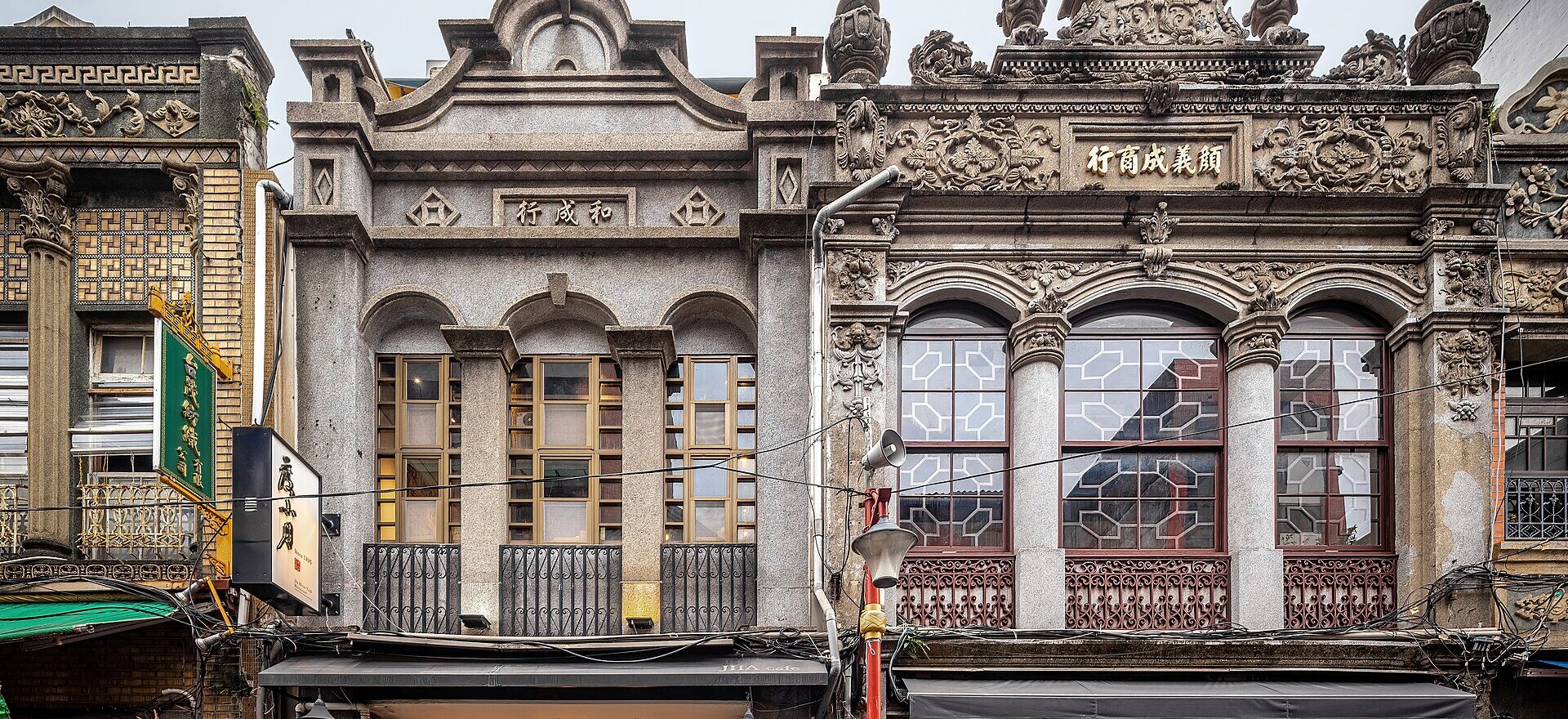
Stand still for a minute on Dihua Street and the place reaches you through your nose first: dried shiitake and star anise, the sweet dust of jujubes and goji berries, and the sharp medicinal note of angelica root drifting out of an apothecary where a man is weighing bark on a brass scale. Look up and the facades above him are a century old — carved pediments, plaster garlands and merchants’ names in raised characters, all paid for by tea. Look along the street and there are scooters, delivery vans, sacks of peanuts and a queue outside a temple the size of a living room. That mix of working trade and faded grandeur is what makes Dihua Street Taipei‘s most rewarding old street to walk, and the spine of Dadaocheng, the nineteenth-century river port that first made this city rich.
This guide treats Dadaocheng as a neighbourhood to explore rather than a place to sleep. It covers the history you can read off the buildings, the walk from Yongle Market up to the river, the City God Temple and its famous matchmaker, the tea merchants and dried-goods shops (and what is actually worth buying), where to eat, the riverside wharf at sunset, the Lunar New Year market and a half-day route that ties it all together. Prices and hours were checked in September 2026; treat them as the right order of magnitude and confirm anything your day depends on. For how Dadaocheng fits into the rest of the city, start with our overview of Taipei neighbourhoods.
Dadaocheng at a glance
| The short version | |
|---|---|
| Where | Datong District, on the east bank of the Tamsui River, north-west of Taipei Main Station |
| Nearest MRT | Beimen (Green Line), about six minutes’ walk to the southern end of Dihua Street; Daqiaotou (Orange Line) for the northern end; Zhongshan (Red and Green lines) about fourteen minutes |
| Time needed | An hour to stroll the main street; two to three hours to explore properly; half a day with the tea shops and sunset by the river |
| Best days | Friday and Saturday afternoons for atmosphere; weekday mornings to see the wholesale trade at work |
| Entry | Free — the street, the temples and the riverside park |
| Do not miss | Xia Hai City God Temple, the fabric floors of Yongle Market, a proper tea merchant, sunset at Dadaocheng Wharf |
What things cost
| Item | Typical cost (September 2026) |
|---|---|
| MRT from central Taipei | From NT$20 with an EasyCard |
| A bowl of noodles or rice-noodle soup at an old stall | Usually well under NT$100 |
| Dried fruit, nuts and snacks | Priced by weight — ask for a small bag and most shops will happily sell you 100–150 g |
| Everyday oolong from a tea merchant | A few hundred NT$ for 150 g; competition-grade teas run into the thousands |
| Praying to the matchmaker at the City God Temple | Free to enter; an optional offering set is sold at the counter |
| Dadaocheng Wharf and the container bars | Free to wander; drinks and snacks at ordinary bar prices |
| Blue Highway boat to Tamsui | About NT$300 one way, mainly at weekends and on holidays |
A short history you can read from the street
Dadaocheng exists because of a fight. In 1853 the settlers of Bangka — today’s Wanhua, a little upriver — fell into a bitter feud between rival groups from different parts of Fujian. The losing side, people from Tong’an county, were burned out and fled downstream to a sunny strip of riverbank that farmers used for drying rice. The name stuck: Dadaocheng (大稻埕), the great rice-drying yard. They carried with them the statue of their protector, the City God of Xiahai, and within six years they had built him the small temple that still stands on Dihua Street.
Their luck turned quickly. When the port of Tamsui opened to foreign trade in 1860, Western merchants arrived looking for something to export, and a British trader named John Dodd found it in the oolong tea grown in the hills around Taipei. With his Taiwanese partner, Li Chun-sheng, he improved the processing, and in 1869 he shipped a cargo of “Formosa Oolong” direct to New York, where it sold very well indeed. Within a couple of decades Dadaocheng was lined with tea firms, foreign trading houses and warehouses, and thousands of women sat in long rooms by the river sorting leaves by hand. Money from tea, and from the rice, sugar, camphor and dried goods that moved alongside it, built the shophouses you walk past today.
Under Japanese rule, from 1895, Dadaocheng became the commercial and cultural capital of Taiwanese Taipei — the Japanese lived mainly in the old walled city to the south-east, the Taiwanese here. It was a district of theatres, restaurants, newspapers and political argument. The doctor and activist Chiang Wei-shui ran his clinic on what is now Yanping North Road, and in 1921 the Taiwanese Cultural Association, the heart of the island’s home-rule movement, was founded in the neighbourhood. The facades changed with the fashions: many of the grandest ones were rebuilt in the 1910s and 1920s with Western-style ornament, and a few in the cleaner modernist lines of the 1930s.
Dadaocheng also appears at the darkest moment of Taiwan’s post-war history. On the evening of 27 February 1947, agents of the government’s tobacco monopoly beat a widow who was selling cigarettes near the Tianma Tea House, on the edge of the district; a shot fired into the angry crowd killed a bystander, and the protests that followed spread across the island as the 228 Incident, and the massacres that came after it. A memorial marks the spot near the junction of Nanjing West Road and Yanping North Road. The museum that tells the full story is in 228 Peace Park, a short MRT ride away.
After the war, when the new government renamed Taipei’s streets after places on the mainland, the old South Street and Middle Street became Dihua Street — Dihua being the former name of Ürümqi, in the far north-west of China. As the city grew eastwards, Dadaocheng slipped into a long, quiet decline. In the late 1980s the city planned to widen Dihua Street, which would have taken the facades with it; a campaign by residents, architects and historians stopped it, and from the 2000s a scheme that let owners sell their buildings’ unused development rights elsewhere helped pay for careful restoration. The result is the Dadaocheng you see now: a wholesale district that never stopped trading, with cafés, galleries and designers moving into the restored buildings between the herbalists.
How to read a Dihua Street shophouse
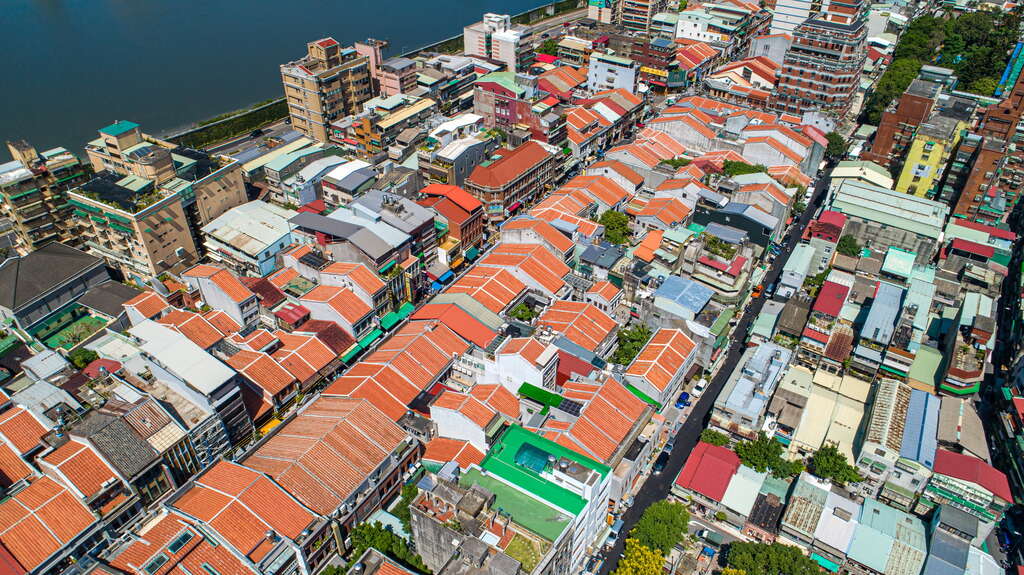
You will enjoy the walk far more if you know what you are looking at, because Dihua Street is essentially an open-air catalogue of about eighty years of Taiwanese commercial architecture. Three styles sit side by side, often on neighbouring plots:
- Southern Fujian (Minnan) style — the oldest and plainest: low brick fronts, simple wooden shutters, tiled roofs and little decoration. These are the Qing-dynasty survivors, and they tell you what the street looked like when the tea trade began.
- Western-influenced facades — the showpieces, mostly from the 1910s and 1920s: tall fronts with pilasters, arched windows, carved pediments and plaster ornament of fruit, flowers and scrolls. The family or firm name is often worked into the top of the facade, so you can still read who built it.
- Early modernist — from the 1930s, with cleaner lines, geometric detail and less ornament. Easy to overlook next to their flamboyant neighbours, but some are beautifully proportioned.
Behind the facade, the layout is the same whichever style you are looking at. The plots are narrow at the street and many times deeper than they are wide. The shop was at the front, with the family living upstairs; then came one or more open courtyards for light and air; and at the back were storerooms and workshops, which in the riverside blocks once opened almost directly onto the landing where goods came in by boat. Some restored shophouses let you walk right through, courtyard by courtyard, and it is worth doing at least once — the jump from the noisy street into a quiet, sunlit courtyard is one of the pleasures of the district.
Along the front, the ground floors are set back to form a continuous covered walkway, the arcade that Taiwanese call tingzijiao (亭仔腳). It keeps off both the rain and the afternoon sun, which is why you can walk Dihua Street comfortably in weather that would be miserable anywhere else. It is also where business happens: sacks, baskets and crates spill out of the shops onto it, and in places you will be stepping round a delivery. The floor levels change from shop to shop, so watch your footing.
Walking Dihua Street, south to north
The historic heart is the southern part of Dihua Street Section 1, from Nanjing West Road north to Minsheng West Road and a little beyond. That is where the finest facades, the temple and most of the interesting shops are. Starting at the southern end means you walk with the history, from the market and the temple towards the quieter merchants’ streets and the river.
Yongle Market and the fabric floors
At the southern end of the street, Yongle Market (永樂市場) looks like nothing much from outside: a plain block with a food market on the ground floor. Go in anyway. Downstairs is a traditional wet market and a handful of old food stalls, including Lin He Fa (林合發), whose sticky rice with mushrooms and pork has been bought for generations by families celebrating a baby’s first month. It sells out early, so go in the morning.
The upper floors are the real surprise: the city’s main fabric market, a warren of stalls stacked to the ceiling with bolts of cotton, silk, lace, brocade and the bright floral Hakka prints that Taiwanese designers love to use on bags and cushions. Many stalls will sell you a short length rather than a whole bolt, and there are tailors who can make up a shirt or a qipao if you have a few days. It is one of the least touristy experiences in central Taipei. Higher still, on the eighth and ninth floors, the Dadaocheng Theatre (大稻埕戲苑) stages Taiwanese opera, puppetry and traditional music — check the programme if you want to see a performance, because these art forms are otherwise hard to catch.
Xia Hai City God Temple and the matchmaker
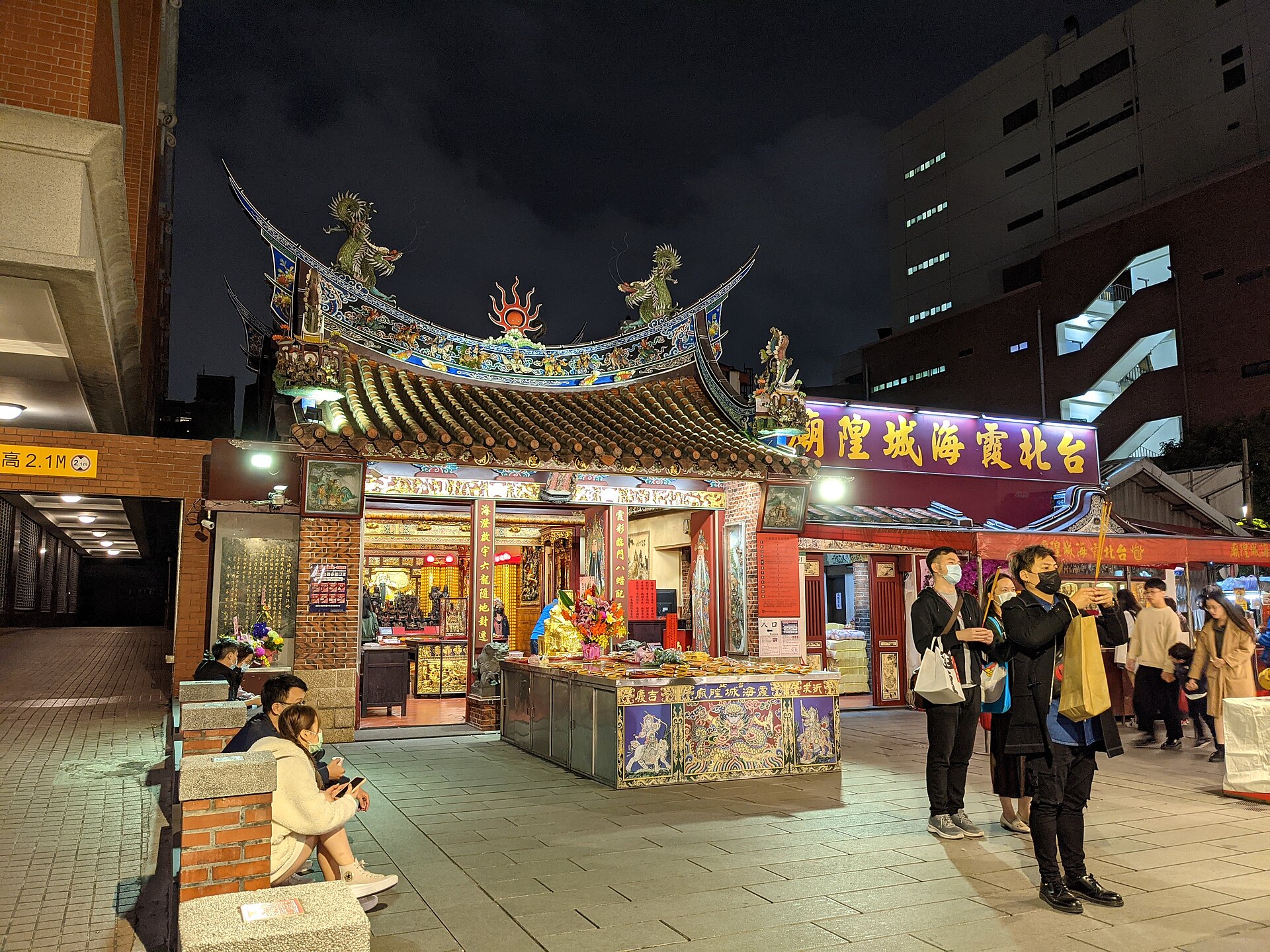
A few steps north, on Section 1 of Dihua Street, is the building the whole district grew up around. The Taipei Xia Hai City God Temple (台北霞海城隍廟) was completed in 1859 to house the statue the refugees from Bangka carried here, and it is astonishingly small — about 150 square metres, into which more than six hundred statues of deities were once crammed. Inside, the City God sits at the main altar; along one wall is a shrine to the thirty-eight “righteous braves” who died protecting his statue during the 1853 feud; and there is a shrine to the City God’s wife, popular with married couples.
Most visitors, though, are here for Yue Lao (月下老人), the Old Man Under the Moon, the god of marriage, who was enshrined here in 1971 and has made this the most famous matchmaking temple in Taiwan. The ritual is simple, and the temple staff are used to foreigners trying it:
- Buy an offering set at the counter, which includes incense and a red thread.
- Pay your respects to the City God first, then go to Yue Lao.
- Tell him, silently, your name, date of birth and address — and then describe the kind of partner you are hoping for. Locals say it pays to be specific.
- Pass the red thread through the incense smoke above the burner, then keep it in your wallet or purse.
- If it works, the custom is to come back with wedding cakes or sweets as a thank-you. You will often see them on the table, and couples do return from abroad to deliver them.
The temple is open daily from 06:00 to 22:00. Weekends are busy and Qixi, the Chinese Valentine’s Day in late summer, is packed. The temple’s great annual event is the City God’s birthday on the thirteenth day of the fifth lunar month, usually in June, when the Welcoming the City God procession of costumed deity figures, drum troupes and firecrackers winds through the district — one of the big temple festivals of the Taipei year. The Ministry of the Interior’s Taiwan Religious Culture Map has a good English page on the temple and the procession. As at any temple, keep your voice down, do not stand in front of people praying, and photograph the architecture rather than the worshippers. Our guide to religion in Taipei explains the etiquette and the gods.
The dried-goods and herbal stretch
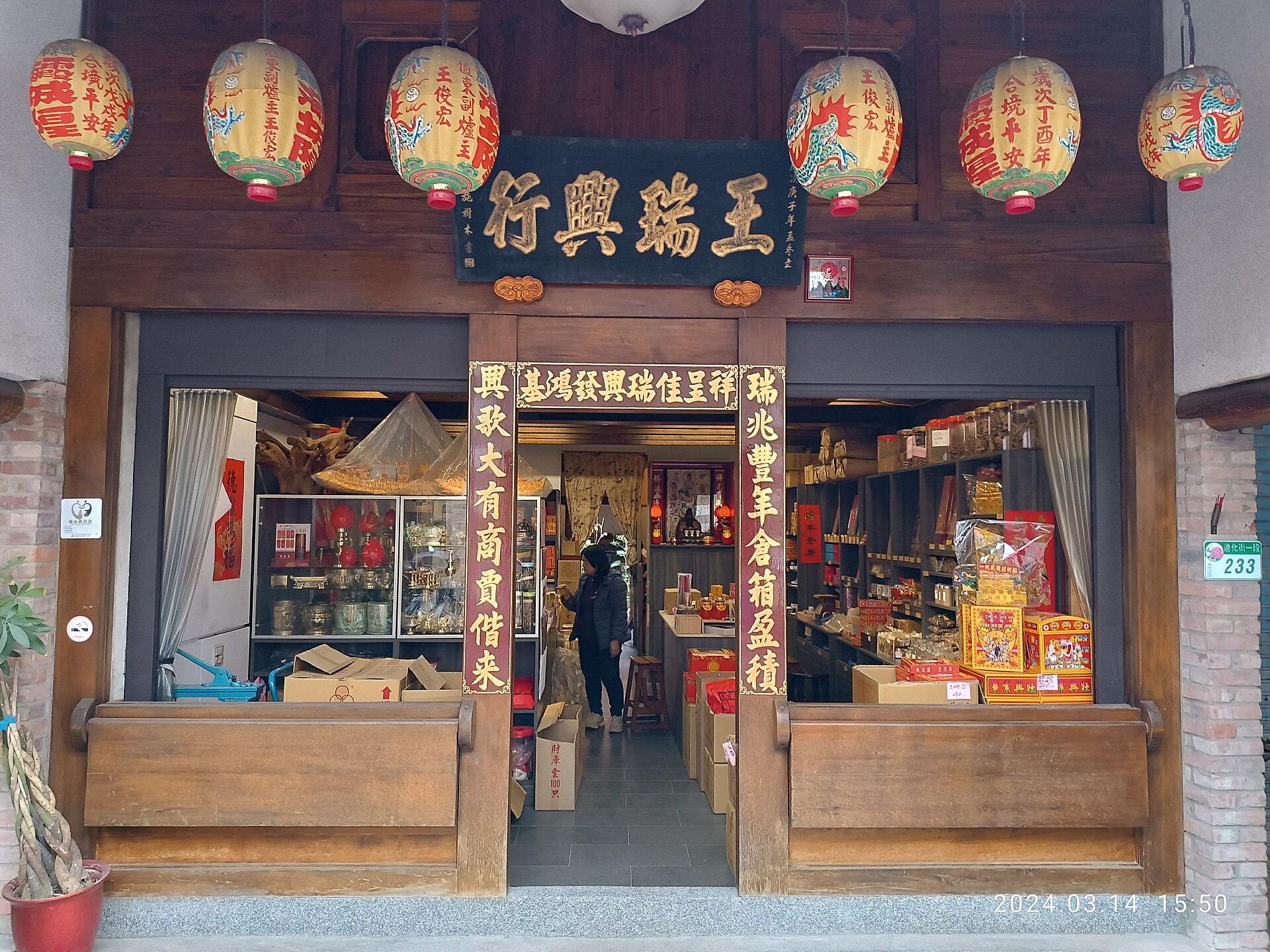
North of the temple, Dihua Street becomes what it has always been: Taipei’s larder. Shop after shop sells dried shiitake and wood-ear mushrooms, dried scallops and shrimp, mullet roe (烏魚子) in glossy amber slabs, lotus seeds, red dates, goji berries, dried longan, candied fruit, nuts of every kind and seaweed. The traditional Chinese medicine shops between them have walls of wooden drawers and glass jars of roots, barks, fungi and dried seahorses, and they will weigh out a mixture for soup for a few hundred NT$ if you describe what you want it for.
Two things will make your visit easier. First, prices are by weight, and the traditional units are still in use: a jin (斤) is 600 grams and a liang (兩) is 37.5 grams, so a price “per jin” is for well over a pound. Second, most dried-fruit and snack shops put out samples, and you are welcome to try before you buy; nobody expects you to buy something from every shop you taste in. Haggling is not the custom in the established shops, where prices are marked, though buying larger quantities sometimes brings a small discount or an extra handful.
Creative shophouses, cafés and tea rooms
Scattered between the wholesalers are restored shophouses that have been given a second life. The best known is ArtYard (小藝埕), near the southern end of Section 1, which packs design shops, a café and small galleries into a long, narrow building of courtyards and staircases, and has become the model for several similar projects along the street. Elsewhere you will find independent coffee shops in old tea warehouses, shops selling Taiwanese-made ceramics, textiles and stationery, and tea rooms upstairs where you can sit over a pot for an hour and watch the street from a first-floor window. This side of Dihua Street is where it earns its reputation as a place to linger; if you like browsing design shops, set aside more time than you think you need.
Guide Street and the merchants’ mansions
One block west, between Dihua Street and the river, Guide Street (貴德街) was where many of the foreign trading houses and wealthy tea merchants had their offices and homes. It is much quieter than Dihua Street and a pleasure to walk. Look for the Chen Tian-lai residence (陳天來故居), the grand Western-style mansion of a tea magnate, finished around 1920, whose facade is one of the finest in the district, and the red-brick Li Chun-sheng Memorial Church, named after Dodd’s partner, who was a devout Christian as well as the most famous Taiwanese tea merchant of his day. These are admired from outside rather than toured, but ten minutes here gives you a much better sense of how rich Dadaocheng once was.
Tea: Dadaocheng’s first fortune
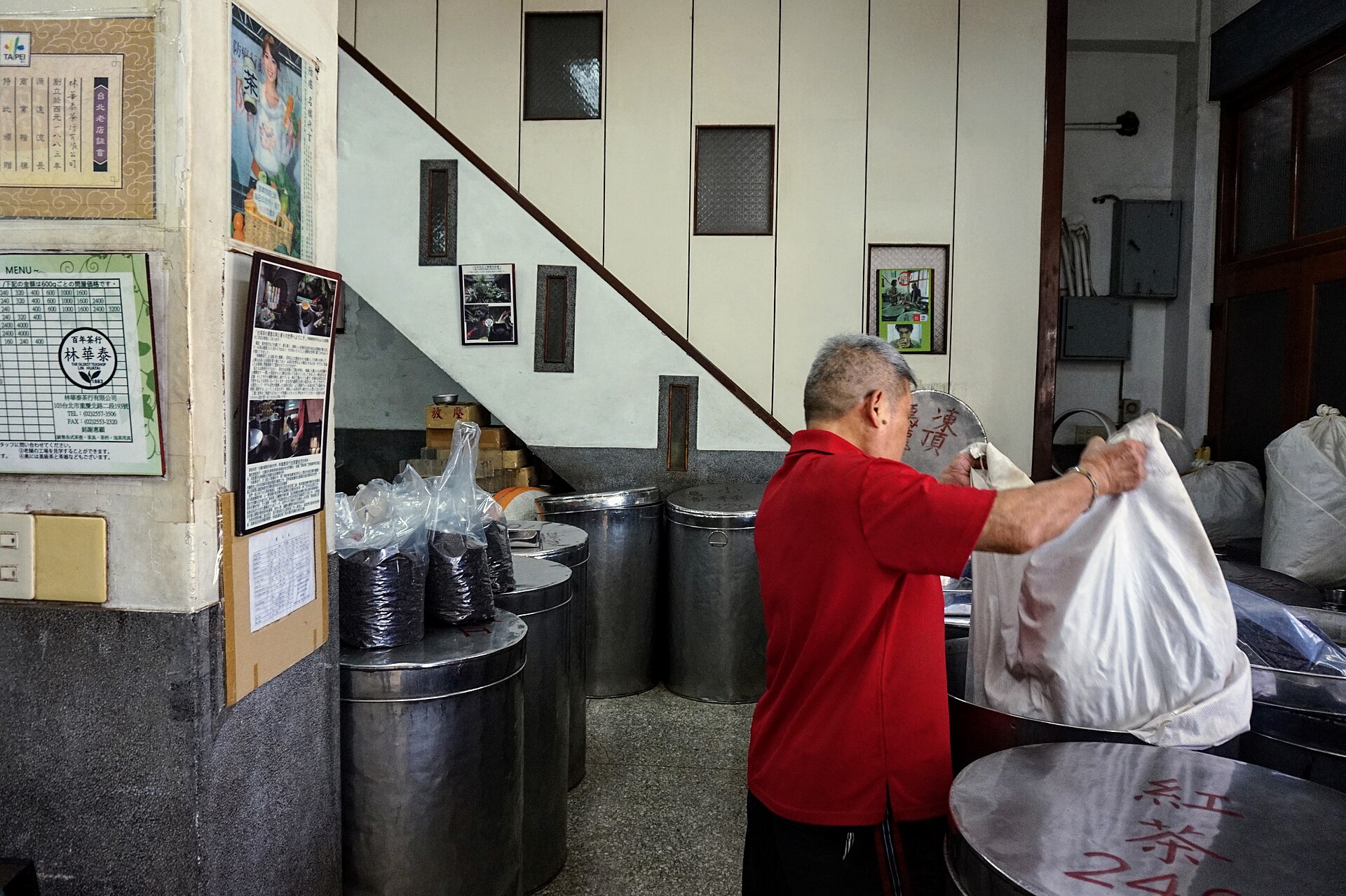
Tea is why Dadaocheng is here, and it is still the best thing to buy. The pleasure is in the old merchants rather than the tourist gift shops, and two are worth the short walk east to Chongqing North Road:
- Lin Hua Tai Tea (林華泰茶行) has been trading since the 1880s and still looks like a wholesale warehouse: big metal tins of tea lined up on the floor, staff scooping and weighing, prices marked per jin. It sells to tea shops and restaurants as much as to the public, which keeps the prices honest. There is little English, but pointing, tasting and writing numbers works fine.
- Wang’s Tea (有記名茶), in a lane off Chongqing North Road, has been roasting tea for more than a century and still charcoal-roasts oolong on the premises. It is a little more polished than Lin Hua Tai, with a small display on the craft, and the roasted oolongs here are the classic Dadaocheng style: toasty, deep and a long way from the green, floral high-mountain teas that dominate modern Taiwanese tea shops.
If you are new to Taiwanese tea, ask to taste two or three and buy a small amount of the one you like; 150 grams (four liang) is a sensible quantity and lasts most people a month. Well-sealed tea travels easily and is allowed into most countries. Our guide to buying tea in Taipei explains the main types, how to judge quality and what to pay, and if you want the view with your tea, the teahouses of Maokong are the other place to go.
Dadaocheng Wharf and the riverside
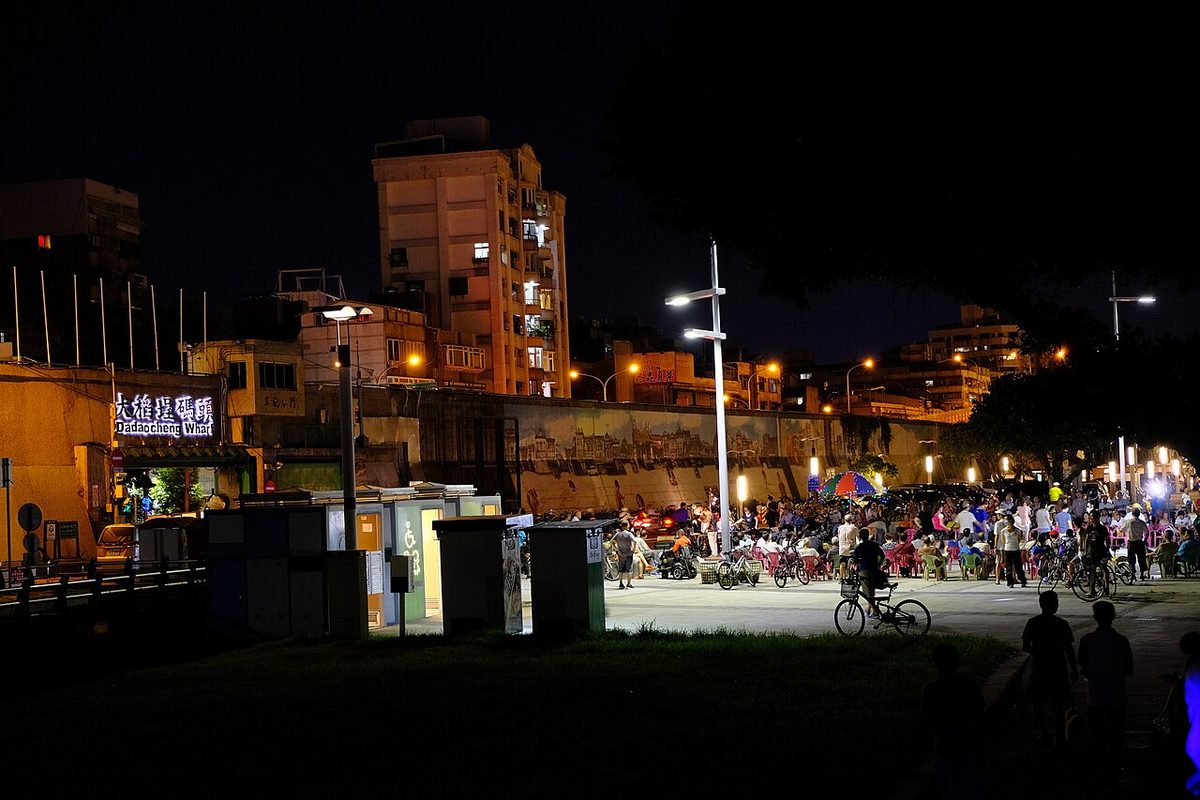
At the western end of Minsheng West Road, a gate in the flood wall — Water Gate No. 5 — leads out of the old streets and onto the riverbank. The flood wall itself tells a story: built in the post-war decades to protect the low-lying district from typhoon floods, it also cut Dadaocheng off from the river that made it, and for a long time the neighbourhood turned its back on the water. The riverside park and the reinvented Dadaocheng Wharf (大稻埕碼頭) have undone some of that.
The river here runs north-south and the wharf faces west, so this is the place for sunset. Come half an hour before, when the light turns gold on the water and the bridges; when the sun goes down behind Sanchong on the far bank, the sky over the river can be spectacular. Along the wharf, a row of converted shipping containers — the container market — sells beer, cocktails, fried snacks and grilled skewers from roughly mid-afternoon until about 22:00, with tables and deckchairs facing the water. It is lively and pleasant, especially at weekends, and it is at its best as a place for a drink rather than a meal. The Taipei tourism office’s Dadaocheng Wharf page lists events at the wharf.
From the wharf, the Blue Highway boats run down the river to Tamsui, mainly on Saturdays and holidays, for about NT$300 one way. It is a slower and more scenic way to reach the old port than the MRT; check the timetable before you plan around it, and see our Tamsui day trip guide for what to do when you arrive. The riverside cycle path also passes the wharf, and a YouBike from one of the docks nearby is an easy way to ride south along the water towards Wanhua or north towards Guandu.
The wharf is also one of the city’s favourite spots for moon-viewing at the Mid-Autumn Festival, and in summer it is the setting for a big fireworks show over the river, usually around Qixi; the date moves each year, so check before you plan around it. Our guide to Taipei in September covers the moon-viewing season.
Where to eat in Dadaocheng
Dadaocheng is an old district, and its best food is old-fashioned, cheap and mostly served in the morning and at lunchtime. Come hungry before noon and you will eat better than at any night market.
Mornings and lunch
- Min Le Swordfish Rice Noodles (民樂旗魚米粉), on Minle Street — a breakfast stall selling bowls of thin rice noodles in a clear swordfish broth, with fried fish and pork on the side. It is a morning affair and closes when the pot is empty.
- The Cisheng Temple forecourt (慈聖宮), on Baoan Street, a few minutes east of Dihua Street — plastic tables under huge banyan trees in front of a Mazu temple, surrounded by old stalls selling pork congee, braised and fried pork, rice-noodle soup and fried oysters. You sit where you like and order from whichever stall you fancy; the stalls deliver to your table. One of the most enjoyable lunches in Taipei, and it is mostly over by mid-afternoon.
- Mai Mian Yan Zai (賣麵炎仔), on Anxi Street — a no-frills noodle shop run by the same family for generations, known for its simple cut noodles in broth and plates of sliced pork, liver and other cuts dipped in soy and garlic. Several old Dadaocheng stalls have appeared on Michelin’s Bib Gourmand list over the years; our guide to Michelin restaurants in Taipei has the current picks.
- Lin He Fa in Yongle Market, for sticky rice to take away (see above).
Stall hours in this part of town are set by the owners, who close for a day or two each week and whenever they have sold out, so have a second choice in mind. If you are here early, our guide to a Taiwanese breakfast in Taipei explains the classics.
An old-fashioned sit-down meal
Bolero (波麗路西餐廳), on Minsheng West Road, opened in 1934 and is Taiwan’s oldest surviving Western-style restaurant. For decades it was where Taipei families arranged formal introductions between prospective couples, and it still has the dark wood, white tablecloths and courteous service of that era. The food — steaks and Western-style set meals — is more interesting as history than as cuisine, but the room is a time capsule, and lunch here is a good excuse to see it.
In the evening
The district quietens after dark, apart from the wharf. For dinner, walk ten to fifteen minutes east to Ningxia Night Market (Shuanglian station, Exit 1, if you come by MRT), one of the best night markets in the city for food: short, dense and focused on eating, with oyster omelettes, taro balls and grilled mochi. Combined with an afternoon in Dadaocheng and sunset at the river, it makes one of the best half-days in Taipei.
What to buy (and what to leave on the shelf)
- Tea — the best souvenir in the district, light, long-lasting and allowed into most countries. See above.
- Dried fruit and nuts — dried mango, guava and pineapple, candied kumquats, roasted peanuts and cashews. Excellent gifts; taste first.
- Dried mushrooms — Taiwanese shiitake are excellent and much cheaper here than overseas. Buy vacuum-packed if you are flying.
- Fabric — a length of Hakka floral print or Taiwanese cotton from the Yongle Market stalls packs flat and costs little.
- Design goods — ceramics, bags, stationery and textiles by Taiwanese designers from the restored shophouses. See our guide to Taiwanese designer shops for more.
- Mullet roe — Taiwan’s great luxury snack, sliced thin and eaten with raw garlic and radish. Delicious, but expensive, and some countries restrict fish products — check.
Be cautious with a few things. Meat products, including the pork jerky sold in many of these shops, are banned or restricted by the customs rules of many countries, and airport bins are full of them. Bird’s nest, ginseng and other high-value medicinals vary enormously in quality and are hard to judge unless you know what you are doing; this is not the place for an impulse purchase. And anything made from protected species is illegal to export, whatever the shopkeeper tells you. Our guide to Taipei souvenirs covers what travels well.
The Lunar New Year market
For about two and a half weeks before Chinese New Year, Dihua Street turns into the city’s New Year market (年貨大街), when Taipei comes to stock up on dried fruit, nuts, sweets, mullet roe and other gifts for the holiday. In 2026 it ran from 31 January to 15 February, along Section 1 of Dihua Street and the neighbouring stretches of Minsheng West Road and Guisui Street. The street fills with extra stalls, red decorations, free samples, calligraphers writing couplets and a solid mass of people — at weekends it is shoulder to shoulder and very slow, which is either the whole point or a nightmare, depending on your temperament. Go on a weekday afternoon if you want to see it without the crush.
Lunar New Year 2027 falls on 6 February, so expect the market to open in the second half of January 2027 and close on the eve of the holiday. Official dates are announced a few weeks beforehand on the city’s tourism site. Our guide to Chinese New Year in Taipei covers the whole holiday, including what closes and when.
A half-day walk through Dadaocheng
This route takes three to four hours at an easy pace, and is timed to finish at the river for sunset. Start about three hours before sunset — around 14:30 in winter, 15:30 in summer.
- Beimen station — come up by the North Gate, the only one of the city’s Qing-dynasty gates still in its original form, and walk north to Nanjing West Road (about six minutes).
- Yongle Market — twenty minutes on the fabric floors.
- Xia Hai City God Temple — fifteen minutes, longer if you are asking Yue Lao for help.
- Dihua Street Section 1, north to Minsheng West Road — an hour of browsing, tasting and looking up at the facades, with a detour into ArtYard.
- Guide Street — ten quiet minutes among the merchants’ mansions.
- A tea merchant on Chongqing North Road — thirty minutes, including tasting.
- Dadaocheng Wharf through Water Gate No. 5 — sunset and a drink.
- Dinner at Ningxia Night Market, ten to fifteen minutes’ walk east.
If you are more of a morning person, reverse the emphasis: breakfast at Min Le or the Cisheng Temple forecourt, the temple before the crowds, the wholesalers at their busiest, lunch, and out before the afternoon heat. And for the full sweep of old Taipei in one day, start at Longshan Temple in the morning, walk north through Ximending to the North Gate, and pick up this route from there — about twenty-five minutes on foot from Ximending to Dihua Street.
Beyond Dihua Street: the rest of Datong
Dadaocheng is only part of Datong District, and three other places reward anyone with extra time:
- Taiwan New Cultural Movement Memorial Museum (台灣新文化運動紀念館), on Ningxia Road, in the former Japanese-era police station where Chiang Wei-shui and other activists were held. Free, well presented and the best place to understand Dadaocheng’s 1920s political life. Check the day it closes before you go.
- Dalongdong, near Yuanshan station on the Red Line, with two of the best temples in Taipei side by side: Baoan Temple, whose restoration won a UNESCO Asia-Pacific heritage award, and the calm, spacious Confucius Temple. About twenty-five minutes’ walk north of Dadaocheng, or a short MRT ride. Our best temples guide covers both.
- Zhongshan’s cafés and design shops, around Chifeng Street, just east of Dadaocheng and a natural next stop. See our Zhongshan district guide.
Practical tips
- Timing. Dihua Street is a working wholesale street, and shops keep their own hours. Most are open by mid-morning and close by early evening; many of the old businesses close one day a week. Late afternoon on a Friday or Saturday is the liveliest; weekday mornings are the most authentic.
- Cash. Card and mobile payment are spreading, but many of the older shops and all of the food stalls still prefer cash. See our guide to money in Taipei.
- Weather. The arcades make this one of the best places in the city for a hot or rainy day; you can walk most of Dihua Street without leaving the shade. The wharf, of course, is fully exposed.
- Traffic. Dihua Street is narrow and still carries cars, vans and scooters. They move slowly, but they do move; stay in the arcades where you can.
- Accessibility. The MRT stations are step-free, and the area is flat, but the arcades change level from shop to shop, with steps and ramps of all heights, so wheelchair users generally have to use the edge of the road. The riverside park is flat and paved. See our accessible Taipei guide.
- With children. Children tend to enjoy the samples, the strange dried things in jars and the open space by the river more than the architecture. A stroller is manageable but awkward in the arcades; a carrier is easier.
- Toilets. The MRT stations, Yongle Market and the riverside park have public toilets; cafés expect you to buy something.
- Photography. Shoot the facades freely, but ask before photographing inside shops or at the temple altars. People are working.
What we would skip
Eating dinner at the container market. The drinks and the view are the point; the food is fairground-standard and pricier than it should be. Have a beer at sunset, then eat at Ningxia.
The far northern end of Dihua Street, if you are short of time. Section 2, beyond Minquan West Road, has some lovely old shopfronts but is mostly ordinary. The best of the street is between Nanjing West Road and Minsheng West Road.
Buying expensive medicinal products on a whim. Ginseng, bird’s nest and cordyceps are serious purchases with serious price differences. If you are not already an informed buyer, enjoy looking.
Dihua Street on a Monday morning or a wet Sunday evening. It is a working street, not a theme park, and at those times it can feel half shut.
Treating it as a photo stop. Dadaocheng rewards slowness: a courtyard, a tea tasting, an hour at the river. If you only have forty minutes, you will see some nice buildings and miss the point.
Dadaocheng’s story begins upriver in Bangka, today’s Wanhua, where the feud of 1853 drove the Tong’an settlers out. The district they left behind is still Taipei’s most devout and old-fashioned, and it makes the perfect morning before an afternoon on Dihua Street; see our guide to Wanhua.
Related Taipei guides
- Taipei Neighbourhoods: A District-by-District Guide
- Ningxia Night Market
- Zhongshan District Guide
- Buying Tea in Taipei
- The Best Temples in Taipei
- Longshan Temple
- Ximending Guide
- Chinese New Year in Taipei
- Tamsui Day Trip
- Taipei Souvenirs
- Things to Do in Taipei
Frequently Asked Questions
Where is Dihua Street in Taipei?
In Datong District, in the north-west of central Taipei, running parallel to the Tamsui River. The historic part is Section 1, from Nanjing West Road north to Minquan West Road, with the best stretch between Nanjing West Road and Minsheng West Road.
How do I get to Dihua Street by MRT?
Take the Green Line to Beimen station and walk north for about six minutes to the southern end of the street by Yongle Market. Daqiaotou station on the Orange Line is closer to the northern end, and Zhongshan station, on the Red and Green lines, is about fourteen minutes’ walk away.
What is Dihua Street famous for?
Its restored nineteenth- and early-twentieth-century shophouses, its dried goods, herbal medicine and tea shops, the Xia Hai City God Temple with its matchmaker god, and the Lunar New Year market held there every winter. It is the main street of Dadaocheng, the old tea-trading port.
Is Dihua Street worth visiting?
Yes — it is one of the best places in Taipei to see the older city, and much more of a working neighbourhood than a tourist street. Give it at least two hours, add a tea merchant and sunset at the river, and it is one of the best half-days in the city.
What is the difference between Dadaocheng and Dihua Street?
Dadaocheng is the historic district, the old river port in what is now Datong District; Dihua Street is its main street. When people say they are going to Dihua Street, they usually mean the whole area, including Guide Street, Yongle Market and the riverside wharf.
When is the best time to visit Dihua Street?
Friday or Saturday afternoon, ending at the river for sunset, is the most enjoyable time. Weekday mornings show the wholesale trade at its busiest. Avoid Monday mornings, when some shops are closed, unless you are just passing through.
What should I buy on Dihua Street?
Tea from one of the old merchants, dried fruit and nuts, dried shiitake mushrooms, fabric from Yongle Market and design goods from the restored shophouses. Avoid meat products, which many countries’ customs will confiscate, and be wary of expensive medicinals unless you know what you are buying.
How do you pray to Yue Lao at the Xia Hai City God Temple?
Buy an offering set at the counter, pay respects to the City God first, then tell Yue Lao your name, birthday and address and describe the partner you hope to meet. Pass the red thread through the incense smoke and keep it in your wallet. If you find love, tradition says you come back with wedding cakes to say thank you.
What are the opening hours of the Xia Hai City God Temple?
It opens early in the morning and closes in the early evening. Published hours vary between sources, so arrive before 19:00 to be safe. Entry is free.
When is the Dihua Street Lunar New Year market?
It runs for about two and a half weeks before Chinese New Year and closes on the eve of the holiday. In 2026 it ran from 31 January to 15 February. For Lunar New Year 2027, on 6 February, expect it to open in the second half of January; check the official dates nearer the time.
Is Dadaocheng Wharf worth visiting?
For sunset, yes. The wharf faces west across the Tamsui River and is free, with container bars selling drinks and snacks from mid-afternoon until about 22:00. Go for a drink and the view, then eat dinner at Ningxia Night Market.
Can I take a boat from Dadaocheng to Tamsui?
Yes. Blue Highway boats run from Dadaocheng Wharf down the river to Tamsui, mainly on Saturdays and holidays, for about NT$300 one way. Check the current timetable before you plan around it; the MRT is faster and runs every day.
Is Dadaocheng a good place to stay?
It has a handful of characterful small hotels and guesthouses in restored buildings, and it is lovely early and late in the day. But it is quiet at night and a little away from the main MRT lines, so most first-time visitors are better off in Zhongshan or Da’an and visiting for the afternoon. Our guide to where to stay in Taipei goes through the options.
The Bottom Line
Dadaocheng is where Taipei made its first fortune, and unlike most old quarters it never stopped doing business. Come in the afternoon, start at Yongle Market and the tiny City God Temple, walk north along Dihua Street looking up at the facades and tasting as you go, buy your tea from a merchant who has been weighing it out since the nineteenth century, and finish at the river as the sun goes down behind the far bank.
Skip the container market’s food, go easy on the medicinal splurges, and give the district more time than you planned. It is not a museum; it is a working street that happens to be beautiful, and that is exactly why it is worth your afternoon.
Photo Credits
Shophouse facades on Dihua Street: Buildings along Dihua Street 07.23 (2) by Supanut Arunoprayote, CC BY 4.0, via Wikimedia Commons.
Aerial view of Dadaocheng: Aerial photographs of Dihua Street by 臺北旅遊網, Attribution, via Wikimedia Commons.
Xia Hai City God Temple at night: PXL 大稻埕霞海城隍廟 01 by 舟集 Boattoad, CC BY-SA 4.0, via Wikimedia Commons.
Traditional shopfront on Dihua Street Section 2: TW 台北市 Taipei 大同區 Datong District 迪化街二段 Dihua Street March 2024 R12S 124 by DONGIE 829 EFUOA, CC0, via Wikimedia Commons.
Bulk tea handling at Lin Hua Tai: In Linhuatai Tea Shop, Taipei 06 by Tbatb, CC BY-SA 4.0, via Wikimedia Commons.