This article contains advertising. Our booking links are routed through a partner that adds commission tracking automatically, so if you book through one we earn a commission from the provider, at no extra cost to you. It never affects what we recommend. Affiliate disclosure
Most people who type Banqiao New Taipei into a search bar want one of two things: a hotel near a high-speed rail station, or the Christmas lights. Both are real. Banqiao Station is where the high speed rail, Taiwan Railways and two metro lines meet, and every winter the plazas around it fill with a small town of glowing trees, carousels and crowds. But ten minutes’ walk from Fuzhong station, down an ordinary street of bakeries and scooter repair shops, a grey wall hides the best reason to come: a nineteenth-century merchant family’s garden, all moon gates, zigzag corridors, carp ponds and pavilions, often described as the most complete traditional Chinese garden surviving in Taiwan. On a weekday morning you can have whole courtyards of it to yourself.
This guide covers Banqiao as a place to explore: the Lin Family Mansion and Garden in detail, the old town around Fuzhong with its Mazu temple and market, the new city around the station, Christmasland in New Taipei City, what to eat, and how Banqiao fits with Sanxia, Yingge and the rest of a trip. Prices and hours change, so check before you go. Banqiao is in New Taipei City, not Taipei City — our guide to Taipei neighbourhoods explains the difference and shows where it fits on the map.
Banqiao at a glance
| The short version | |
|---|---|
| Where | Just south-west of Taipei across the Tamsui River; the administrative centre of New Taipei City |
| Getting there | Blue Line MRT to Banqiao or Fuzhong, a short ride from Taipei Main Station; high speed rail and Taiwan Railways also stop at Banqiao |
| Time needed | Two hours for the Lin Family Garden; half a day with the old town and a meal; an evening for Christmasland |
| Best times | Weekday mornings for the garden; mid-November to late December evenings for the Christmas lights |
| Entry | Lin Family Mansion and Garden NT$80; temples, streets and Christmasland free |
| Do not miss | The Lin Family Garden’s pavilions and ponds, the carved front hall of the family residence, Cihui Temple’s gilded ceiling |
What things cost
| Item | Typical cost (September 2026) |
|---|---|
| MRT from Taipei Main Station to Banqiao or Fuzhong | Roughly NT$25–30 with an EasyCard |
| Lin Family Mansion and Garden | NT$80 per person (charged since 1 June 2026) |
| Guided tour of the garden in English or Japanese | Free for booked groups of more than five, on weekdays |
| Cihui Temple and the old-town temples | Free |
| Christmasland in New Taipei City | Free; some rides and pop-up attractions charge a small fee |
| A bowl of noodles or rice in the old-town market area | Roughly NT$50–150 |
| Dinner in a station-area mall food court | Roughly NT$150–350 |
Understanding Banqiao
Banqiao means “plank bridge”, after a wooden footbridge that once crossed a creek here, and for most of the Qing dynasty that was about the size of it: a farming village on the plain south-west of the Taipei basin’s river ports. It was written with different characters for most of its history — 枋橋, which also means plank bridge — until the Japanese colonial government standardised the name as 板橋 in 1920. Older maps and some romanisations spell it Banciao, which is why you will still see that spelling on Taiwan Railways signs and in older station photographs.
What turned the village into a town was one family. The Lin family — known formally as the Lin Ben Yuan family — came to Taiwan from Zhangzhou in Fujian province in the late eighteenth century and grew rich from the rice trade, salt and land reclamation. In 1851 they moved their base to Banqiao, built a fortified residence, and spent the rest of the century enlarging it into a complex of courtyards and gardens. The town grew up around their gates, and the family’s wealth paid for temples, schools and, in a century of bitter feuds between settler groups from different parts of Fujian, a defensive wall around the town.
The twentieth century rewrote Banqiao twice. After 1945 the plain filled with housing for workers and for refugees arriving from the mainland, and today Banqiao has the third-highest population density of any district in Taiwan, at more than 24,000 people per square kilometre. A new city centre has grown up around the rebuilt underground Banqiao Station, which opened in 1999: government towers, malls, hotels and plazas, all on a grid a few hundred metres from the old town. When Taipei County became New Taipei City in 2010, Banqiao, with more than half a million people, became its administrative centre.
For a visitor the result is two Banqiaos side by side. Fuzhong is the old town, with the Lin family’s garden, the Mazu temple, the market and narrow lanes. Banqiao Station is the new town of glass, plazas and Christmas lights. They are one metro stop — or a fifteen-minute walk — apart, and a good visit uses both.
Getting to Banqiao
The Blue Line (Bannan Line) is the easy way in. From Taipei Main Station, trains heading west towards Dingpu pass Longshan Temple and cross under the Tamsui River to reach Banqiao; Fuzhong, the stop for the old town and the Lin Family Garden, is the next station. Our Taipei MRT guide covers fares and transfers.
- For the Lin Family Mansion and Garden: Fuzhong station, then on foot; the garden’s official directions give the exit to use and the walking route.
- For Christmasland, City Hall and the malls: Banqiao station. The plazas are right outside.
- By high speed rail: Banqiao is the first stop south of Taipei Main, and most trains call here. If you are staying in western Taipei or New Taipei, boarding at Banqiao saves a trip into the centre. See our high speed rail guide.
- By Taiwan Railways: local and express trains on the west coast line stop at Banqiao, a few minutes from Taipei Main.
- By the Circular Line: the Yellow Line, which curves round the south-western suburbs, also stops at Banqiao and links it with Xinpu Minsheng, Zhonghe and Xindian.
Banqiao Station is a large underground interchange with several levels and a lot of exits. Allow a few minutes to change between the MRT, the railways and the high speed rail, and follow the colour-coded signs rather than the crowds.
The Lin Family Mansion and Garden
The Lin Family Mansion and Garden (林本源園邸) is the reason Banqiao appears in guidebooks, and it deserves the attention. What survives is two linked parts: the family’s Three-Courtyard Residence (三落大厝), built in the early 1850s, and the pleasure garden beside it, which the family kept enlarging until it reached its final form late in the nineteenth century. A still larger five-courtyard house once stood next door; it was demolished decades ago, which is why the surviving buildings sit a little oddly against the apartment blocks on one side.
The family’s fortunes turned with Taiwan’s. When Japan took the island in 1895, many of the Lins left for Xiamen on the mainland, and a son later built the Shuzhuang Garden on Gulangyu island, said to have been shaped by memories of this one. After 1949 refugee families from the mainland, and later other Taiwanese residents, came to live in the Banqiao garden. It took years of negotiation and a long restoration in the 1980s to clear and repair it before it opened to the public with an admission fee, and a second round of restoration followed from 1997 to 2001. The regular NT$80 admission resumed on 1 June 2026.
What to see in the garden
Chinese gardens are designed to be walked slowly, with each corner revealing a new framed view, and this one packs an extraordinary amount into a compact space. Follow the covered corridors and do not rush. The highlights:
- Jigu Library (汲古書屋) — the study where the Lin boys did their lessons, named after a famous book collector’s library.
- Fangjian Studio (方鑑齋) — a scholar’s studio and retreat, with an opera stage close by.
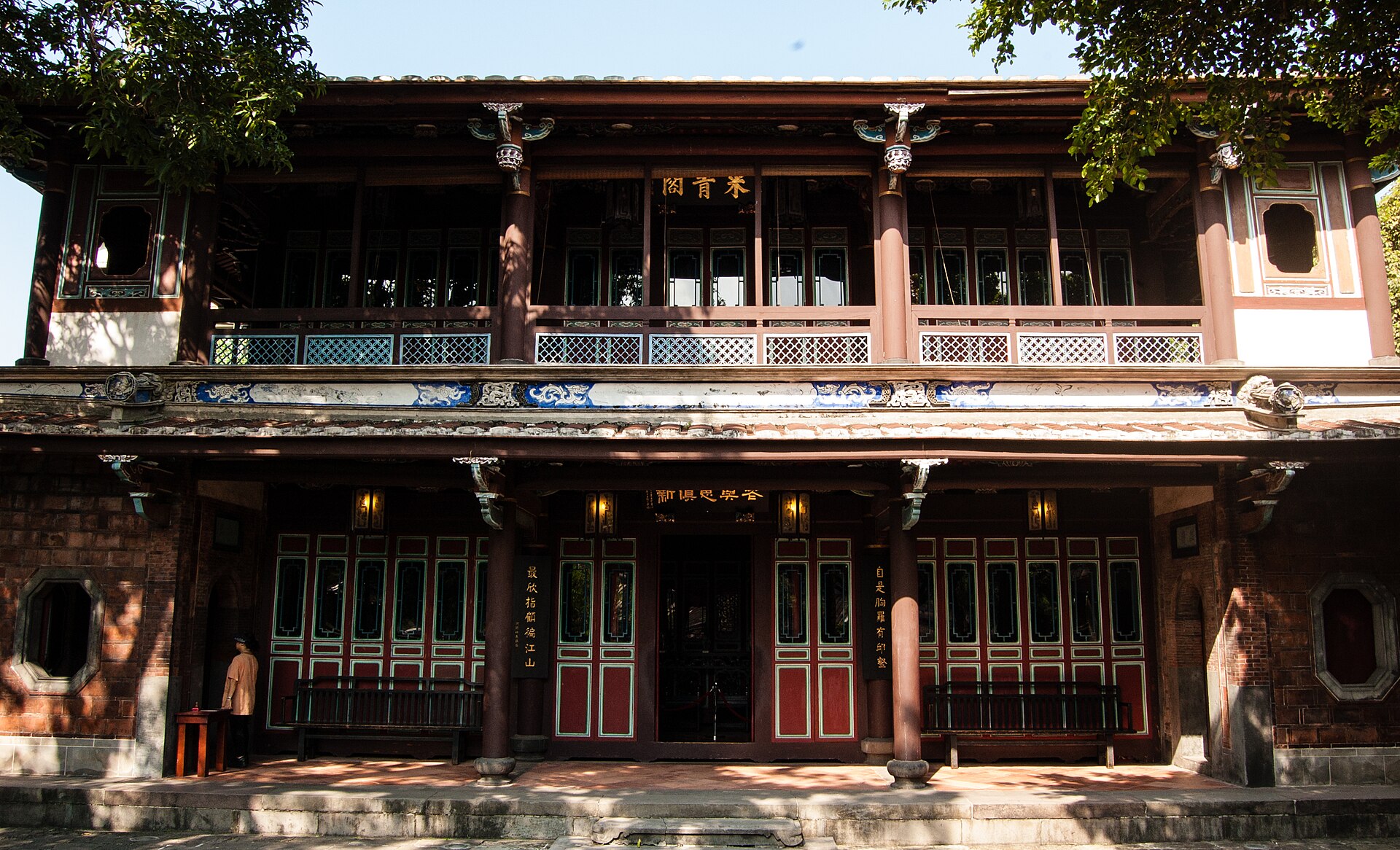
- Laiqing Pavilion (來青閣) — a richly carved wooden guesthouse where the family lodged its visitors, facing a small opera stage across its courtyard.
- Dingjing Hall (定靜堂) — the largest hall, used for banquets and family gatherings, built around a quadrangle.
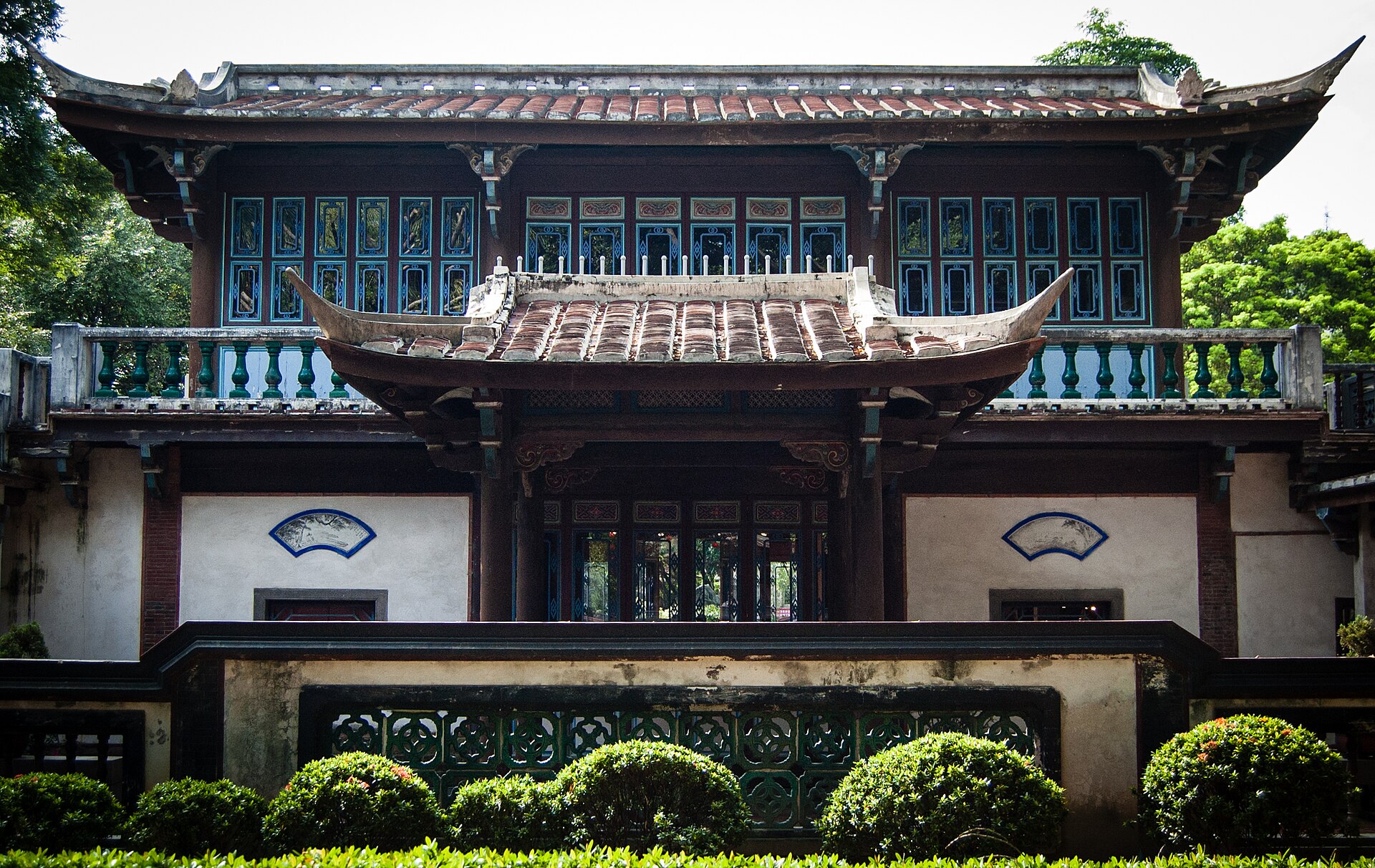
- Guanjia Tower (觀稼樓) — the “tower for viewing the crops”, from whose upper floor the family could once look out over their farmland.
- Banyan Shade Pond (榕蔭大池) — the largest body of water in the garden, ringed by artificial hills built from stones brought from the family’s ancestral village in Zhangzhou, with pavilions and old banyan trees.
Look at the doorways and windows as you go. They come in the shapes of vases, fans, peaches, leaves and bats, and almost every one is a visual pun: a vase (瓶, ping) for peace (平), a bat (蝠, fu) for good fortune (福), a peach for long life, a fan (扇, shan) for kindness (善). Walls are pierced by lattice windows that frame the next courtyard like a painting, and the paving, balustrades and tiles all repay a closer look.
The Three-Courtyard Residence
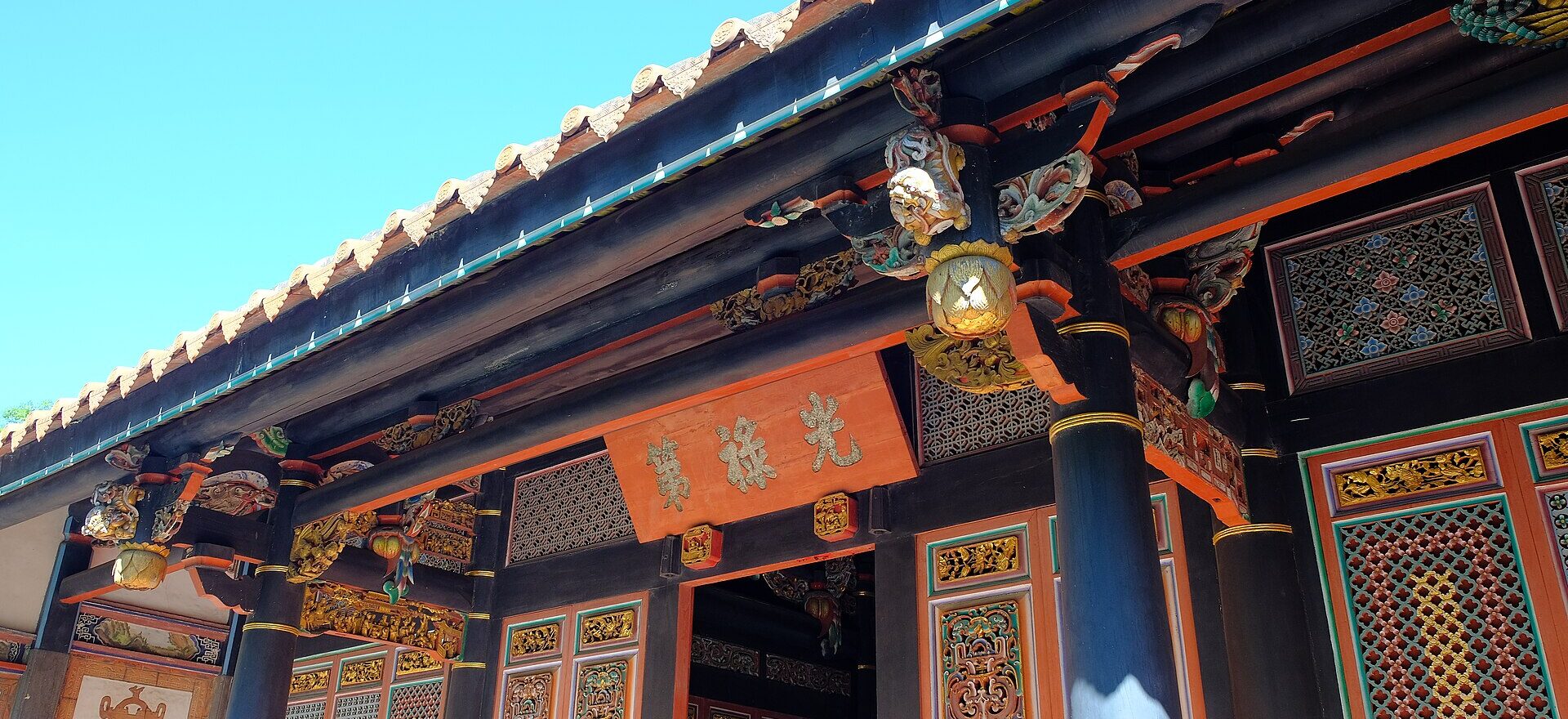
The residence is the other half of the visit, the house where the family’s 光祿第 plaque still hangs. Access to the residence has long been more restricted than the garden, with parts shown only on guided tours, so ask at the ticket office which halls are open on the day and whether a tour is starting soon.
Practical details
- Hours: 09:00–17:00. Closed on the first Monday of each month and a few other listed days, including part of Lunar New Year; the garden’s opening calendar lists every closure date.
- Admission: NT$80 per person; the regular charge resumed on 1 June 2026.
- Guided tours: free English and Japanese tours for groups of more than five, on weekdays only, booked at least a week ahead through the garden office. Individuals can explore on their own; the signage is bilingual.
- Rules: no smoking, running, pets, or eating and drinking indoors, and do not feed the fish. Visitor numbers are capped at busy times.
- Time needed: an hour and a half to two hours to see the garden and residence properly; longer if you like to sketch or photograph.
Opening days, tour arrangements and closures are posted on the garden’s official website, which is worth checking before you go. Arrive at 09:00 on a weekday for the quietest courtyards; weekend afternoons bring families, school groups and photographers with costumed models.
Honest verdict: if you have any interest in Chinese architecture, gardens or Taiwanese history, this is one of the best two hours you can spend in greater Taipei, and far less crowded than the city’s big-name sights. It is also shady and cool on a hot day. If you do not care for old buildings, the new NT$80 fee will feel like money for a pretty walk, and you can skip it.
Fuzhong: the old town
Around Fuzhong station, the Banqiao that grew up at the Lins’ gates survives in fragments among the newer buildings: a grid of busy shopping streets, temples, a covered market and lanes of small restaurants. It is not a preserved old town in the way that Dadaocheng or Sanxia are, but it is lively, very local and good for an hour’s wander before or after the garden.
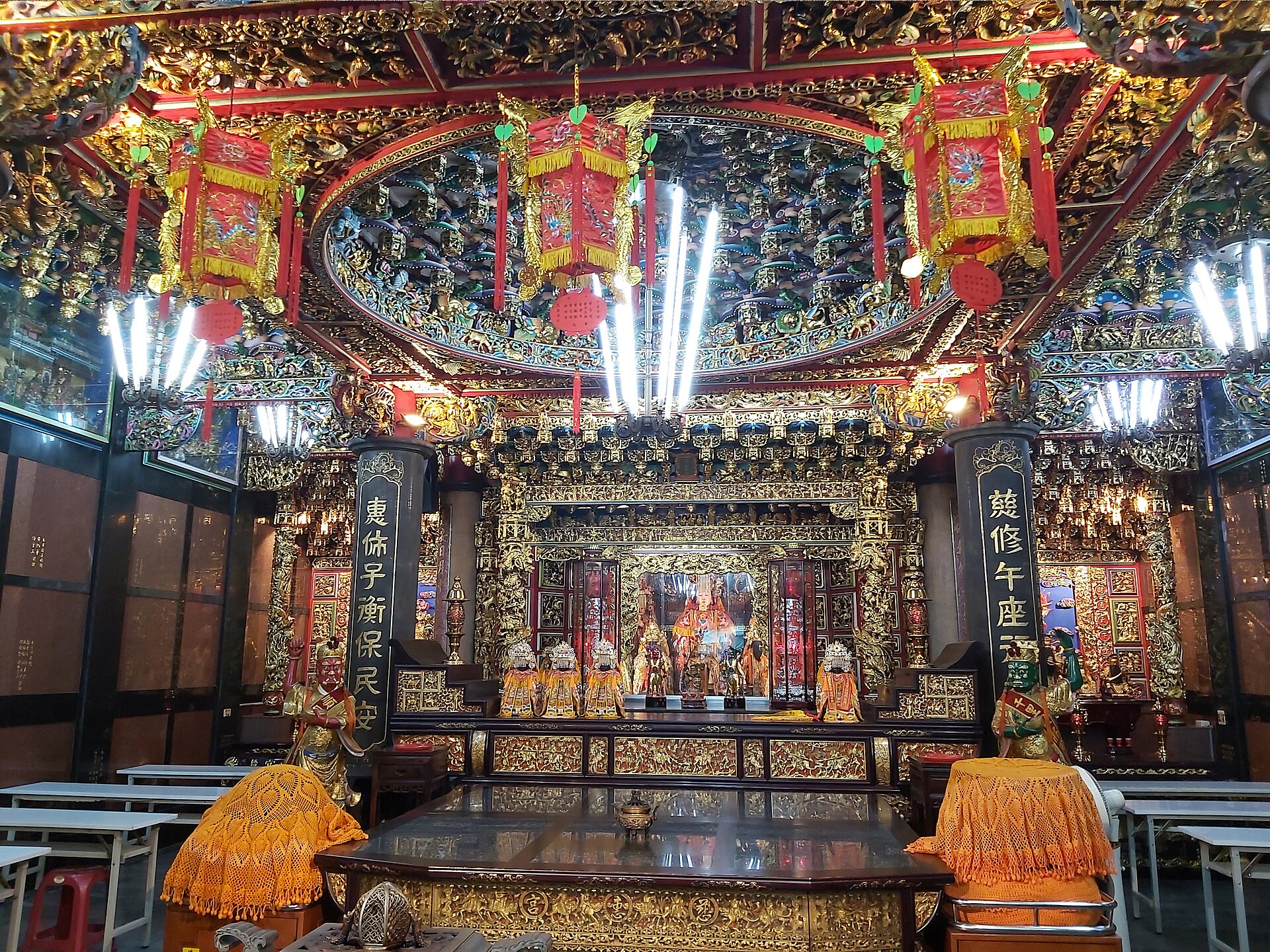
Cihui Temple (慈惠宮) on Fuzhong Road is Banqiao’s temple to Mazu, the sea goddess who is the most widely worshipped deity in Taiwan. Step inside for the main hall, which is a riot of gilded carving: a golden altar, rows of attendant statues, embroidered lanterns and a spiralling caisson ceiling of carved brackets that draws the eye upwards. Visitors are welcome as long as they are quiet and keep out of the way of worshippers; our guide to Taipei etiquette covers the basics of temple manners.
Nearby, Huangshi Market (黃石市場) is Banqiao’s old market, rebuilt and reopened in July 2025 in a new nine-storey complex with three basement levels. Its ground floor holds produce, meat and seafood stalls alongside prepared food and snacks. Come hungry, point at what looks good and expect prices far below those at the station malls — roughly NT$50–150 for a bowl of noodles, rice or soup. Many stalls close by early afternoon, and some take a day off each week, so do not build a meal plan around a single shop.
Honest verdict: Fuzhong is best treated as the setting for the garden rather than a destination in itself. Wander, eat, look into the temple, and move on.
Banqiao Station and the new city centre
Come up from the underground platforms at Banqiao Station and you are in a different city: wide plazas, the tall towers of the New Taipei City Government, hotels, department stores and malls including Mega City, and a big bus station alongside. It is clean, convenient and entirely modern, and outside the Christmas season there is little here for a visitor beyond food courts, shopping and air conditioning on a hot afternoon.
That changes in winter. The large open space in front of City Hall, known as Citizen’s Square, and the plazas around the station are the stage for Christmasland, and for a few weeks the whole area is lit up after dark.
Christmasland in New Taipei City
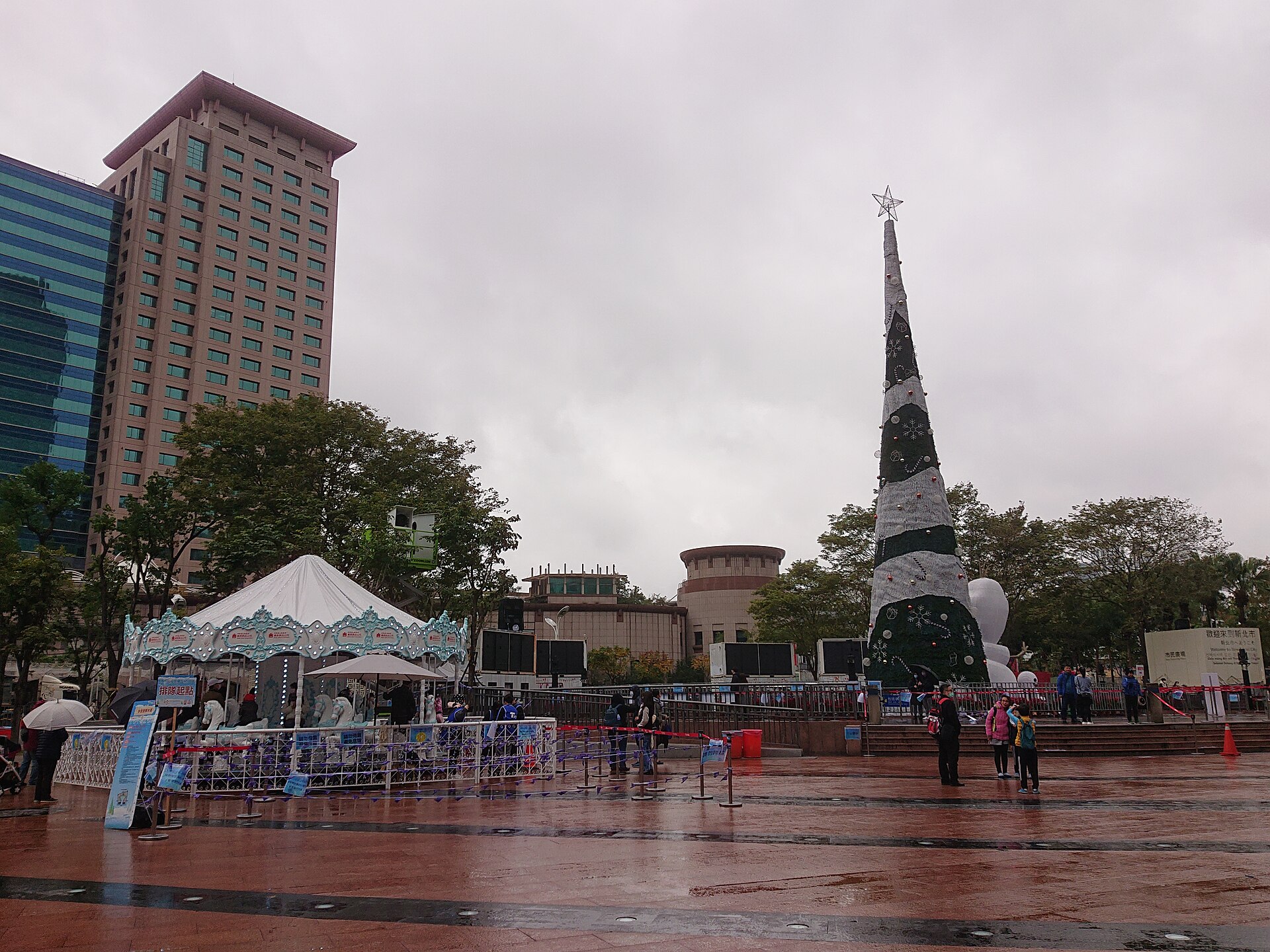
Christmasland in New Taipei City (新北耶誕城) has been held around Banqiao Station every winter since the early 2010s, organised by the city government. Each year has a theme; the 2025 edition, “Circus Carnival”, ran from 14 November to 28 December, with installations spread across Citizen’s Square, the plazas in front of City Hall and the station, the bus station and Fuzhong Plaza. Expect a giant lit tree, walk-through light tunnels, themed installations, a carousel, performances on stage, food stalls and a great many selfies.
Christmasland 2026 runs from 13 November to 27 December 2026, as listed on the Tourism Administration’s events calendar. Check the programme on the city’s tourism site, newtaipei.travel, before you go.
- Getting there: Blue Line or high speed rail to Banqiao; the displays start outside the station exits.
- When to go: on a weekday evening, soon after the lights come on at dusk. Weekend nights in December, and the nights around Christmas itself, are packed shoulder to shoulder, and the MRT platforms fill up as everyone leaves at once.
- Cost: free to walk around; some rides and pop-ups charge.
- With children: fun for small children early in the evening; less fun at 21:00 in a crowd on a Saturday.
Honest verdict: Christmasland is cheerful, free and very well produced, and if you are in Taipei in December with children it is an easy, happy evening. It is also, in the end, a big municipal light show around a railway station. Nobody should plan a trip to Taiwan around it, and if crowds make you miserable, go on a Monday. Our guide to Taipei in December covers the rest of the season, from hot springs to the New Year’s Eve fireworks.
Where to eat in Banqiao
- The old-town market and lanes: the most characterful eating, around Huangshi Market and the streets near Fuzhong station. Noodles, rice dishes, soups, braised pork rice and snacks at neighbourhood prices; best at breakfast and lunch.
- Nanya Night Market (湳雅夜市): Banqiao’s own night market, a local affair of fried snacks, grilled skewers, desserts and carnival games rather than a tourist attraction. Worth a stroll if you are staying nearby; not worth crossing the city for when Taipei has markets like Raohe and Ningxia.
- Station-area malls: food courts, chain restaurants and dessert shops under one roof, roughly NT$150–350 a meal. Unexciting but reliable, open late, and very handy with children or in the rain.
For a broader picture of what to order and how, see our guide to Taiwanese street food.
Combining Banqiao with the rest of your trip
Banqiao sits on the Blue Line between central Taipei and the south-western suburbs, which makes it easy to string together with other stops:
- Longshan Temple and Wanhua are a few stops back towards the city on the same line. A morning in the Lin Family Garden and an afternoon at Longshan Temple and Bopiliao make a good old-Taipei day — see our Wanhua District guide.
- Sanxia and Yingge are further out the other way. Ride the Blue Line to Dingpu and change to the new Sanying Line for Sanxia’s temple and old street and Yingge’s pottery shops. Our guide to Sanxia and Yingge has the details, and Banqiao makes a natural stop on the way back.
- Heading south by high speed rail: if you are catching a train to Taichung, Tainan or Kaohsiung, an hour in the Lin Family Garden before boarding at Banqiao is a civilised way to start the journey. Leave your bags in the station lockers.
A half day in Banqiao
- 09:00 — The Lin Family Mansion and Garden. Blue Line to Fuzhong, Exit 3, and walk to the entrance for opening time. Allow two hours for the garden and residence.
- 11:00 — Cihui Temple. Walk back towards Fuzhong Road and step into the Mazu temple.
- 11:30 — Lunch around Huangshi Market. Noodles, soup or rice at one of the stalls or small restaurants near the market.
- 13:00 — Onward. Walk or ride one stop to Banqiao Station for coffee and the malls, then either head back into Taipei via Longshan Temple or continue out to Sanxia and Yingge.
In December, flip it: garden in the afternoon, dinner in the old town, and Christmasland after dark.
Banqiao through the year
- Winter (December–February): Christmasland until late December, then Lunar New Year, when the garden closes for part of the holiday and the temples are at their busiest.
- Spring (March–May): pleasant weather for the garden, with flowering trees in the courtyards. The plum rains usually arrive in May and June.
- Summer (June–September): hot and humid, but the garden’s shade, corridors and ponds make it more comfortable than most outdoor sights. Go early and retreat to the malls at midday. Check typhoon warnings before travelling.
- Autumn (October–November): the most comfortable season, and the run-up to Christmasland, which usually opens in mid-November.
Banqiao with children
Children tend to enjoy the Lin Family Garden more than their parents expect. The zigzag corridors, bridges, fish ponds and oddly shaped doorways make it feel like a maze, and there is plenty of shade — just keep small hands off the carvings and away from the pond edges, which are not fenced everywhere. Christmasland is the obvious winter treat, best early on a weekday evening, and the station-area malls have family restaurants, nursing rooms and play areas for rainy days. For more ideas across the city, see our guide to Taipei with kids.
For pushchairs, the station area is easy, but the garden has steps, thresholds and narrow bridges throughout. A baby carrier is the better choice there.
What we would skip
- The station-area malls as a sight. They are good malls. So are the ones in Xinyi, and you do not need to ride out to Banqiao for them.
- Christmasland on a December Saturday night unless you enjoy crowds. Go on a weekday, or early.
- Nanya Night Market as a special trip. It is a perfectly good neighbourhood market; Taipei’s big ones are better.
- The Lin Family Garden on its closed days. The first Monday of each month catches people out every time — check before you set off.
- Choosing a Banqiao hotel just because it is cheaper. It can work if you are catching early high speed trains, but for a first trip most visitors are happier closer to the old city and the night markets. See our guide to where to stay in Taipei.
Related Taipei guides
- Taipei Neighbourhoods: A District-by-District Guide
- Sanxia and Yingge Day Trip
- Wanhua District Guide
- Longshan Temple
- Best Temples in Taipei
- Taipei in December
- Taiwan High Speed Rail from Taipei
- Taipei MRT Guide
- Taipei Culture
- Day Trips from Taipei
Frequently Asked Questions
Is Banqiao worth visiting?
Yes, for the Lin Family Mansion and Garden, which is one of the finest historic sites in greater Taipei and far quieter than the big city sights. Add Cihui Temple and lunch in the old town for a satisfying half day. In November and December, Christmasland is an extra reason to come in the evening.
Is Banqiao part of Taipei?
Not officially. Banqiao is a district of New Taipei City, the separate municipality that surrounds Taipei City, and it is New Taipei’s administrative centre. In practice the two cities run together, share the MRT and the EasyCard, and most visitors would never notice the border.
How do I get to Banqiao from Taipei Main Station?
Take the Blue Line MRT towards Dingpu. Banqiao comes first and Fuzhong is the next stop. The high speed rail and Taiwan Railways also stop at Banqiao, a few minutes from Taipei Main.
How do I get to the Lin Family Mansion and Garden?
Take the Blue Line to Fuzhong station, the nearest stop, and walk from there; the garden’s website publishes the exit to use and the route. From Banqiao Station it is a fifteen- to twenty-minute walk or a short taxi ride.
Is the Lin Family Garden free?
Not any more. Since 1 June 2026, when the regular charge resumed, admission is NT$80 per person. Free English and Japanese guided tours are available for booked groups of more than five on weekdays.
What are the opening hours of the Lin Family Mansion and Garden?
Daily from 09:00 to 17:00, except the first Monday of each month and a few listed days such as part of Lunar New Year. Check the official website before you go, as closure days and tour arrangements change.
Can I visit the Lin Family Mansion in English?
Yes. Signs are bilingual, so you can explore on your own. Free guided tours in English and Japanese are offered to groups of more than five on weekdays, booked at least a week ahead through the garden office.
When is Christmasland in New Taipei City in 2026?
From 13 November to 27 December 2026, according to the Tourism Administration’s events calendar. The event usually opens in mid-November and closes shortly after Christmas — the 2025 edition ran from 14 November to 28 December. Check newtaipei.travel for the programme before you travel.
Is Christmasland free?
Yes, walking around the displays is free. Some rides and pop-up attractions charge a small fee, and food stalls sell snacks and drinks.
Does the high speed rail stop at Banqiao?
Yes. Banqiao is the first stop south of Taipei Main, and most high speed trains call there. It is a convenient place to board if you are staying in western Taipei or New Taipei.
What is there to eat in Banqiao?
Local noodle shops, rice dishes and snacks around Huangshi Market and Fuzhong station, Nanya Night Market in the evenings, and food courts and chain restaurants in the malls around Banqiao Station. The old-town food is the most interesting and the cheapest.
How much time do I need in Banqiao?
Two hours for the Lin Family Mansion and Garden, and half a day if you add Cihui Temple and lunch in the old town. Christmasland needs an hour or two in the evening.
Is Banqiao a good place to stay?
It can be, if you are catching early high speed trains or want more space for your money, and the Blue Line gets you into central Taipei quickly. For a first visit, though, most people are happier staying closer to the old city, the night markets and the main sights.
The Bottom Line
Banqiao is easy to dismiss as a commuter town with a big railway station, and most of it is exactly that. But one Blue Line ride from Taipei Main, the Lin family’s garden is one of the loveliest places in greater Taipei — a Qing-dynasty world of pavilions, ponds, moon gates and punning windows, restored, newly repainted and, on a weekday morning, gloriously quiet. Pay the NT$80, give it two unhurried hours, look into Cihui Temple, eat in the old-town lanes, and you have one of the best half days in the region. Come back in December for the lights if you have children in tow. Skip the rest without guilt.
Photo Credits
The front hall of the Three-Courtyard Residence: 2020 Three-house Courtyard (Lin Family Mansion and Garden) a by Taiwankengo, CC BY-SA 4.0, via Wikimedia Commons.
Laiqing Pavilion: 2011-08-02 Lai Ching Hall of the Lin Family Mansion and Garden by tomscoffin, CC BY 2.0, via Wikimedia Commons.
Guanjia Tower: 2011-08-02 Guan Jia Hall of the Lin Family Mansion and Garden by tomscoffin, CC BY 2.0, via Wikimedia Commons.
The main hall of Cihui Temple: Interior of the Cihui Mazu Temple-01.2024-07-03 by 阿道, CC BY-SA 4.0, via Wikimedia Commons.
Christmasland in New Taipei City: 2022 Christmasland in New Taipei City Plaza by Jiazheng0609, CC BY-SA 4.0, via Wikimedia Commons.