This article contains advertising. Our booking links are routed through a partner that adds commission tracking automatically, so if you book through one we earn a commission from the provider, at no extra cost to you. It never affects what we recommend. Affiliate disclosure
Ask any Taipei foodie which night market they actually go to, and the answer is rarely Shilin. It’s Raohe Night Market — the 600-meter pedestrian street running through the Songshan District, lit by lanterns at the Songshan Ciyou Temple end, and crammed with local food, including stalls the Michelin Guide has recommended. The pepper bun queue starts before sunset. And the whole walk, from the temple to the far western end, is short enough to do well in one evening, with plenty of chances to fill up on the way.
Raohe is also the night market that consistently delivers what most travelers actually want: real local energy without overwhelming tourist traffic, high food quality without the chaos of Shilin’s labyrinth, and a layout that makes a single walk-through manageable rather than exhausting. It’s why Raohe is always a serious contender in any “best night market in Taipei” debate.
This guide is the practical one — how to get to Raohe Night Market, when to arrive, the must-eat stalls (including the Michelin-listed ones), the temple at the entrance, and how to do a Raohe night the way locals do. By the end, you’ll know exactly where to spend your two hours and what to order.

Raohe Night Market at a Glance
- Location: Raohe Street, Songshan District, Taipei
- Hours: 5:00 PM – midnight daily
- Get there: MRT Songshan-Xindian (Green) Line to Songshan Station, Exit 5
- Layout: About 600 meters along Raohe Street, with Songshan Ciyou Temple at the eastern end
- Best for: Serious foodies, Michelin-recognized stalls, locals-style night market experience
- Time needed: Allow an unhurried evening of grazing
- Cost: NT$300–500 per person for a substantial street-food dinner
- Best night: Tuesday–Thursday at 6 PM
What Is Raohe Night Market?
Raohe Night Market (饒河街觀光夜市) opened in 1987 along Raohe Street in the Songshan District of eastern Taipei. The market runs along a single pedestrian stretch of Raohe Street, about 600 meters long, with the historic Songshan Ciyou Temple at its eastern end. Food stalls sit side by side with clothing, accessory, and game vendors.
The market’s reputation has risen sharply over the last decade. Once an everyday neighborhood night market, it’s now best known for the quality of its street food, particularly since the first Michelin Guide Taipei recommended several of its stalls in 2018.
Raohe Night Market vs. Shilin Night Market
The two most-asked-about Taipei night markets play different roles:
Raohe is for food quality. Michelin-recommended stalls. A more concentrated layout. Fewer tourists. Locals’ clear favorite.
Shilin is for scale and variety. 500+ vendors across multiple streets and an underground food court. More clothing and game stalls. Bigger, louder, more famous, more touristy.
Many travelers do both — Shilin for the spectacle, Raohe for the actual best food. If you can only do one and you care about eating well, choose Raohe.
How to Get to Raohe Night Market
The MRT is the easiest way. Songshan Station (the eastern terminus of the Songshan-Xindian Green Line) drops you within a minute of the temple end of the market.
- From Taipei Main Station: Blue Line, then change to the Green Line for Songshan
- From Ximending: Green Line, direct to Songshan
- From Taipei 101: Red Line from Taipei 101/World Trade Center, changing to the Green Line for Songshan (plan the transfer with the Taipei Metro journey planner)
Use Exit 5. You’ll come up at street level facing Songshan Ciyou Temple — the lantern-lit, dragon-roof temple is the unmistakable landmark. The market entrance is across the street.
By taxi, expect NT$200–400 from most central neighborhoods.
When to Visit Raohe Night Market
Like all Taipei night markets, timing matters significantly:
Best time to arrive: 5:30–6:30 PM. The market opens at 5 PM, so you get in before the evening gets going. You’ll have your pick of the lines and full energy from the chefs.
Later evenings can be crowded. Particularly weekends. The pepper bun queue can get long, especially on holidays.
Late slot: up to midnight. The market runs until midnight, though individual stalls can sell out or close earlier. Good for a slower walk if you’ve already eaten elsewhere.
Best day: Tuesday–Thursday. Calmest crowds and shortest queues. Friday and Saturday nights are louder but more atmospheric.
Avoid: Lunar New Year week (many stalls close), typhoon nights (vendors close down), and very rainy nights (some stalls don’t open).
The Layout: A Linear Walk-Through
Raohe’s biggest advantage over Shilin is its layout. The market is a single 600-meter pedestrian street, so you can walk it end to end at your own pace and graze as you go.
The classic walking route:
- Start at the eastern entrance (temple side). Photograph Songshan Ciyou Temple’s lantern-lit facade. Enter the market through the large illuminated gate.
- Walk west for about 600 meters. Stalls fan out along both sides of the street; ducking into the lanes off Raohe is generally not productive — most are residential.
- Reach the western arch. Smaller arch with fewer crowds. Some travelers turn around and walk back; others carry on to Houshanpi MRT (Bannan Blue Line).
- Walk back if you have energy. The return walk lets you stop at stalls you skipped — often quieter on the way back.

Must-Eat Stalls at Raohe Night Market
1. Fuzhou Ancestor Pepper Buns (福州世祖胡椒餅)
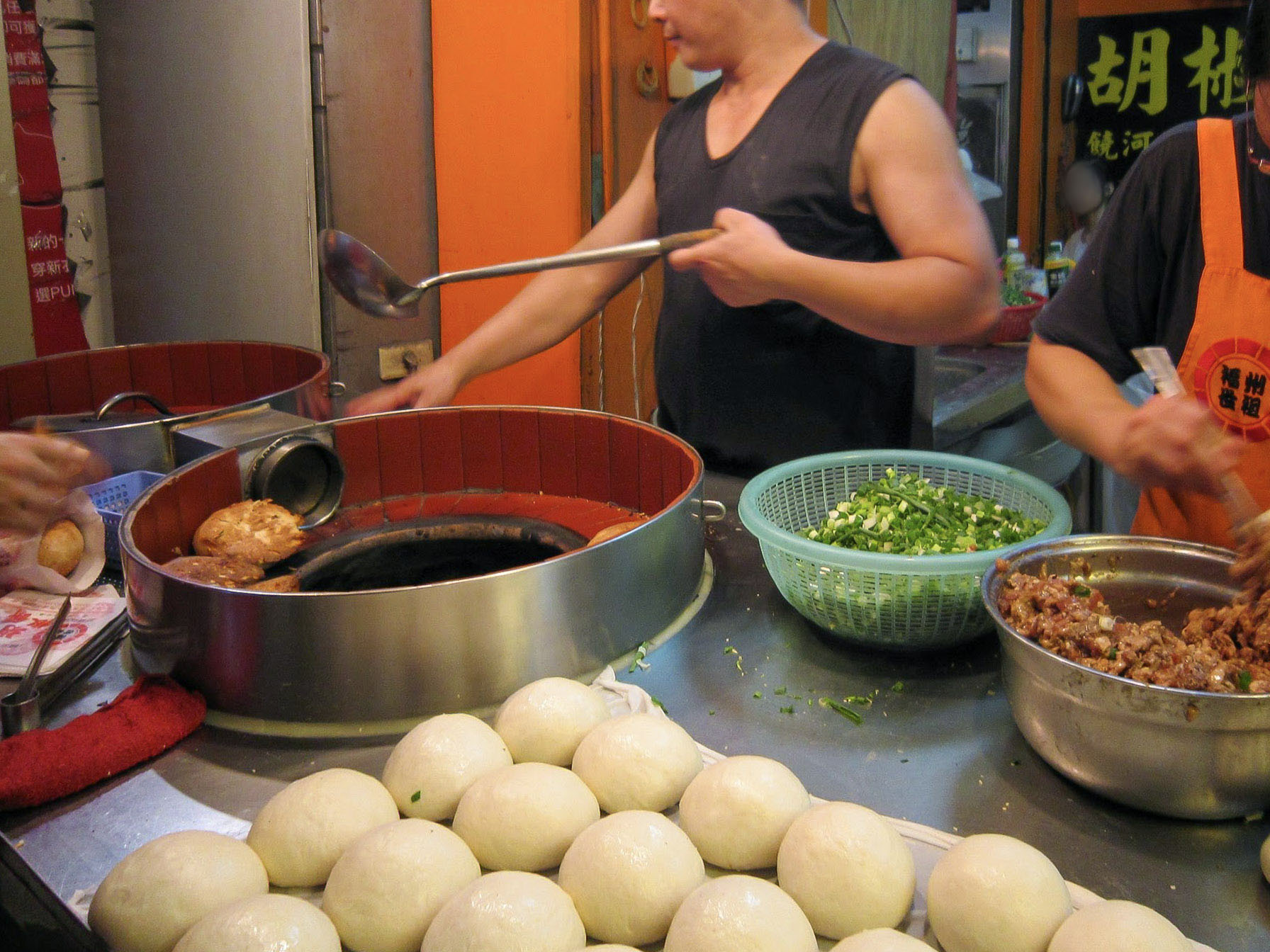
The single most famous stall at Raohe. Also Michelin Bib Gourmand-listed. The pepper bun (胡椒餅) is a clay-oven-baked round bun stuffed with seasoned pork, spring onions, and aggressive black pepper. The buns are pressed against the inside of a charcoal-fired tandoor-style clay oven and baked until the outside is crisp and the inside is soup-laden. NT$60 each.
The line is legendary, and it can be long, especially on holidays, so build a wait into your plan.
Pro tip: The bun is dangerously hot when fresh. Let the filling cool a little before the first bite. Bite from the side; the steam vents and the soup pours.
2. A-Kuo Lu Wei (阿國滷味)
Michelin Bib Gourmand. Lu wei (滷味) is a Taiwanese braised-food bar — you point at items (duck wings, white radish, tofu skin, pig ear, century egg) and they’re warmed in a savory broth of soy sauce, rock sugar, and Chinese herbs. NT$30–80 per item. A great way to taste several Taiwanese flavors in one stop.
3. Chen Tung’s Medicinal Pork Rib Soup (陳董藥燉排骨)
Michelin Bib Gourmand. Pork ribs simmered for hours with traditional Chinese medical herbs. The broth is dark, deeply savory, almost like medicine in the best way. The meat falls off the bone. NT$120 per bowl. Ideal as a sit-down rest in the middle of your walk.
4. Oyster Vermicelli (蚵仔麵線)
Several stalls along the street serve this Taiwanese specialty — thick rice vermicelli in a starchy broth, with fresh oysters, pork intestine, and cilantro. NT$70 per bowl. The broth is the test of the stall — strong umami, slightly thick, not gloopy.
5. Stinky Tofu (臭豆腐)
Several stalls serve different versions — fried, steamed, fermented in different styles. NT$70 per portion.
6. Shaved Ice & Mango Desserts
Several dessert stalls along the market. Mango shaved ice (peak season May–September) is the headline. Brown sugar shaved ice with red beans and tofu pudding is the year-round classic. NT$80–150.
7. Bubble Tea
Multiple bubble tea stalls; pick one with the tapioca pearls visibly cooking in the front window. NT$50–80 per cup.
Songshan Ciyou Temple: Visit Before You Eat
Songshan Ciyou Temple (松山慈祐宮) at the eastern entrance is one of Taipei’s prettiest temples, and visiting it before the night market is highly recommended. The temple is dedicated to Mazu, the goddess of the sea — the same deity at the heart of the famous annual Mazu Pilgrimage. Completed in 1757, it rises six floors, with elaborate carvings, lanterns, and shrines.
The temple is open daily from 5:30 AM to 10:30 PM. A short visit before joining the night market line makes a calm pre-dinner moment, and at dusk look up at the roof ridge, where twin dragons crown the elaborately decorated roof.
What to Order: A Sample Raohe Itinerary
If you want a tested order that hits Michelin stalls, traditional flavors, and dessert without overeating, try this:
- 5:30 PM: Arrive at Songshan MRT Exit 5. Photograph Ciyou Temple. Visit the temple briefly.
- 6:00 PM: Enter the night market. Get in line at Fuzhou Ancestor Pepper Buns. Eat one as you walk.
- 6:30 PM: Pick up a few items from A-Kuo Lu Wei — duck wing, tofu skin, white radish.
- 7:00 PM: Sit down for a bowl of Chen Tung’s medicinal pork rib soup. Take 20 minutes to slow down.
- 7:30 PM: Keep walking west along the street, stopping for whatever has a queue of locals.
- 8:00 PM: Stinky tofu and a small portion of oyster vermicelli.
- 8:30 PM: Mango shaved ice or brown sugar shaved ice.
- 9:00 PM: Bubble tea on the walk back to the MRT.
Total spend: NT$400–600 per person.
Tips for a Better Raohe Visit
Bring cash. Some stalls take credit cards now, but many don’t. NT$1,000 in small bills covers most visits.
Wear shoes you can stand in. The market is paved and clean, but you’ll be on your feet for 90+ minutes.
Arrive hungry but not starving. The aim is to graze. If you’re starving you’ll order too much at the first stall.
Look at the queue, not the sign. The best stalls almost always have a line of locals. If a stall has no queue and English signs everywhere, it’s probably not the food story.
Don’t eat at every stall. Pick 5–7 things, not 12. You’ll enjoy them more.
Take photos before they cool. Pepper buns photograph best straight from the oven.
Use the trash bins. Color-coded for recycling and waste.
Restrooms: The MRT station and several side-street public toilets are free. The night market itself doesn’t have public toilets.
Common Mistakes
Going on a Saturday at 8 PM. Peak crowds. Expect long queues at the famous stalls.
Carrying six things at once. The street is narrow at peak. One or two items per stop is much easier.
Skipping the temple. Many travelers walk past Songshan Ciyou and miss what’s arguably the most photographic temple in eastern Taipei.
Trying to compare to Shilin in real time. Different markets, different roles. Just eat what’s in front of you.
Eating only at the stalls with English signs. Don’t limit yourself to them. Use Google Translate (camera mode) or just point at what others are eating.
Showing up at 11 PM expecting full energy. The market runs to midnight, but individual stalls may sell out or shut well before then.
Beyond Food: What Else to Do at Raohe
The market is mostly about food, but a few additional stops:
Shop the small clothing and accessory stalls. Cheap, trendy, perfect for picking up a Taiwan-themed souvenir.
Game stalls. Carnival-style ring toss, dart games, and shooting galleries. Cheap, fun, kitschy.
Foot massage. Several reflexology shops around the market offer 30-minute foot massages for NT$300–500. Recovering after the walk is a Raohe tradition.
Photograph the temple’s carvings. Songshan Ciyou Temple rises six floors, and its elaborate carvings are worth a closer look.
Come early and make an evening of the neighbourhood. Behind Ciyou Temple, the red arch of the Rainbow Bridge crosses the Keelung River, and the sunset from it is one of the prettiest in the east of the city; if you have the afternoon free, the tree-lined streets of the Minsheng Community are a short ride away. Our Songshan District guide has the route.
Related Taipei guides
- Shilin Night Market: The Complete Guide for Tourists
- Ningxia Night Market: Old-School Taipei Classics
- Tonghua Night Market: The Local-Favorite Taipei Market
- Shida Night Market: Student-Style Eats in Taipei
- Nanjichang Night Market: Hidden Local Favorite
- Huaxi Street Night Market (Snake Alley) Guide
Frequently Asked Questions
Why is Raohe Night Market famous?
Raohe is famous for its street food, including Michelin Bib Gourmand-listed stalls. The pepper buns at Fuzhou Ancestor Pepper Pie are particularly iconic.
How do I get to Raohe Night Market?
Take the Taipei MRT Songshan-Xindian (Green) Line to Songshan Station. Use Exit 5. The market entrance and Songshan Ciyou Temple are directly across the street.
What time does Raohe Night Market open?
The market opens at 5:00 PM and runs to midnight daily. The best time to visit is 5:30–6:30 PM, shortly after opening and before the evening gets busy.
What are the must-try foods at Raohe Night Market?
Pepper buns at Fuzhou Ancestor (Michelin Bib), braised foods at A-Kuo Lu Wei (Michelin Bib), medicinal pork rib soup at Chen Tung (Michelin Bib), oyster vermicelli, and stinky tofu. End with mango shaved ice in season.
Is Raohe Night Market better than Shilin?
Most serious foodies and locals say yes for food quality. Raohe has more Michelin recognition, less tourist density, and a simpler linear layout. Shilin is bigger and more varied. If food is the priority, choose Raohe.
How long should I spend at Raohe Night Market?
Allow an unhurried evening. The market is a single 600-meter street, so a thorough walk-and-graze fits comfortably without rushing.
Is Raohe Night Market crowded?
Friday and Saturday evenings tend to be the most crowded. Tuesday through Thursday evenings are noticeably calmer. Visiting at 5:30–6 PM right at opening is the lightest window.
Can I bring kids to Raohe Night Market?
Yes, but it’s tighter and busier than Shilin. Strollers can struggle in peak crowds; a baby carrier is easier. Avoid Saturday 7–10 PM with small children.
What’s the temple at Raohe Night Market?
Songshan Ciyou Temple, a Mazu (sea goddess) temple completed in 1757, sits at the eastern end of the market. It is beautiful at dusk and well worth a short visit before you eat.
Final Take
Raohe Night Market is the locals-favorite Taipei night market for a reason — better food, smaller queues, calmer pace, and a striking temple gate at the entrance. Show up at 5:30 PM, photograph the temple, get in line for a pepper bun first, then graze your way down the 600-meter street with a stop for medicinal pork rib soup in the middle. Two hours later, you’ll understand why this is the night market locals actually go to.
Photo Credits
Taipei pepper buns: Hujiao bing stall Taipei by KQuhen, CC BY-SA 4.0, via Wikimedia Commons.