This article contains advertising. Our booking links are routed through a partner that adds commission tracking automatically, so if you book through one we earn a commission from the provider, at no extra cost to you. It never affects what we recommend. Affiliate disclosure
Beitou is the easiest, cheapest, and most authentic hot spring experience in Asia that you can reach by metro. A 30-minute MRT ride from central Taipei drops you into a valley of sulfur-steaming streams, century-old Japanese-era bathhouses, and modern hot spring hotels with private rooms – all carved into the foothills of Yangmingshan National Park. This Beitou hot springs guide covers the public baths versus private hotels, the three different sulfur water types, what to expect inside, how to get there, what to bring, and how to combine the soak with the rest of the neighborhood’s attractions. Written for 2026 visitors who want to do Beitou right the first time.

Why Beitou Is the Best Hot Spring Day Out from Taipei
Three things make Beitou special. First, the water – Beitou sits on a geothermal vent connected to the Datun Volcano Group, producing some of the most concentrated naturally hot, mineral-rich spring water anywhere in Asia. The Japanese, who colonized Taiwan from 1895 to 1945, identified Beitou as a premier onsen district within a decade of arriving and built bathhouses that still operate today. Second, the access – the Taipei MRT extends a dedicated branch line to Xinbeitou Station, dropping you a short walk from the 1913 public bathhouse (now the Hot Spring Museum) and 5 minutes’ walk from most of the spring hotels. No other capital city in Asia offers metro-level access to a natural hot spring district. Third, the variety – Beitou has everything from old-style public baths used by 80-year-old locals to NT$5,000+ private spring suites at five-star hotels, all within the same square kilometre.
The Three Types of Beitou Spring Water
Beitou is one of the few hot spring districts in the world with three chemically distinct spring types, all within a few hundred metres of each other. Knowing which water you are bathing in matters – each type has a different smell, mineral profile, claimed health effect, and visual character.
White Sulfur Spring (白磺泉)
The most common Beitou type. Milky-white from suspended sulfur particles, weakly acidic, with a strong but not overwhelming sulfur smell. Temperature 50-60 °C at the source, mixed down to bathing temperature. Most Beitou hotels and the lower-altitude public bathhouses pipe this water. Said to soften skin and relieve muscle aches.
Green Sulfur Spring (青磺泉)
Higher acidity (pH 1.4-1.6 – among the most acidic natural baths in the world). Pale yellow-green color in the deep source pool at Hell Valley (Dihuagu); appears clearer at the spas. Strong sulfur smell, sharp on the skin in the first minute. Said to be antibacterial and good for skin conditions.
Iron Sulfur Spring (鐵泉)
Iron-mineralized, rust-brown when fully oxidized. Less acidic than the green sulfur, very mineral-tasting. Less common but available at several Beitou hotels. Said to help with circulation and joint pain.
For first-time visitors, white sulfur is the standard and friendliest. Green sulfur is the historic showpiece worth trying at least once – ask which water a bath uses before you pay. Iron sulfur is a niche bonus.
Public Hot Springs in Beitou
Beitou’s public baths are the cheapest, most local and most authentic option. Expect to share communal pools with regulars, follow strict cleanliness rules and pay far less than you would at a hotel. The choice is narrower than many older guides suggest, though. The famous 1913 public bathhouse is now a museum, and the open-air Millennium Hot Spring has been closed for renovation since January 2025, which leaves Longnaitang as the classic place for a traditional communal soak.
Beitou Hot Spring Museum (北投溫泉博物館)
Some older guides still describe this building as a working public bath with NT$40 entry. It is not. Built in 1913 during the Japanese colonial period as the Beitou Public Bath, it is now the Beitou Hot Spring Museum, at 2 Zhongshan Road in Beitou Park, and you cannot bathe here. Entry is free; it is open Tuesday to Sunday, 10:00–18:00 (last entry 17:45), and closed on Mondays. Come for the building and the story of Beitou’s bathing culture, then go and soak somewhere else – 30–45 minutes is enough.
Millennium Hot Spring (千禧湯) – Closed for Renovation
Officially the Beitou Park Outdoor Hot Spring, this open-air pool in Beitou Park was the valley’s most photographed public bath: mixed-gender, swimsuits required, NT$60 (NT$30 concessions). It closed on 24 January 2025 for a major renovation after years of sulphur corrosion. The works were scheduled to finish in September 2026, and the reopening date is to be announced by the Taipei Parks and Street Lights Office (pkl.gov.taipei); it had not reopened when we checked in late September 2026. Check there before you plan a day around it.
Longnaitang (瀧乃湯)
With the old Public Bath turned into a museum and the Millennium pools shut, Longnaitang is the place for a traditional public soak. Usually dated to 1907, it is older than the museum building and still a working bathhouse: small indoor pools, a mostly elderly local clientele, gender-separated and nude (no swimsuits). You will find it at 244 Guangming Road, six to eight minutes’ walk from Xinbeitou station. The public baths open Thursday to Tuesday in three sessions a day between 06:30 and 21:00, and it is closed on Wednesdays; private rooms run from 12:00 to 18:00 (last entry 17:00). We could not confirm the 2026 admission price, so check it at the door. It is genuinely a step into Taiwan’s hot spring history.
If the Millennium is still closed when you visit, or you want to weigh Beitou against Yangmingshan, Wulai, Jiaoxi and Jinshan, our Taipei hot springs guide covers every way to bathe, from free foot baths to private rooms.
Private Hot Spring Hotels in Beitou
If communal nudity does not appeal, or you want a more spa-like experience, Beitou’s private hot spring hotels offer rooms with in-room hot spring tubs (NT$1,500-3,500 for two hours) or full overnight stays. Most rent the spring rooms by the hour as well as for the night – perfect for a day-trip soak.
Villa 32
The benchmark luxury hot spring hotel in Beitou. Modern design, multiple outdoor and indoor pools, four spring types available, exceptional spa services. Hourly day-spa packages from NT$2,500 per person; overnight rooms NT$15,000+. The Japanese garden setting and white sulfur main pool are some of the most beautiful in Asia. Reservation essential.
Spring City Resort
Mid-range hot spring hotel with multiple outdoor pools, swim-suited mixed-gender. Day pass NT$800-1,200 per person depending on time. Less polished than Villa 32 but offers more variety of pools (cold plunge, hot, warm, infinity edge). Family-friendly. Indoor private rooms also available.
Gaia Hotel
Slightly more boutique than Spring City, smaller and quieter. Day-spa passes NT$1,500-2,000 with locker rooms, multiple pool types, and lounge access. Strong food and beverage program. Popular with the “hot spring after a hike” crowd.
Asia Pacific Resort (亞太飯店)
Older hotel, less polished but solid value. Day-use private spring rooms from NT$700 per person for 90 minutes. Good option if you want privacy and a cheap entry point.
Marshal Zen Garden
A converted historic residence with a small number of luxury rooms; the spring experience is more about the historic setting (Marshal Chiang Wei-kuo lived here) than the size of the pools. NT$15,000+ for an overnight stay; lunch with bath access from NT$2,500 per person.
Sweetme Hotspring Resort
Modern, family-friendly hotel with day-use packages. Mixed-gender outdoor pools require swimsuits; gender-segregated indoor pools allow nudity. NT$800-1,500 for day-use depending on time.
Hot Spring Etiquette: What You Need to Know
Beitou hot spring etiquette draws heavily from Japanese onsen culture but is somewhat more relaxed. The key rules:
Shower first. Always. Every public bath has wash stations at the entrance. Soap up, rinse thoroughly, then enter the pool. Going into the water without showering is the single biggest social offense.
Know whether you wear a swimsuit. Most Beitou hotels require swimsuits in their mixed-gender pools, as did the Millennium Hot Spring before it closed for renovation. Longnaitang and Spring City’s gender-segregated indoor pools require full nudity. If in doubt, ask at the front desk.
Tattoos. Unlike traditional Japan, Beitou does not ban tattoos. Visible tattoos are welcomed at every facility.
Photos. Not allowed inside any bath area. Phones go in the locker before you enter.
Hair up. Long hair should be tied up or covered with a small towel – hair must not touch the water.
Quiet voices. Beitou is not a swim-party environment. Conversations are quiet, especially at Longnaitang, where elderly regulars come for relaxation.
Time limits. Most public baths operate in 2-3 hour slots. You leave when the slot ends, regardless of how much you have soaked. Hot springs are intense – 15-30 minutes total in the hot water is plenty for most people.
Hydrate. The water is hot and acidic enough that you will sweat heavily and lose minerals. Drink water before, between dips, and after.
Medical caution. The high-acidity green sulfur water is not recommended for people with heart conditions, pregnancy, or fresh wounds. Discuss with a doctor before visiting if you are uncertain.
How to Get to Beitou from Taipei
By MRT (the only sensible option): Take the Red Line (Tamsui-Xinyi) to Beitou Station. Switch to the dedicated branch line one stop to Xinbeitou Station (新北投). The Xinbeitou MRT terminal is the heart of the hot spring district – the Hot Spring Museum, Longnaitang, the Millennium pool (closed for renovation) and most hotels are within a 5-15 minute walk. Total travel time from Taipei Main Station: 30-40 minutes. Cost: NT$35 one-way with EasyCard.
By taxi: NT$400-600 from central Taipei, more from the airport. Taxis can drop directly at your hotel. Useful only if you have heavy luggage or are arriving very late.
By car: Free parking at most hotels; metered street parking near Xinbeitou Station. Driving from Taipei downtown takes 25-35 minutes outside rush hour.
What to Bring
Required:
A small towel for washing and drying. Hotels provide these; public baths require you to bring your own (or rent for NT$30-50).
Swimsuit if you are going to a mixed-gender pool. Speedos or simple swimsuits required – board shorts not always allowed.
A clean change of clothes (you will be sweaty and damp after).
Bottled water for hydration.
NT$200 in coins for lockers.
Recommended:
A waterproof bag for wet swimsuit and towel.
Shampoo, conditioner, and body wash if you have sensitive skin (most public baths provide basic soap; hotels provide better products).
A bathing cap if you have long hair.
Snacks – bath time can burn surprising calories.
Skip:
Jewelry – silver tarnishes immediately in sulfur water, gold gets coated, and pearls dissolve.
Phones in the bath area – they will be banned from entry anyway and humidity damages them.
Combining Beitou With Other Activities
The Beitou hot springs district is small but the surrounding area offers a perfect half-day combination with the soak:
Beitou Hot Spring Museum. Inside a restored 1913 Japanese bathhouse. Free entry. Tatami rooms, historic photos, and a working scale model of the original communal bath. 30-45 minutes is enough.
Beitou Library. Award-winning green-certified architecture in a quiet park. Built almost entirely of wood, low-energy, with elegant reading rooms. Free entry. 20 minutes.
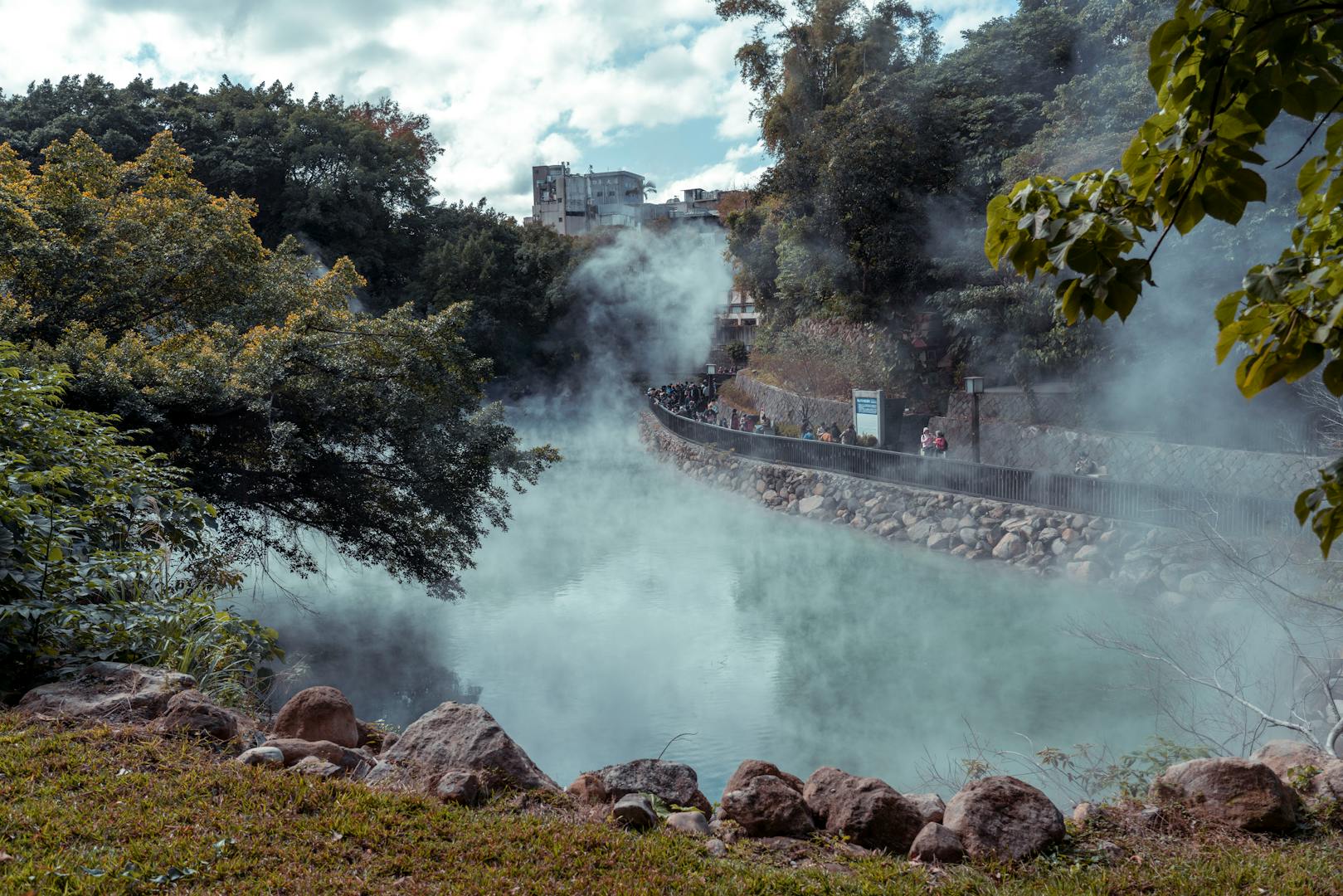
Hell Valley (Dihuagu, 地熱谷). The source of the green sulfur. A small, fenced thermal lake at 80-90 °C with steam rising constantly. Free to view from the walkway. The most striking visual in Beitou. 15 minutes.
Plum Garden. A small Japanese-era teahouse and garden, walking distance from the MRT.
Beitou Park. The valley park that runs between the MRT and the public baths. Connects most of the above attractions. Pleasant 15-minute walk along a stream.
Yangmingshan day trip. Buses run from Beitou up to Yangmingshan National Park – ideal combination is morning hike, afternoon soak, evening Taipei dinner.
Best Time to Visit Beitou
Beitou is a year-round destination but each season has a different character:
Winter (December-February): Peak season. Cool air (12-18 °C) and steaming-hot water are the classic hot spring contrast. Outdoor pools are magical. Hotels book up on weekends – reserve ahead.
Spring (March-May): Mild weather, fewer crowds. Cherry blossoms in March along the valley. Excellent shoulder-season conditions.
Summer (June-August): Hot and humid (28-33 °C). Outdoor pools less appealing; indoor and aircon-equipped private rooms are better. Strong rainy weather possible.
Autumn (September-November): Best month is November – cool dry weather, light crowds, comfortable air for outdoor pools. October can still have typhoon risk.
Within the day, the best soaking times are early morning (Longnaitang’s first session starts at 6:30am) for a quiet experience, or late afternoon to early evening (4-7pm) for the atmosphere and a sunset transition into night.
Day Plan: 6-Hour Beitou Itinerary
If you want to do Beitou as a half-day trip from central Taipei, this is the route we recommend in this Beitou hot springs guide. Avoid Mondays, when the museum and Hell Valley are closed, and Wednesdays, when Longnaitang is.
10am: MRT from your hotel to Xinbeitou Station. Walk into the valley along the Beitou Park stream.
10:30am: Beitou Hot Spring Museum (45 minutes).
11:30am: Walk uphill to Hell Valley to see the geothermal lake (15 minutes).
12pm: Lunch at one of the valley restaurants – Manlaide Onsen Ramen (literally a hot-pot ramen specialist) or one of the hotel restaurants for set lunch with bath access.
1:30pm: Soak. Choose your venue based on preference – Longnaitang for a traditional nude public bath (check the next session time at the door); Spring City or Sweetme for outdoor pools in swimsuits; Villa 32 or Gaia for a luxury day pass. Once the Millennium Hot Spring reopens, add it to the list.
4pm: Return to MRT, back to Taipei.
Total spend: the museum and Hell Valley are free; the bath costs anything from Longnaitang’s modest entry fee to NT$2,500 (Villa 32), plus NT$300-800 for lunch.
If Beitou’s sulphur is not for you, the obvious alternative is an hour away on the other side of the mountains. Jiaoxi’s water is clear and completely odourless, the foot baths in the middle of town are free, and the town has more hotels with hot spring water piped into the room than anywhere else within easy reach of Taipei. Our guide to Jiaoxi hot springs explains how the public baths, hotel pools and private rooms work.
There is much more to Beitou than the water. The 1913 public bathhouse is now the free Hot Spring Museum — a museum, not a place to bathe — the wooden Beitou Public Library is one of the loveliest buildings in the city, and Guandu’s temple and wetlands are three MRT stops away. Our Beitou district guide covers the valley walk, the hills and the latest on the Millennium Hot Spring’s renovation.
The classic way to earn a Beitou soak is to climb the mountain above it first. Qixing Mountain, Taipei’s highest peak at 1,120 metres, rises straight out of Yangmingshan National Park behind Beitou; climb it in the morning past the steaming fumaroles at Xiaoyoukeng, then take the bus down for an afternoon in the water. Our Qixing Mountain guide has the routes and bus connections.
Related Taipei guides
- Taipei 101 Observatory: Tickets, Tips & What to Expect
- Chiang Kai-shek Memorial Hall: Complete Visitor Guide
- National Palace Museum Taipei: Must-See Artifacts & Guide
- Longshan Temple Taipei: History, Etiquette & Tips
- Elephant Mountain Hike: Best Sunset in Taipei
- Maokong Gondola: Tea Plantations & Scenic Views
Frequently Asked Questions
How do I get to Beitou hot springs from Taipei?
Take the MRT Red Line (Tamsui-Xinyi) to Beitou Station, then transfer to the branch line one stop to Xinbeitou. Total travel time 30-40 minutes from Taipei Main Station, costs NT$35 with EasyCard. The Xinbeitou exit puts you at the heart of the hot spring district.
Are Beitou hot springs free?
Bathing is not free, but a public bath costs far less than a hotel. Longnaitang, the Japanese-era bathhouse on Guangming Road, is the budget choice – check the current price at the door. The open-air Millennium Hot Spring (NT$60 when open) has been closed for renovation since January 2025. Private hot spring hotels charge NT$800-3,500+ per person for day-use access. The sights are free: Hell Valley and the Hot Spring Museum, which is the old 1913 Public Bath – a museum now, not somewhere to bathe.
Do you have to be naked in Beitou hot springs?
Depends on the venue. Longnaitang, the traditional public bath, requires full nudity (gender-separated). The Millennium Hot Spring, closed for renovation since January 2025, was mixed-gender with swimsuits required. Private hotels usually offer both options – swimsuit for the mixed outdoor pools, nude for the gender-segregated indoor pools. Private in-room baths are your own choice.
Are tattoos allowed in Beitou hot springs?
Yes. Unlike many Japanese onsen, Beitou welcomes guests with tattoos at every public bath and hotel. No coverups or special arrangements are needed.
How long should I soak in a hot spring?
Total soaking time of 15-30 minutes in the hot pools is plenty for most people. Many regulars alternate between hot (10 minutes), cold plunge (1-2 minutes), and warm pools across a 2-hour session. The high-acidity green sulfur water is more intense; limit single sessions to 10-15 minutes.
What is the difference between Beitou’s hot springs?
Beitou has three water types: white sulfur (milky white, most common, mild), green sulfur (highly acidic, rising at Hell Valley), and iron sulfur (mineral-rich, rust-colored). Each has different claimed health effects, smells, and visual characteristics.
Are Beitou hot springs safe for kids?
Yes, with supervision. Most family-friendly hotels (Sweetme, Spring City) have mixed-gender pools that allow children with parents. The public baths are not designed for young kids. Limit kids to 5-10 minutes in the hot pools and prioritize the warmer (not hottest) pools. Babies under 6 months are generally not recommended.
Do Beitou hot springs require reservations?
Public baths operate on a time-slot basis but rarely require advance booking – just arrive at the start of a slot. Private hot spring hotels for overnight stays require booking 2-4 weeks ahead for weekends. Hourly day-use rooms at the better hotels (Villa 32, Gaia) should be booked at least a few days ahead, especially Friday-Sunday.
What is the best Beitou hot spring hotel?
Villa 32 is the consensus top choice for luxury – exceptional design, multiple pool types, full spa. Spring City Resort is the best mid-range family option. Asia Pacific is the best value private-room day-use option. For the most authentic local experience, skip the hotels and go to Longnaitang, the Japanese-era public bathhouse.
Can I visit Beitou hot springs in winter?
Yes – winter is the peak season for Beitou. The contrast between 12-15 °C air and 40-45 °C hot spring water is the classic experience. Hotels book up on winter weekends; reserve ahead. Indoor pools are an option if rain hits.
The Bottom Line
Following this Beitou hot springs guide, even first-time visitors can do the district like locals. Take the MRT to Xinbeitou, decide upfront whether you want communal authenticity with the locals at Longnaitang (closed Wednesdays) or NT$2,500 private luxury (Villa 32), respect the etiquette (shower first, no phones, quiet voices), and budget 3-6 hours total including museum and meals. The Millennium Hot Spring has been closed for renovation since January 2025, so check whether it has reopened before you count on it. Pair the hot springs with the Hot Spring Museum, Hell Valley, and a short walk through Beitou Park, and you have one of the best half-day trips available from any Asian capital. Bring a towel, leave the jewelry behind, and soak.