This article contains advertising. Our booking links are routed through a partner that adds commission tracking automatically, so if you book through one we earn a commission from the provider, at no extra cost to you. It never affects what we recommend. Affiliate disclosure
Standing at the eastern end of Liberty Square, the Chiang Kai-shek Memorial Hall is one of Taipei’s major landmarks and visitor attractions. The white-and-blue marble building, the 89 steps leading to the main entrance, the panoramic view across a plaza of more than 240,000 square meters, the honor guard drilling on Democracy Boulevard below the steps — it earns its place on a first-time itinerary, and it is more impressive in person than in photos.
The hall is also more layered than its postcard image. Built in 1980 as a memorial to Taiwan’s long-time autocratic leader, it later became a stage for the island’s democracy movement: in 1990 the Wild Lily student movement gathered on the square. (The 2014 Sunflower Movement, often mentioned alongside it, centred on the occupation of the Legislative Yuan.) The plaza was rededicated as Liberty Square in 2007. Since July 2024 the honor guard no longer stands in the upstairs statue hall; its drill now takes place outdoors on Democracy Boulevard. For travelers, this means a visit is part architecture, part military pageantry, part Taiwanese-political history lesson — all in one morning.
This guide is the practical one for visiting Chiang Kai-shek Memorial Hall in 2026: opening hours, the changing of the guard schedule, how to get there, what to see beyond the main hall, the history behind the building, and the small details that make a visit better than a quick tour-bus drive-by. By the end, you’ll know exactly how to plan a satisfying 90 minutes here.

Chiang Kai-shek Memorial Hall at a Glance
- Address: No. 21, Zhongshan South Road, Zhongzheng District, Taipei City
- Hours: 9:00 AM – 6:00 PM daily (occasional closures for events, maintenance, public holidays)
- Admission: see the memorial hall’s website for the hall, museum and special exhibitions
- Get there: MRT to Chiang Kai-shek Memorial Hall Station (Red Tamsui-Xinyi Line or Green Songshan-Xindian Line)
- Changing of the guard: Held outdoors on Democracy Boulevard, below the main hall’s front steps (since July 15, 2024), through the day except in rain; times on the memorial hall’s website
- Time needed: 90 minutes for a thorough visit; 45 minutes for a quick visit
- Best time to visit: Mid-morning or late afternoon
What Is Chiang Kai-shek Memorial Hall?
The Chiang Kai-shek Memorial Hall is a white marble memorial building completed in 1980 to honor Chiang Kai-shek, the Republic of China leader who governed Taiwan under martial law from 1949 until his death in 1975. The hall sits at the eastern end of Liberty Square, a vast public plaza covering more than 240,000 square meters.
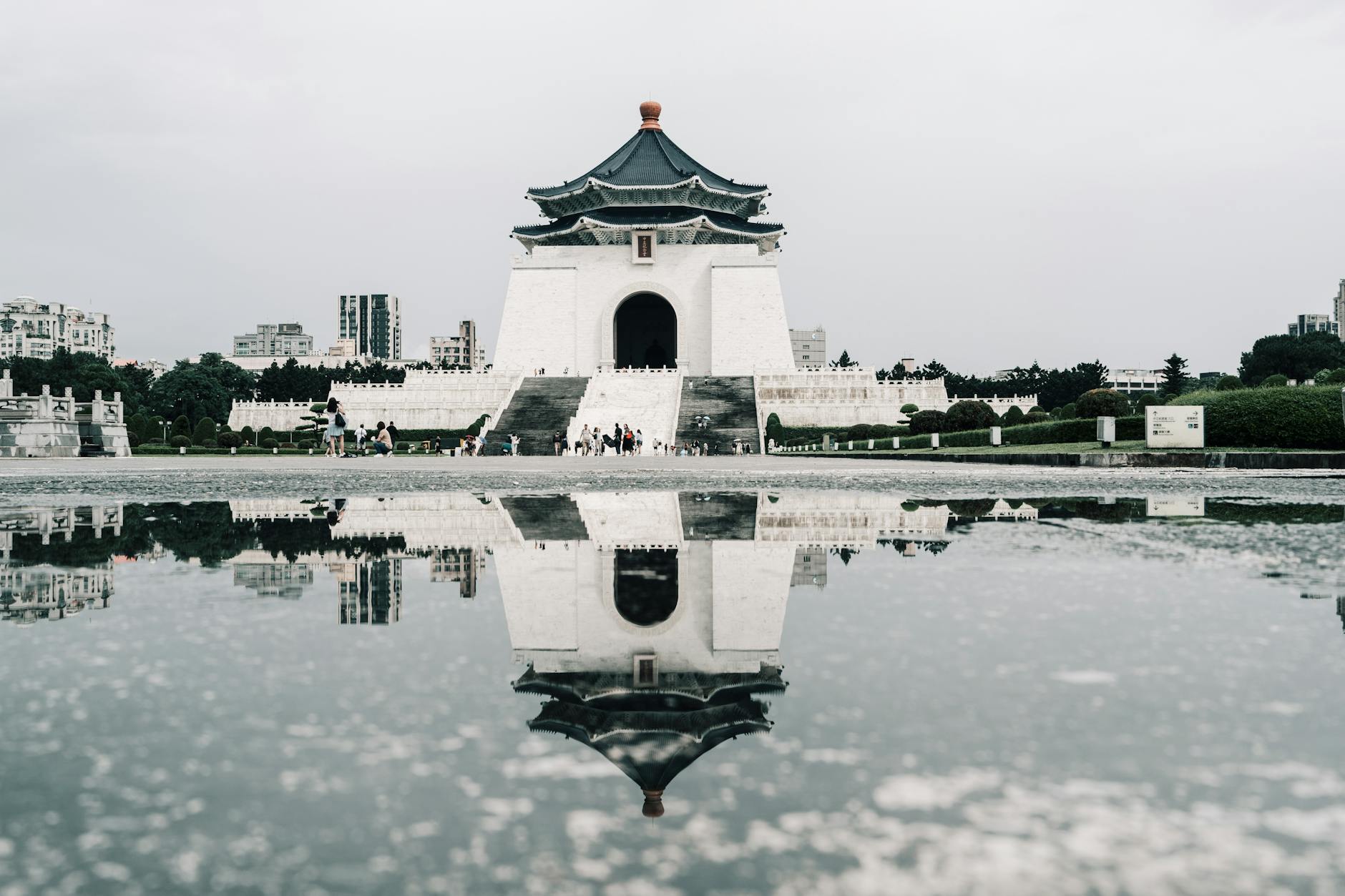
The building’s design draws explicitly on classical Chinese architecture: a four-sided white marble base topped with a blue octagonal roof. The number 8 (the number of sides on the roof, 89 steps to the entrance) carries traditional symbolism of abundance and prosperity. The 89 steps specifically represent Chiang’s age at his death.
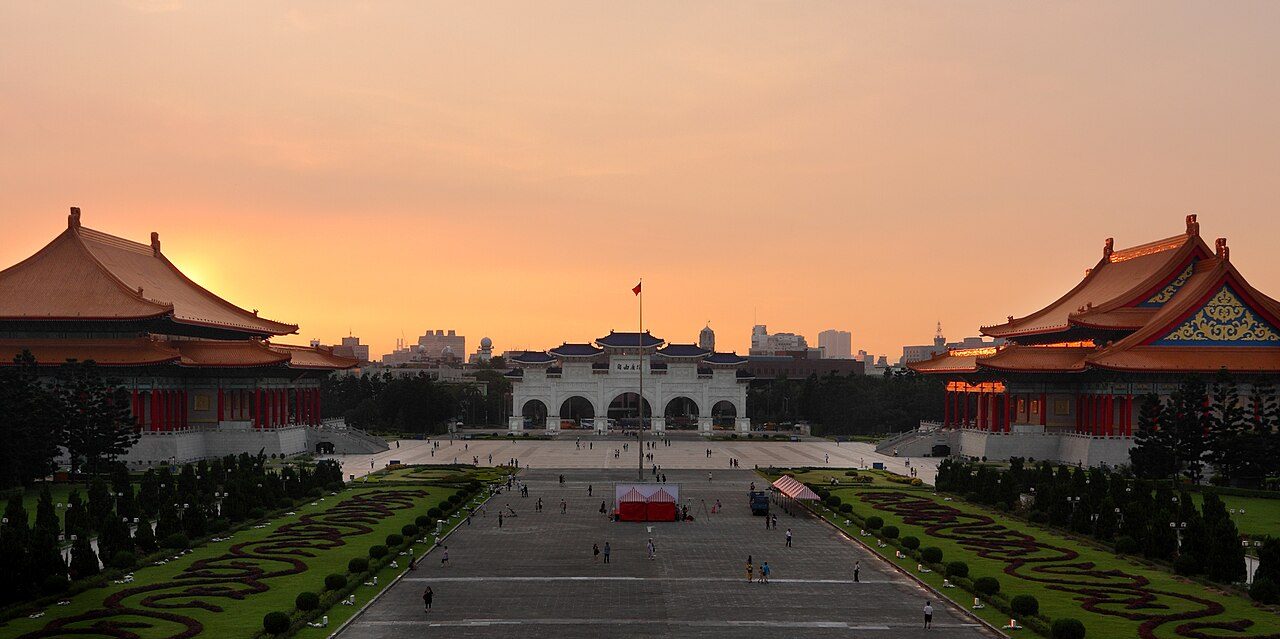
The plaza around the hall includes the twin National Theater and National Concert Hall buildings (both 1987, in traditional Chinese palace style) and the large entry archway bearing the inscription “Liberty Square” (自由廣場).
Hours and Opening Times
The Memorial Hall and grounds operate on different schedules:
- Memorial Hall building (interior): 9:00 AM – 6:00 PM daily.
- Liberty Square (outdoor plaza): Not open round the clock; the park keeps set hours, so check the memorial hall’s website before an early-morning or late-night visit.
- Park gardens: Open daily from early morning to late evening.
Closed on: Lunar New Year’s Eve and Lunar New Year’s Day, 228 Peace Memorial Day (February 28), occasional maintenance days, and during major typhoons or government events. The official Chiang Kai-shek Memorial Hall website publishes the closure calendar.
The Changing of the Guard Ceremony
The changing of the guard is the headline visitor experience and worth timing your visit around. The ceremony involves three honor-guard soldiers (rotating between the Army, Navy, and Air Force, with each branch wearing distinctive uniforms) performing a precise, slow-motion drill featuring rifle handling, marching, and saluting. The drill itself is short, so be in place before it starts.
2026 schedule:
- Times: Roughly hourly during the day, and called off in rain; check the memorial hall’s website for the day’s schedule
- Location: Democracy Boulevard, below the main hall’s front steps (moved from the upstairs statue room in July 2024)
- Best viewing spot: Arrive 5–10 minutes early and stand near the front of the rope barrier for an unobstructed view
In July 2024 the drill moved from the upstairs statue room to Democracy Boulevard, below the main hall’s front steps. The ceremony itself is unchanged — the location is what shifted.
Honor guard rotation: The three branches rotate every few months. The Army wears olive-green uniforms with black helmets; the Navy wears white with white helmets; the Air Force wears light blue with light blue helmets. If you visit multiple times in a year, you may see different uniforms.
How to Get to Chiang Kai-shek Memorial Hall
The MRT is by far the easiest way. Chiang Kai-shek Memorial Hall Station is served by both the Red (Tamsui-Xinyi) Line and the Green (Songshan-Xindian) Line, making it one of the most accessible spots in the city.
- From Taipei Main Station: Red Line, 3 minutes (2 stops south)
- From Ximending: Green Line toward Xindian, 3 minutes (2 stops)
- From Taipei 101: Red Line toward Tamsui or Beitou, 10 minutes (5 stops)
- From the airport: Airport MRT to Taipei Main Station, then transfer to the Red Line south
Use Exit 5 for direct access to Liberty Square and the main entry archway. By taxi from most central neighborhoods, expect NT$150–300.
What to See at Chiang Kai-shek Memorial Hall
The Main Hall and Statue
Climb the 89 steps to the main entrance. Inside the upper-floor main hall is a 6.3-meter-tall bronze seated statue of Chiang Kai-shek. The hall is open 9:00 AM – 6:00 PM, apart from announced closures. The honor guard used to stand in this hall; since July 2024 its drill has been held outdoors on Democracy Boulevard instead. Photography is permitted.
The Museum (Lower Levels)
The ground level houses a museum and exhibition spaces documenting Chiang Kai-shek’s life and political career, plus rotating exhibitions on Taiwan’s modern history. The exhibits include personal artifacts (a black Cadillac that belonged to Chiang, his uniforms and medals), biographical timelines, photographs, and historical documents. English signage is good. Allow 30–45 minutes.
Liberty Square
The plaza in front of the hall covers more than 240,000 square meters, so allow time to walk its full length, from the entry archway to the steps. The square is both a tourist attraction and a working public space — locals practice tai chi here in the morning, students roller-skate in the afternoon, and major political rallies have happened here for the last 40 years.
The National Theater and National Concert Hall
The twin buildings flanking the square (1987) are major performing arts venues. Both are designed in traditional Chinese palace style with red columns, yellow tile roofs, and intricate decorative details. Tours of the buildings are occasionally offered; concerts and theater performances are regular and tickets can be purchased online or at the venue. Even if you don’t see a show, walking the colonnaded entrances is photogenic.
Gardens, Ponds, and Parks
The grounds around the hall include manicured gardens, two reflecting ponds (the lower-level ponds are particularly photogenic in golden hour), seasonal flower displays, and shaded walking paths. Cherry blossom trees bloom briefly in February-March; azaleas in March-April. The gardens are popular with local families on weekend afternoons.
Best Time to Visit Chiang Kai-shek Memorial Hall
The site is rarely truly crowded except during peak public holidays, but the experience varies meaningfully by time:
Best time of day: 9:00 AM, right at opening, or late afternoon for golden-hour photography across the plaza. Check the memorial hall’s website for the day’s guard times.
Worst time: Saturday and Sunday afternoons during peak tourist season (December and Lunar New Year), when school groups and tour buses cluster.
Best season: Cherry blossoms make February–March a photo-worthy window. Spring (March–April) and autumn (October–November) generally have the best weather.
Best photo conditions: Just after a rain, when the marble is wet and reflective. Or at sunset, when the orange light hits the white marble.
The History Behind the Hall
Understanding the hall makes the visit better. A short version:
Chiang Kai-shek (1887–1975) led the Republic of China government, lost the Chinese Civil War to Mao Zedong’s Communist forces in 1949, and retreated to Taiwan, where he ruled as president under martial law until his death. His government founded modern Taiwan and is credited with its rapid economic development, but it also imposed authoritarian rule, suppressed Taiwanese identity and language, and conducted extensive political repression (the “White Terror” period).
After his death, the construction of the memorial was approved by the Executive Yuan, designed by architect Yang Cho-cheng, and completed in 1980. The design was modeled on Sun Yat-sen’s Mausoleum in Nanjing, China.
From the late 1980s and through the 1990s, the plaza became Taiwan’s most important political space. The 1990 Wild Lily Student Movement took place here, with students pressing for political reform, and the square went on to host democracy rallies through the decade; the movement helped lead to the direct presidential elections that began in 1996.
In 2007, then-President Chen Shui-bian rededicated the plaza as “Liberty Square” (自由廣場), with the new name engraved on the entry archway. The hall’s original “Da Zhong Zhi Zheng” archway inscription was changed to “Liberty Square” — a politically charged gesture by a DPP president acknowledging the plaza’s role in democratic transition.
On July 15, 2024, the honor guard stopped standing in the upper-floor statue hall; its drill is now held outdoors on Democracy Boulevard, below the main hall’s front steps. Current public discussion includes ongoing debate about the hall’s future role, balancing history, transitional justice, and the building’s importance as a public space.
What to Combine with a Visit
The memorial hall sits in a great location for combining with other Taipei stops:
Yongkang Street (永康街): A short walk southeast. Taipei’s famous food street — Din Tai Fung, Yong Kang Beef Noodles, mango shaved ice, and dozens of cafés. Perfect lunch stop.
Da’an Forest Park: Plot the route on a map app from whichever gate you leave by. Taipei’s “Central Park,” good for an hour of green space.
Huashan 1914 Creative Park: North of the memorial; walk it or take a short taxi ride. A converted Japanese-era winery turned creative arts complex, with galleries, design shops, and cafés.
Bopiliao Historic Block: Green Line to Ximen, change to the Blue Line for Longshan Temple, then walk to the block. The most-preserved 19th-century shophouse street in Taipei.
Taipei 101: 10 minutes by Red Line MRT south.
A standard half-day combination: arrive at the memorial at 9:00 AM, watch the changing of the guard, see the museum and statue, walk to Yongkang Street for lunch around noon, and finish with Da’an Forest Park or Taipei 101 in the afternoon.
Tips for a Better Visit
Arrive 5–10 minutes early if you want a good spot for the changing of the guard. Stand near the front on Democracy Boulevard, below the main hall’s steps.
Bring a camera with a wide-angle lens. The hall and plaza are vast — phone cameras work fine but wide-angle gear gets the iconic compositions.
The reflecting ponds are best photographed in late afternoon. Walk down to the lower paths around the ponds.
Sunset on the steps is a photographer’s classic. The hall faces west, so the marble glows orange around dusk.
Wheelchairs and strollers welcome. Liberty Square is fully accessible, and the hall has an accessible elevator.
Don’t expect food or coffee inside the hall. A small café is in the lower museum level, but most visitors save meals for nearby Yongkang Street.
Photography is permitted throughout the building and grounds. The honor-guard ceremony can be photographed (and even filmed); just don’t cross the rope barriers.
Bathrooms are available on the lower museum level — clean and free.
Common Mistakes
Arriving late and missing the ceremony. The drill is short, so check the day’s times on the memorial hall’s website and be in place a few minutes early.
Climbing the 89 steps and skipping the museum. The ground-level museum is more interesting than most visitors expect.
Not walking the full plaza. Many visitors photograph the hall from the steps and leave. The opposite end of Liberty Square (the entry archway with the “Liberty Square” inscription) is the better classic photo angle.
Visiting during a typhoon. The memorial closes during severe weather. Check the official site if a typhoon warning is active.
Skipping it because it’s “old-school authoritarian iconography.” The site has substantial democratic-transition history and is one of Taipei’s important public spaces. Visit, then form your own view.
The memorial hall and Yongkang Street make a natural pair: a short walk southeast from the plaza brings you to the original Din Tai Fung, Sichuan-style beef noodles and the mango ice that made the street famous. Our Yongkang Street guide explains what to order and how to avoid the worst of the queues.
The memorial hall is only one part of a remarkable few square kilometres. Nearby, you can tour the Presidential Office for free on weekday mornings (9:00 AM to noon, entering before 11:30 AM) with valid photo ID, and 228 Peace Memorial Park holds the Taipei 228 Memorial Museum, with the National Taiwan Museum, Taiwan’s oldest, at its north entrance. Our Zhongzheng District guide links them into a day.
Related Taipei guides
- National Palace Museum Taipei: Must-See Artifacts & Guide
- Longshan Temple Taipei: History, Etiquette & Tips
- Elephant Mountain Hike: Best Sunset in Taipei
- Beitou Hot Springs Guide: Public & Private Baths
- Yangmingshan National Park: Trails, Flowers & Hot Springs
- Maokong Gondola: Tea Plantations & Scenic Views
- Best Things to Do in Taipei: Top 25 Activities
Frequently Asked Questions
Is Chiang Kai-shek Memorial Hall free?
Admission details for the hall, the museum and any special exhibitions are on the memorial hall’s official website, so check there before you go. Liberty Square is an open public park, though it keeps set opening hours.
What time is the changing of the guard at Chiang Kai-shek Memorial Hall?
The honor guard drill runs roughly once an hour during the day, but not in rain, and the hall’s official website lists the times. Since July 15, 2024 it has been held outdoors on Democracy Boulevard, below the main hall’s front steps, rather than in the upstairs statue hall.
How do I get to Chiang Kai-shek Memorial Hall?
Take the Taipei MRT to Chiang Kai-shek Memorial Hall Station (Red or Green Line). Use Exit 5 for direct plaza access. From Taipei Main Station the train ride is 3 minutes.
How long does it take to visit Chiang Kai-shek Memorial Hall?
90 minutes for a thorough visit including the museum, statue, changing of the guard, and a walk around the plaza. 45 minutes for a quick stop.
Is Chiang Kai-shek Memorial Hall worth visiting?
Yes — it’s a photogenic and historically important Taipei landmark. The architecture, the changing of the guard ceremony, the museum, and the wider Liberty Square plaza together make for a 90-minute visit that anchors most first-time itineraries.
Can I take photos at Chiang Kai-shek Memorial Hall?
Yes. Photography is allowed throughout the hall, the museum, the statue room, and the outdoor plaza. The changing of the guard can be photographed from behind the rope barriers.
What are the hours of Chiang Kai-shek Memorial Hall?
The hall building is open 9:00 AM to 6:00 PM daily, with closures for Lunar New Year, 228 Peace Memorial Day, and occasional maintenance. Liberty Square (outdoor) keeps its own opening hours and closes overnight.
What is Liberty Square?
Liberty Square is the public plaza, more than 240,000 square meters in size, in front of Chiang Kai-shek Memorial Hall. It was rededicated as Liberty Square in 2007 to mark Taiwan’s transition to democracy. The 1990 Wild Lily Student Movement gathered here.
Where did the changing of the guard move to in 2024?
From 15 July 2024 the honor guard no longer stands in the upstairs statue hall. The drill is held outdoors on Democracy Boulevard, below the main hall’s front steps. The ceremony itself is unchanged; the venue is what shifted.
Final Take
The Chiang Kai-shek Memorial Hall is one of those rare attractions that’s photogenic, historically rich, and centrally located — and somehow still surprises most first-time visitors with how much there is to see. Check the day’s guard times on the memorial hall’s website, walk the museum on the lower floor, photograph the reflecting ponds, then head to Yongkang Street for lunch. 90 minutes well spent on any Taipei itinerary.