This article contains advertising. Our booking links are routed through a partner that adds commission tracking automatically, so if you book through one we earn a commission from the provider, at no extra cost to you. It never affects what we recommend. Affiliate disclosure
Ride the little branch train into Xinbeitou on a cold winter evening and you can smell where you are before the doors open: a faint whiff of sulphur, drifting down the valley from a lake that steams like a kettle. Taipei sits on the edge of a volcanic field, and the heat that built Yangmingshan still leaks out of the ground all around the city — in Beitou’s sulphur springs, in the clear, silky water of Wulai’s river gorge, in the flat-land springs of Jiaoxi an hour away, and in a string of smaller spots along the coast. Taipei hot springs are one of the great, underrated pleasures of a trip here: cheap, easy to reach by metro, bus and train, and at their best in exactly the months when the rest of the city is grey and damp.
This guide is the overview: the main hot spring areas around Taipei and how they differ, the kinds of water, the different ways to bathe (from free foot baths to private rooms), what it all costs, the etiquette nobody explains, what has closed or changed recently, and which to choose for your trip. For the detail on each place, follow the links to our guides to Beitou hot springs, Wulai and Jiaoxi. Prices and opening details were checked in October 2026; treat them as the right order of magnitude and check before you go.
Taipei hot springs at a glance
| Area | Water | From central Taipei | Best for |
|---|---|---|---|
| Beitou | Sulphur, including rare acidic “green sulphur” | About 30 minutes from Taipei Main Station by MRT | An easy evening soak, history and the Thermal Valley |
| Yangmingshan and Xingyi Road | Sulphur | By bus or taxi from the nearest MRT station | Combining a mountain hike with a bath |
| Wulai | Clear, odourless sodium bicarbonate | About an hour by MRT and bus | A river gorge setting, Atayal culture and a waterfall |
| Jiaoxi | Clear, odourless sodium bicarbonate | About an hour to 80 minutes by bus; check the timetable | Foot baths, cheap public baths, an overnight stay |
| Jinshan | Varied, including iron-rich water | An hour or more by bus | Pairing a soak with the north coast |
| Su’ao | A rare carbonated cold spring | About two hours by train | Something different on a Yilan trip |
What things cost
| Type of bath | Typical cost (September 2026) |
|---|---|
| Public foot baths (Jiaoxi and elsewhere) | Free |
| Public bathhouse, gender-separated | Roughly NT$80–250, e.g. Tangweigou in Jiaoxi about NT$80, Jiaoxi’s Forest Hot Spring NT$250 |
| Beitou’s open-air Millennium Hot Spring (when open) | NT$60, concessions NT$30 — closed for renovation since January 2025 |
| Hotel public pools, day use | From a few hundred NT$ at simple places to well over NT$1,000 at resorts |
| Private hot spring room (湯屋), rented by the hour | Varies widely by hotel, day and time; weekends cost more |
| A night in a hotel with a hot spring tub in the room | Varies with the season; book ahead for winter weekends |
| Towel, cap or locker at a public bath | A small extra, usually tens of NT$ |
Why Taipei is a hot spring city
Taiwan sits where two tectonic plates collide, and the island is dotted with more than a hundred hot spring sources. Around Taipei, the heat comes mostly from the Datun volcano group — the dormant volcanoes of Yangmingshan on the city’s northern edge — where fumaroles still hiss at Xiaoyoukeng and Beitou’s Thermal Valley steams day and night. Other springs, such as Wulai’s and Jiaoxi’s, rise not from volcanoes but from deep faults, where groundwater is heated far below the surface and forced back up.
People have bathed in these waters for centuries, but modern bathing culture arrived with the Japanese, who governed Taiwan from 1895 to 1945 and brought their love of the onsen with them. They built a grand public bathhouse in Beitou in 1913, developed inns and resorts around it, and turned hot spring bathing into a national pastime. The Japanese-style rules — shower first, bathe naked in single-sex pools, keep quiet — still shape the public baths today, while Taiwan has added its own traditions: family bathing in private rooms, hot spring hotels with tubs in every bedroom, and a whole cuisine of hot-spring-poached eggs and vegetables.
Understanding the water
The springs around Taipei fall into a few broad types, and they feel quite different:
- Sulphur springs (Beitou, Yangmingshan) — the classic volcanic spring: milky or pale green, strong-smelling, often acidic, and quick to tarnish silver jewellery. Beitou’s rare acidic “green sulphur” water deposits a mineral called hokutolite, named after Beitou and otherwise found only at Tamagawa Onsen in Japan. Beitou also has milder “white sulphur” and iron-bearing water; our Beitou guide explains the differences.
- Sodium bicarbonate springs (Wulai, Jiaoxi) — clear, odourless and gentle, with a slippery, silky feel that gives them their reputation as “beauty springs”. The easiest water for first-timers and children.
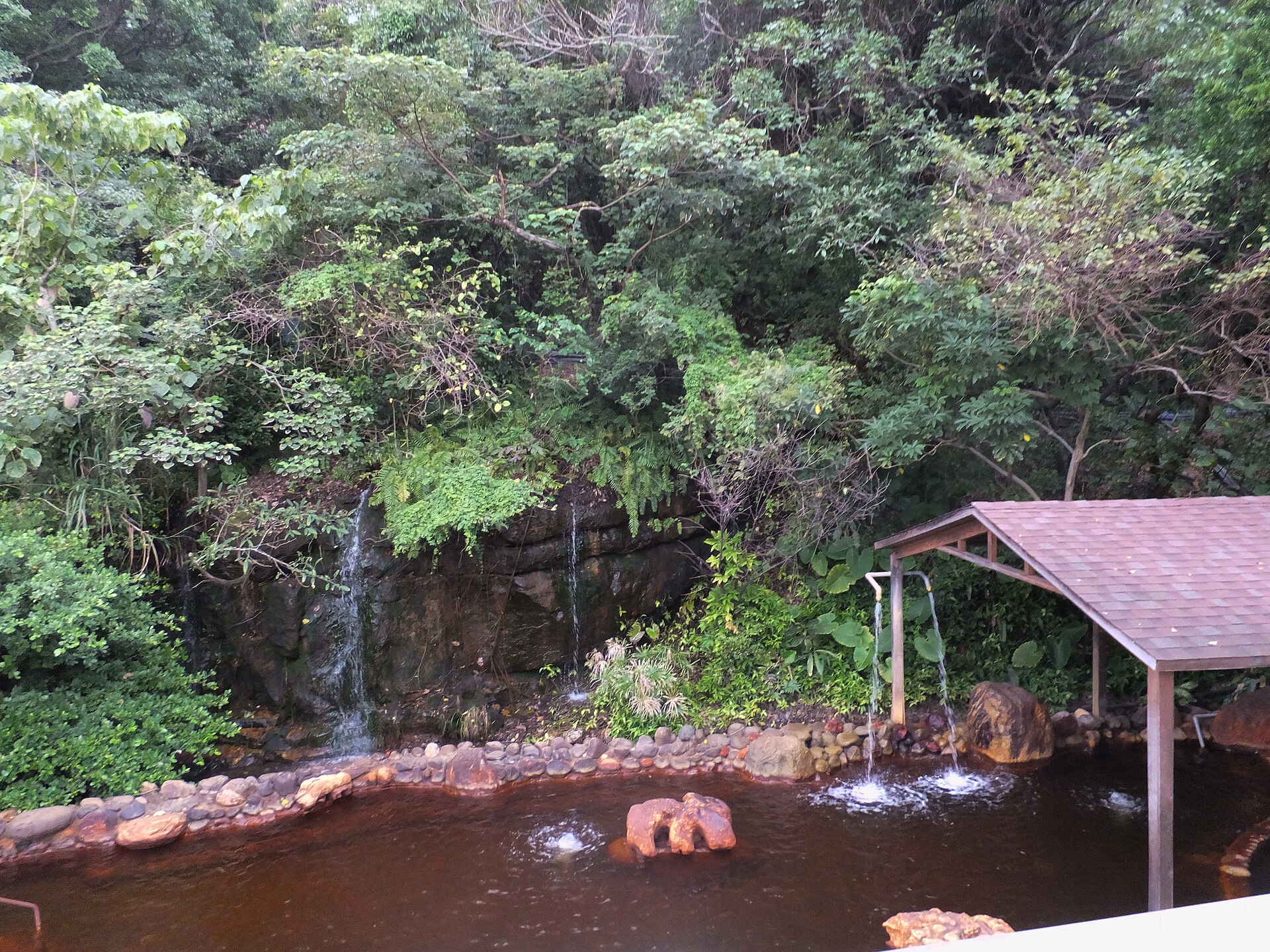
- Iron-rich and mixed springs (Jinshan and parts of Beitou) — the water oxidises to a rusty orange-brown in the pool. It stains towels, so do not bring your best one.
- Carbonated cold springs (Su’ao) — not hot at all, but naturally fizzy, cool water that fills with tiny bubbles as you sit in it. A rarity.
Claims about the health benefits of each type are everywhere, from eczema to arthritis. Enjoy the warmth and the ritual; treat the medical claims with a pinch of salt.
Beitou: the classic
Beitou, at the end of a short MRT branch line from Beitou station to Xinbeitou, is Taipei’s hot spring district, and for most visitors it is the obvious first choice. The valley below Yangmingshan is lined with bathhouses, hotels and Japanese-era buildings, and the streams running through Beitou Park steam in winter. Our Beitou hot springs guide covers where to bathe in detail, and our Beitou District guide the rest of the neighbourhood. What you need to know before you go:
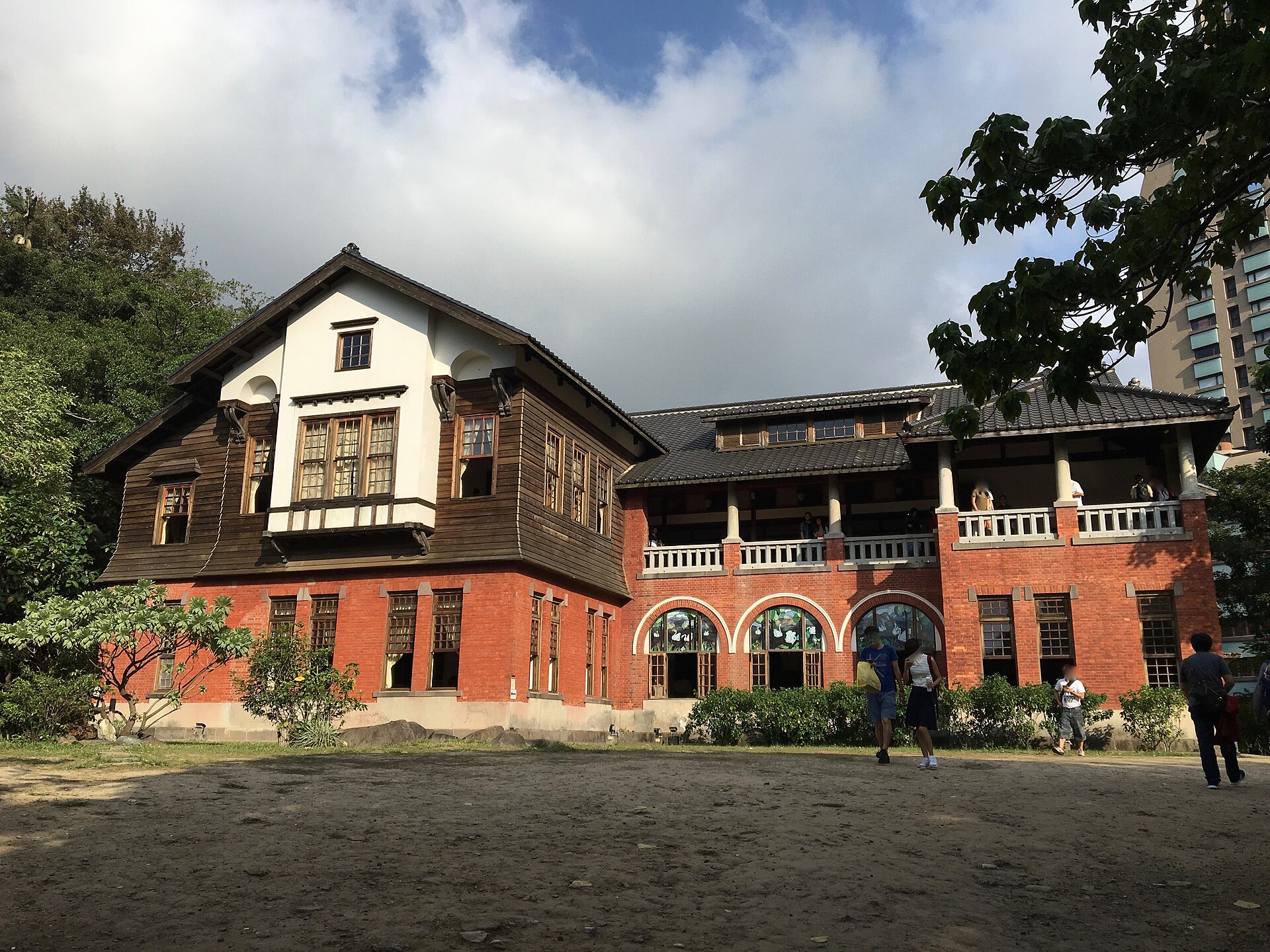
- The 1913 public bathhouse is a museum, not a bath. The handsome brick-and-timber building in Beitou Park is the Beitou Hot Spring Museum — free, open Tuesday to Sunday 10:00–18:00, and well worth an hour. You cannot bathe there.
- The Millennium Hot Spring is closed. Beitou’s famous cheap open-air public pool (千禧湯), NT$60 when open, closed on 24 January 2025 for a long renovation after years of sulphur corrosion. The works were scheduled to finish in 2026, with a reopening date to be announced by the Taipei Parks and Street Lights Office (pkl.gov.taipei). Check before you plan around it.
- The cheap alternative is Longnaitang. Longnaitang (瀧乃湯), on Guangming Road, an 8–10 minute walk from Xinbeitou station, is one of the oldest bathhouses in Beitou: plain, local and nude, with gender-separated pools. It opens Thursday to Tuesday (closed Wednesdays) in three sessions a day between 06:30 and 21:00, and also has private rooms in the afternoon. Check the price board at the door.
- Hotels do the rest. Dozens of hotels, from simple inns to design resorts, sell day use of their public pools and rent private rooms by the hour.
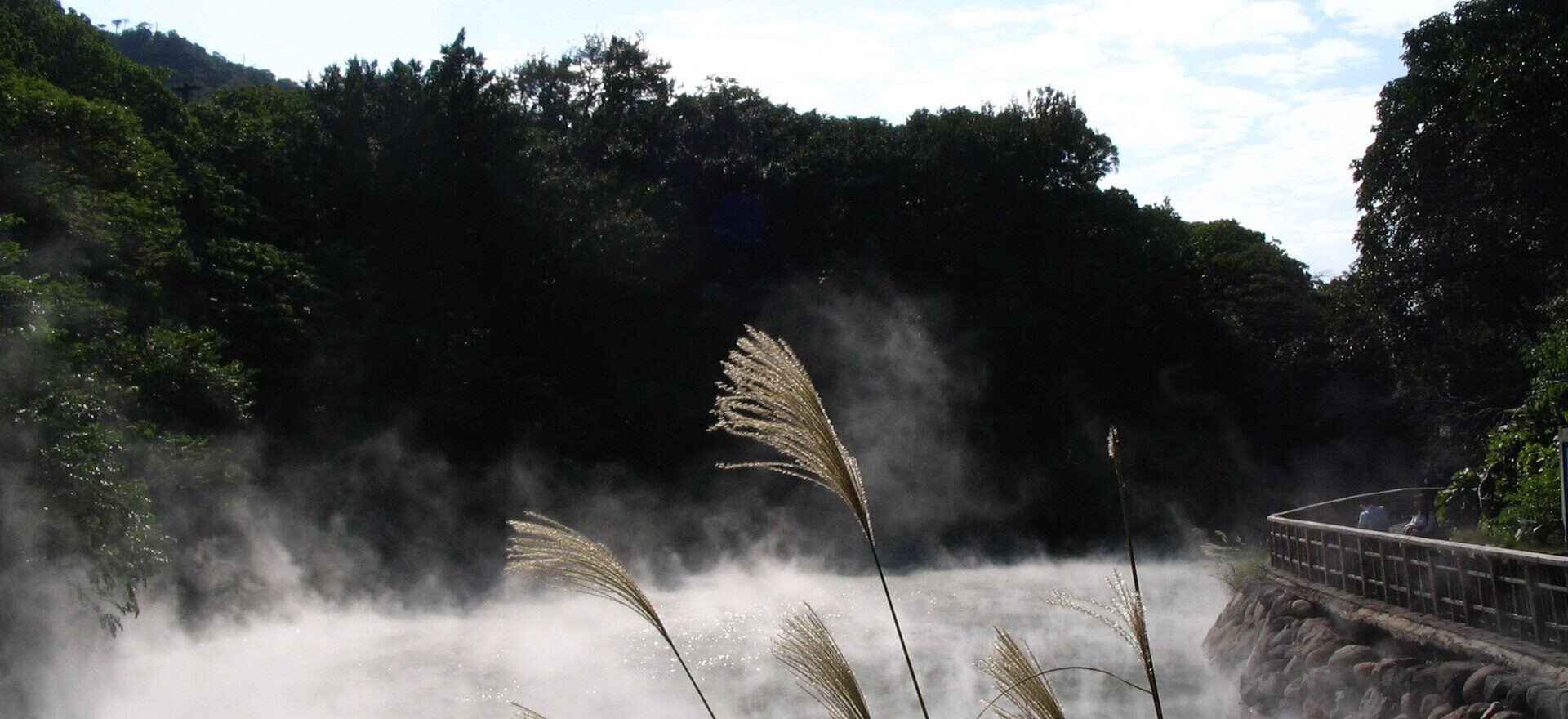
- See the source. The Thermal Valley (地熱谷), a steaming green lake at the head of the valley, can be viewed from its walkway (Tuesday to Sunday 09:00–17:00, closed Mondays). You cannot bathe in it — the water is close to boiling.
Beitou is also the natural end to a day on Yangmingshan: climb Qixing Mountain in the morning and take the bus down for an afternoon soak.
Yangmingshan and Xingyi Road
Above Beitou, the volcanic slopes of Yangmingshan have springs of their own. Lengshuikeng (冷水坑), on the eastern side of Qixing Mountain, has long had a simple public bath and a foot-soaking pool popular with walkers coming off the trail; opening arrangements have changed over the years, so ask at the Lengshuikeng visitor centre before counting on a soak. Our guide to Yangmingshan National Park covers the area.
On the lower slopes between Shipai and Beitou, Xingyi Road (行義路) is known for its hot spring restaurants, which pair a pool or private room with a meal. It is a very local experience — families and groups of friends making a night of it — and best reached by taxi or bus from Shipai station. Prices and quality vary widely from one to the next; look at the pools before you pay.
Wulai: hot springs in a river gorge
Wulai (烏來), an Atayal village in the mountains south of the city, has the most beautiful setting of any hot spring near Taipei: a steep, forested gorge where two rivers meet, with a waterfall a short walk away. Its water is clear and odourless, and the village’s hotels pipe it into indoor and outdoor pools overlooking the river. Our Wulai day trip guide covers the bus from Xindian, the old street, the waterfall and where to bathe.
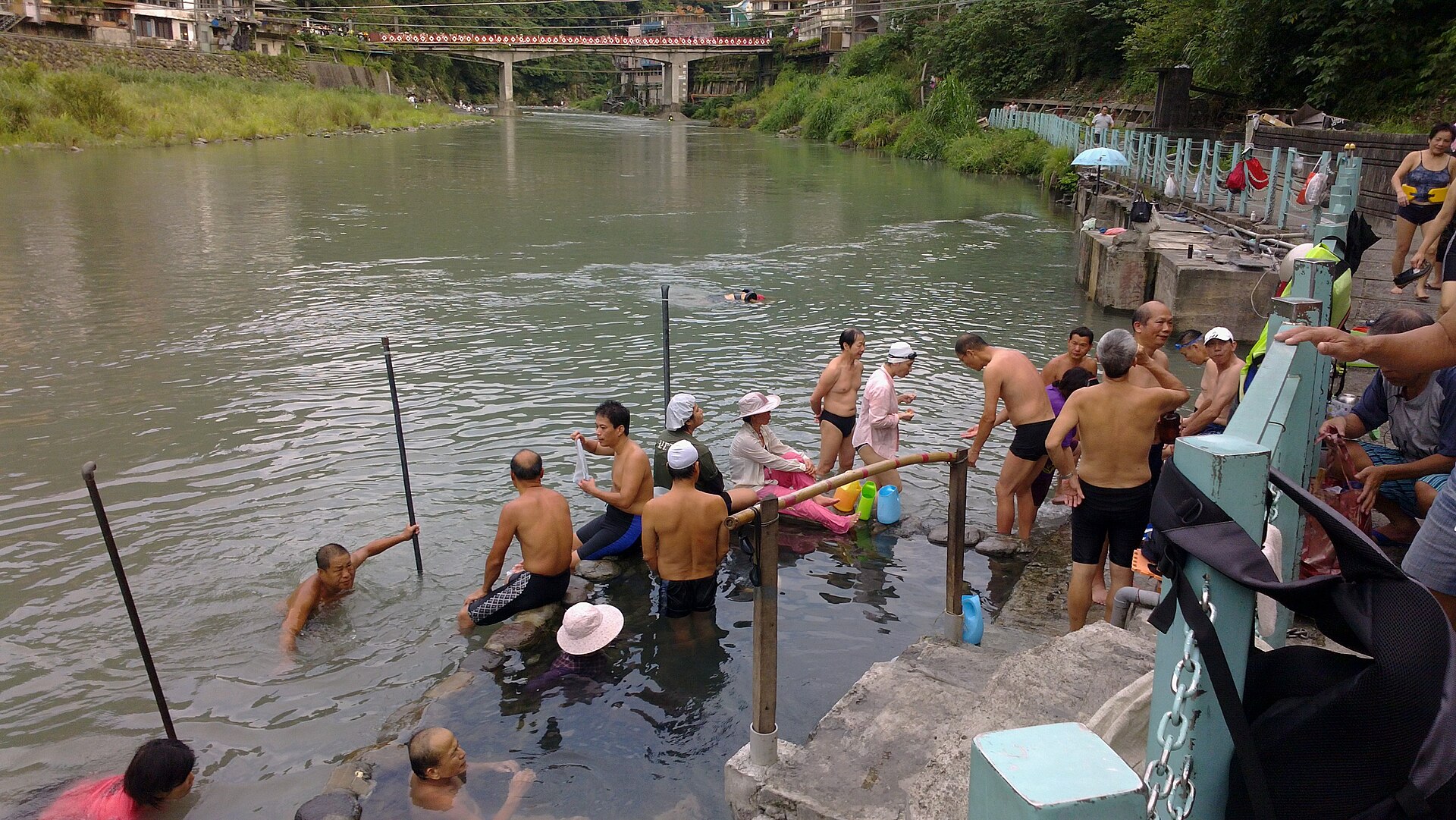
One important change: Wulai was once famous for free rock pools on the riverbank below the old street, where hot spring water mixed with the river. New Taipei cleared them in 2017, and bathing in the riverbed is now banned. Some older guides and blogs still recommend them. Soak in a hotel or bathhouse instead — the rivers here also rise fast after rain, which is one reason the pools were closed.
Jiaoxi: the easiest good hot spring
A bus ride from Taipei through the Hsuehshan Tunnel, Jiaoxi (礁溪) in Yilan County is a whole town built on hot water. Its springs rise on the flat plain rather than in the mountains, and the water is clear, odourless and hot. Jiaoxi’s great advantage is how easy it makes things: public foot baths in two town-centre parks, two cheap public bathhouses, and many hotels with hot spring water piped into the rooms.
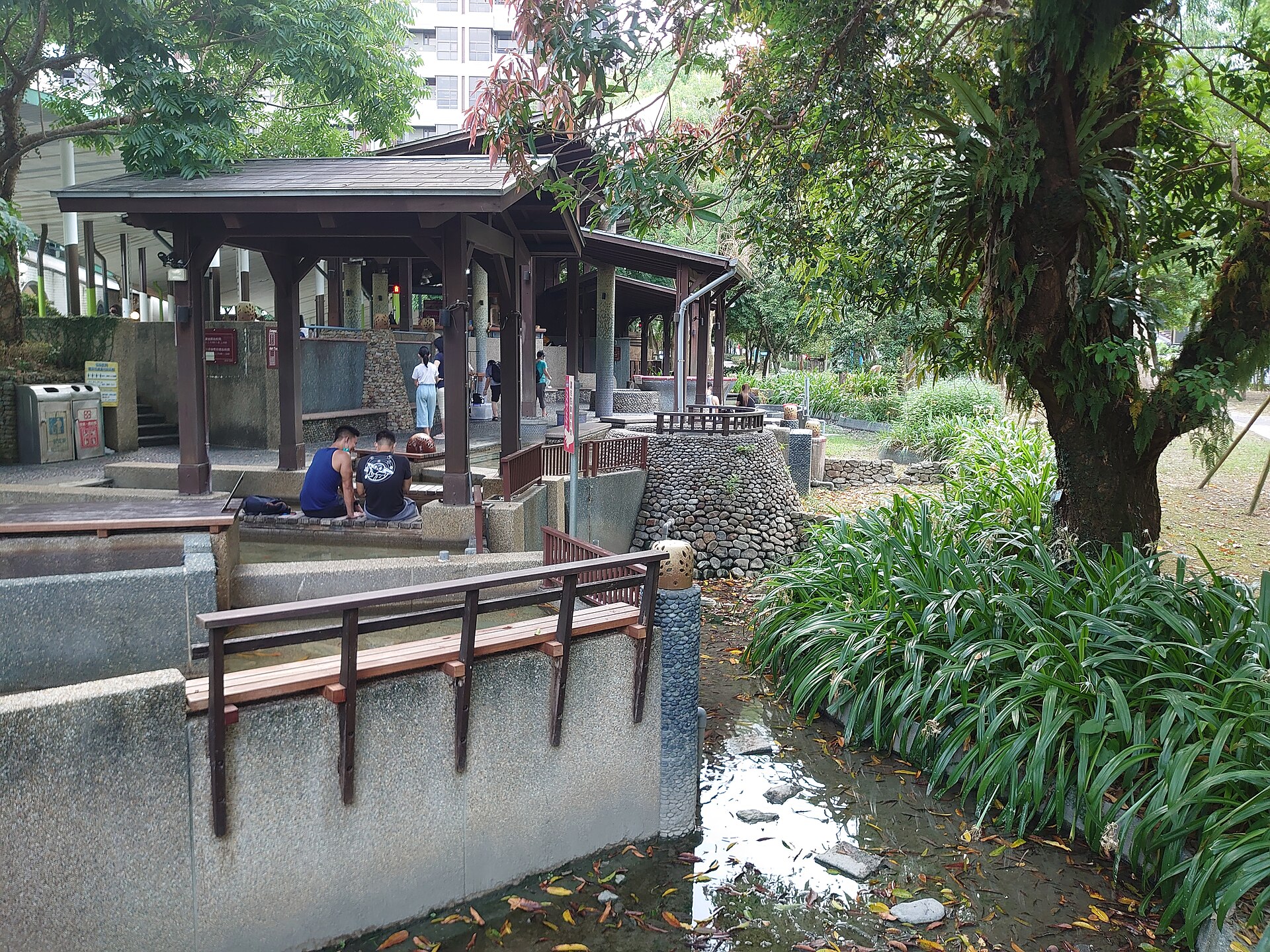
- Foot baths at Jiaoxi Hot Spring Park, open until 22:00, and at Tangweigou Hot Spring Park near the station.
- Public baths: the gender-separated Forest Hot Spring in Jiaoxi Hot Spring Park (NT$250, open 08:00–24:00) and the cheaper Tangweigou bathhouse (around NT$80).
- Getting there: Kamalan bus 1915 from Taipei Bus Station or the Technology Building MRT station, or Capital Star 1572 from Taipei City Hall, take roughly an hour to 80 minutes depending on traffic; trains also run from Taipei to Jiaoxi. Check the operators’ timetables before you go.
Our Jiaoxi hot springs guide has the full detail, including the bathing etiquette and the waterfall walk nearby, and our guide to Yilan from Taipei covers the county.
Jinshan: hot springs by the sea
On the north coast, Jinshan (金山) is a small seaside town known for three things: its old street, its famous duck, and its hot springs. The water here comes in several types, including iron-rich springs that turn the pools a deep rusty orange, and a number of hotels have baths looking out towards the ocean. It is quieter and less polished than Beitou, and it pairs naturally with a day on the coast — the beaches of the north coast, Yehliu Geopark, the Juming Museum’s sculpture park — all linked by the 716 tourist shuttle from Tamsui.
Su’ao: the cold spring
At the southern end of the Yilan plain, the port town of Su’ao (蘇澳) has something very unusual: a carbonated cold spring (蘇澳冷泉), where naturally fizzy water rises at a cool 22°C or so. Sitting in it is a strange, pleasant sensation, like bathing in mineral water, and on a hot summer day it is a welcome alternative to a hot spring. The public pools are a short walk from Su’ao station; allow about two hours from Taipei by train. It makes a fine detour on a Yilan trip, but it is not worth the journey on its own.
Further afield
Taiwan has hot springs in almost every county, and several famous ones are worth knowing about if you are travelling round the island: the mountain resorts of Taian in Miaoli and Guguan in Taichung, the east coast springs of Ruisui and Antong in Hualien, Zhiben near Taitung, and the extraordinary mud springs of Guanziling in Tainan. None is a day trip from Taipei. Our guide to Taiwan beyond Taipei will help you plan a longer route.
Five ways to bathe
1. Foot baths
The gentlest introduction: sit on the edge of a shallow stone channel of hot water with your trousers rolled up and your feet in. Jiaoxi’s are free and open late, and they are a sociable, family-friendly way to warm up on a cold evening. Bring a small towel, and wash your feet first if there is a tap.
2. Public baths
Gender-separated pools where you bathe naked, Japanese-style, after showering thoroughly. They are cheap, simple and full of regulars, and they are the most traditional experience — but they are not for everyone. Examples include Longnaitang in Beitou and the Forest Hot Spring and Tangweigou bathhouse in Jiaoxi.
3. Hotel public pools
Most hot spring hotels sell day passes to their public pool areas, usually outdoor and mixed, with several pools at different temperatures. Swimsuits are required, and swimming caps often are too. This is the most popular option with Taiwanese families and the easiest for visitors unsure about nude bathing.
4. Private rooms
Private hot spring rooms (湯屋) are small rooms with a tub filled with spring water, rented by the hour or ninety minutes for couples, families or friends. They are ideal if you are shy, bathing with children, or visiting with a partner of the opposite sex. Prices vary widely by hotel, day and time; weekend evenings are the most expensive and the most likely to have a queue.
5. Staying the night
Many hotels in Beitou, Wulai and especially Jiaoxi have hot spring water piped into a tub in every room. Stay the night and you can soak before bed and again before breakfast, which is the most relaxing way of all. Book well ahead for winter weekends and Lunar New Year.
Hot spring etiquette
Taiwan’s public baths follow Japanese customs, and regulars notice when visitors do not. The rules are simple:
- Shower thoroughly before you get in, with soap, at the washing stations. This is the single most important rule.
- Know whether to wear a swimsuit. Gender-separated public baths are nude; mixed pools require swimsuits, and often caps. If in doubt, ask at the counter.
- Keep your towel out of the water. Fold a small towel on your head or leave it at the side.
- Tie up long hair, or wear a cap where required.
- No swimming, splashing or diving, and keep your voice down.
- No photographs in public bathing areas, ever.
- Tattoos are rarely a problem in Taiwan, unlike in parts of Japan, but a few upmarket places have their own rules — ask if you are worried.
- Rinse off after an acidic sulphur bath if the staff recommend it, and remove silver jewellery before you get in.
Staying safe in hot water
- Keep soaks short: ten to fifteen minutes at a time, with breaks to cool down. Hot water is more tiring than it feels.
- Drink water before and after, and skip the alcohol until afterwards.
- Do not bathe straight after a big meal, a hard hike without rest, or on an empty stomach.
- Check with your doctor first if you are pregnant or have heart or blood-pressure problems, and get out at once if you feel dizzy.
- Keep children’s soaks very short and away from the hottest inlets.
- Never bathe in natural pools or rivers that are not official bathing areas: the water can be scalding or acidic, rivers flood, and in places such as Wulai it is illegal.
When to go
The hot spring season in Taipei is the cool season, roughly October to March, and the best time of all is a damp winter evening, when steam rises off the pools and the city’s chill finally makes sense of the whole idea. Weekends and holidays are busy, especially Lunar New Year, when hotels fill up and private rooms have queues; weekday evenings are quieter and sometimes cheaper. Summer is possible — early morning or after dark, or in the cool water of Su’ao — but a midday soak in August is an endurance test. Our guides to Taipei in winter and Taipei in December have more ideas for the season.
Which hot spring should you choose?
| If you… | Choose |
|---|---|
| Have one evening and no car | Beitou, about 30 minutes from Taipei Main Station by MRT |
| Want the most beautiful setting | Wulai |
| Want the cheapest good soak | Jiaoxi’s foot baths and NT$80 public bath |
| Want to stay the night in a hot spring room | Jiaoxi, then Beitou |
| Are pairing it with a mountain hike | Yangmingshan and Beitou |
| Are pairing it with the coast | Jinshan |
| Are visiting in the heat of summer | Su’ao’s cold spring, or an evening in Beitou |
| Are shy about bathing with strangers | A private room anywhere |
A hot spring day from Taipei
Two classic ways to build a day around the water:
- Mountain and sulphur: bus up to Yangmingshan in the morning, climb Qixing Mountain from Xiaoyoukeng, walk down towards Lengshuikeng, then take the bus down to Beitou for the Thermal Valley, the Hot Spring Museum and an afternoon soak, finishing with dinner in Beitou or at Shilin Night Market on the way home.
- Gorge and waterfall: MRT to Xindian and the bus to Wulai; walk the old street and up to Wulai Waterfall; lunch on Atayal dishes; then a long soak in a riverside hotel pool as the light goes, and the bus back after dark.
For an overnight trip, take the bus to Jiaoxi in the afternoon, soak your feet in the park, eat in town and let a hot spring tub in your room do the rest.
Hot springs with children
Children are welcome at hotel pools and in private rooms, which are the best options for families. Jiaoxi’s free foot baths are perfect for a first try, and the clear, odourless water of Jiaoxi and Wulai is kinder to young skin than Beitou’s acidic sulphur. Keep soaks to a few minutes, keep children away from the hottest pools and inlets, check age rules before using adult public baths, and never let them near natural thermal pools such as Beitou’s Thermal Valley. Our guide to Taipei with kids has more ideas.
What we would skip
- Wulai’s old river pools. They are gone, bathing in the river is banned, and the fines are steep.
- Planning a Beitou trip around the Millennium Hot Spring without checking that it has reopened.
- Going to the 1913 “public bath” expecting to bathe. It is the Hot Spring Museum — lovely, free, and dry.
- A midday soak in July or August. Go early, go late, or go to Su’ao’s cold spring.
- Saturday night in Jiaoxi without a booking, or anywhere at Lunar New Year.
- Believing the health claims on the signs. Enjoy the water for what it is.
Related Taipei guides
- Hiking in Taipei: Best Trails, Beaches & Outdoor Escapes
- Beitou Hot Springs Guide
- Beitou District Guide
- Wulai Day Trip
- Jiaoxi Hot Springs
- Yilan from Taipei
- Yangmingshan National Park
- Qixing Mountain
- Taipei in Winter
- Taiwan Beyond Taipei
Frequently Asked Questions
What is the best hot spring near Taipei?
For convenience, Beitou, about 30 minutes from Taipei Main Station by MRT. For setting, Wulai’s river gorge. For value and choice, Jiaoxi in Yilan, about an hour to 80 minutes by bus, with foot baths and cheap public baths.
How do I get to Beitou hot springs?
Take the Red Line MRT to Beitou station and change to the short branch line for one stop to Xinbeitou. The hot spring district, the Hot Spring Museum and the Thermal Valley are all within walking distance of Xinbeitou station.
Is the Millennium Hot Spring in Beitou open?
It closed on 24 January 2025 for a major renovation after years of sulphur corrosion. The works were scheduled to finish in 2026, with the reopening date to be announced by Taipei’s Parks and Street Lights Office. Check before you go.
Can you bathe in the Beitou Hot Spring Museum?
No. The 1913 Japanese-era bathhouse is now a free museum, open Tuesday to Sunday 10:00–18:00. It shows how the baths once worked, but there is no bathing.
Are there free hot springs in Taipei?
Free foot baths, yes — the best are in Jiaoxi. Free full-body bathing is rare: Wulai’s old free river pools were cleared and bathing in the river there is now banned, and natural thermal areas such as Beitou’s Thermal Valley are far too hot and acidic to touch.
Do you have to be naked in Taiwanese hot springs?
In gender-separated public baths, yes. Mixed pools at hotels and resorts require swimsuits, and often swimming caps. Private rooms let you choose. If in doubt, ask at the counter.
Can you go to hot springs in Taiwan with tattoos?
Generally yes. Tattoos are rarely an issue at Taiwanese hot springs, unlike in parts of Japan, though a few upmarket hotels have their own rules. Ask if you are unsure.
How much do hot springs in Taipei cost?
Foot baths are free. Public bathhouses cost roughly NT$80–250. Hotel day passes range from a few hundred NT$ to well over NT$1,000, and private rooms vary widely by hotel and time of day.
What is the best time of year for hot springs in Taipei?
October to March, and above all on cool, damp winter evenings. Weekdays are quieter than weekends, and around Lunar New Year it is worth checking availability before you go.
Can I combine hot springs with hiking near Taipei?
Yes, and it is the classic combination. Climb Qixing Mountain in Yangmingshan and take the bus down to Beitou, or walk to Wulai Waterfall and soak in a riverside hotel pool afterwards.
Is Wulai or Beitou better?
Beitou is closer, easier and has the history and the Thermal Valley; its sulphur water is strong-smelling. Wulai has a far more beautiful setting and clear, odourless water, but it takes about an hour to reach.
Are hot springs safe for children?
Yes, with care. Choose hotel pools or private rooms, keep soaks to a few minutes, avoid the hottest pools and inlets, and check age rules before using adult public baths. Clear bicarbonate water, as in Jiaoxi and Wulai, is gentler than acidic sulphur.
The Bottom Line
Taipei’s hot springs are one of the best reasons to visit in the cooler months, and one of the easiest pleasures the city offers. Beitou is a metro ride away and full of history — just remember that the Millennium Hot Spring is closed for reconstruction and the 1913 public bathhouse is now the Beitou Hot Spring Museum. Wulai adds a river gorge and a waterfall, Jiaoxi adds foot baths and a hot spring tub in your hotel room, and Jinshan and Su’ao add the coast and a rare cold spring. Shower first, keep the soaks short, respect the rules and the bans, and save the best of it for a chilly winter evening.
Photo Credits
The Thermal Valley in Beitou: Beitou Hell Valley 2 by Minghong, CC BY-SA 3.0, via Wikimedia Commons.
The Beitou Hot Spring Museum: Beitou Hot Spring Museum, Taipei, Taiwan by FireFeather, CC BY-SA 4.0, via Wikimedia Commons.
The riverbank pools at Wulai in 2012: 2012-06-10 Locals in Wulai Hot Springs by Teo Romera, CC BY-SA 2.0, via Wikimedia Commons.
The foot baths at Jiaoxi Hot Spring Park: 礁溪溫泉公園足湯1 by Yu tptw, CC BY-SA 4.0, via Wikimedia Commons.
An iron-rich hot spring pool in Jinshan: Jiujinshan Zongdu Hotspring 舊金山總督溫泉 – panoramio by lienyuan lee, CC BY 3.0, via Wikimedia Commons.