This article contains advertising. Our booking links are routed through a partner that adds commission tracking automatically, so if you book through one we earn a commission from the provider, at no extra cost to you. It never affects what we recommend. Affiliate disclosure
An hour from Taipei Main Station, beyond Tamsui and around the top of the island, the city gives way to a coast of wind, rock and small fishing harbours with the East China Sea on one side and the dormant volcanoes of Yangmingshan on the other. It is the north coast Taiwan saves for its postcards: a black-and-white lighthouse on the northernmost point of the main island, bright green algae over grooved volcanic rock at Laomei, a sea arch at Shimen, a white-sand bay at Baishawan, and an open-air sculpture park on the hills above Jinshan. None of it is far. The problem, as ever on this coast, is joining it up — and the answer depends on the season, because the bus that makes it easy runs every day in summer and only at weekends in winter.
This guide covers the coast from Baishawan to Cape Fugui and on to Jinshan, stop by stop: how to get around by the 716 shuttle, by car or by scooter, what each place is actually like, when the algae turns green, where you can swim, and what to skip. Prices and timetables were checked in September 2026; treat them as the right order of magnitude and confirm before you go.
At a glance
| What | Cost or detail |
|---|---|
| 716 Crown Northern Coast shuttle | NT$15 a section · NT$90 end to end · EasyCard, cash (no change) or mobile pay |
| When the 716 runs | Daily May–October; weekends and holidays only November–April |
| Transport day pass | Taipei Fun Pass – Transportation, 1 day: NT$180, covers the shuttles, city buses and MRT |
| Baishawan, Laomei, Shimen Arch | Free |
| Fugui Cape Lighthouse grounds | Free · 09:00–18:00 April–October, to 17:00 November–March · closed Mondays |
| Juming Museum | NT$280 · 10:00–18:00 May–October, to 17:00 November–April · closed Mondays |
| Laomei’s green algae | Best in April and May, at low tide |
| Time needed | A full day for the highlights; two half-days if you want the beach as well |
The coast in one sweep
The north coast runs roughly west to east from Tamsui, at the mouth of the river, around the northern tip of the island at Shimen, and on through Jinshan and Wanli to Yehliu and Keelung. Provincial Highway 2 follows the shore the whole way. Behind it rise the volcanic hills of Yangmingshan, and much of the rock along this stretch is dark volcanic stone from those hills, sculpted by wind and sea into shapes you will not see elsewhere on the island.
In order, the stops that matter are Qianshui Bay, Baishawan, Linshanbi, Cape Fugui and its lighthouse, the Laomei Green Reef, the Shimen Arch, the Juming Museum and Jinshan. Yehliu and Keelung, at the eastern end, have their own guides on this site; this page is about the stretch in between, which most visitors skip on their way to the Queen’s Head.
Getting around
The 716 Crown Northern Coast shuttle
The Taiwan Tourist Shuttle route 716 is the car-free answer. It starts at Tamsui MRT station and follows the coast road to Yehliu Geopark, stopping at Qianshui Bay, the Sanzhi and Baisha Bay visitor centres, the Shimen wedding plaza, Fugui Cape Lighthouse, Laomei, the Shimen Arch, Zhongjiao Bay, the Juming Museum and central Jinshan along the way.
- Fares: the route is split into six sections at NT$15 each, or NT$90 for the whole run. Pay with an EasyCard, a mobile wallet, or cash — the driver gives no change.
- When: it runs every day from May to October, but only on weekends and public holidays from November to April. On a winter weekday there is no 716 at all.
- How often: a handful of departures a day from Tamsui, roughly every seventy-five minutes from 08:00 with a gap around lunch, and about two and a quarter hours end to end. Check the current timetable on the North Coast National Scenic Area’s shuttle page before you set off — and note the time of the last bus back.
- Passes: the Taipei Fun Pass – Transportation one-day pass, NT$180 at MRT information counters, covers the 716 along with the city’s buses and metro. The full Taipei Fun Pass also includes the Juming Museum.
The shuttle’s weakness is its frequency. With more than an hour between buses, you can realistically hop off at three or four stops in a day, not eight. Pick your stops before you board, and plan each one around the next bus rather than the other way round.
On winter weekdays, the ordinary New Taipei buses from Tamsui MRT still run along the coast road and stop at most of the same places. They are slower and less convenient, but they exist.
By car or scooter
With your own wheels, the north coast becomes a relaxed, flexible day: stop anywhere, linger at the lighthouse, and come home over the mountains. Highway 2 is a good, easy road, though busy with day-trippers on summer weekends. The best loop out of Taipei runs up to Tamsui, east along the coast, and back over Yangmingshan on the Yangjin Highway from Jinshan — coast in the morning, mountains in the afternoon.
Car hire needs an International Driving Permit alongside your licence; our car rental guide has the detail. Scooters are how most Taiwanese do this coast, but renting one legally needs a licence category most visitors do not hold, whatever the shop tells you.
By bike
The coast road is part of the round-island cycle route and is popular with Taipei’s road cyclists at weekends. It is rideable for fit cyclists, but it carries trucks and tour coaches, has little shoulder in places, and the wind off the sea can be brutal in winter. Not a casual ride.
With a hired driver
For a family or a group of three or four, a car and driver for the day is often the most sensible option of all: no licence questions, no timetables, and someone who knows where to park at Laomei on a spring Saturday. Taipei taxi firms and small tour operators quote day rates for exactly this loop; agree the route, the stops and the finishing time before you set off. Our taxi guide covers how booking works.
The stops, west to east
Qianshui Bay and Sanzhi
Just past Tamsui, Qianshui Bay is a small, shallow bay lined with cafés — a good sunset spot at the end of the day rather than a reason to stop in the morning. Sanzhi, a little further on, is a quiet farming district with a visitor centre. If you have seen photographs of futuristic “UFO houses” here, they were demolished years ago; do not go looking for them.
Baishawan
Baishawan — “white sand bay” — is the north coast’s best beach: about a kilometre of pale sand in a sheltered curve, free to use, with a visitor centre, showers and a lifeguarded swimming area in the summer season. On a hot summer weekend it is thoroughly Taiwanese — families, tents, parasols, kites, and a queue of cars on the coast road — and on a weekday it can be almost empty. It is the one place on this coast where swimming is straightforward; elsewhere, the currents make it a bad idea.
Linshanbi
At the eastern end of Baishawan, the low headland of Linshanbi has a flat, easy trail around its edge past volcanic rocks sculpted by wind and sea, tide pools and a small fishing harbour. It takes about an hour at a stroll and is a good way to walk off lunch.
Cape Fugui and its lighthouse
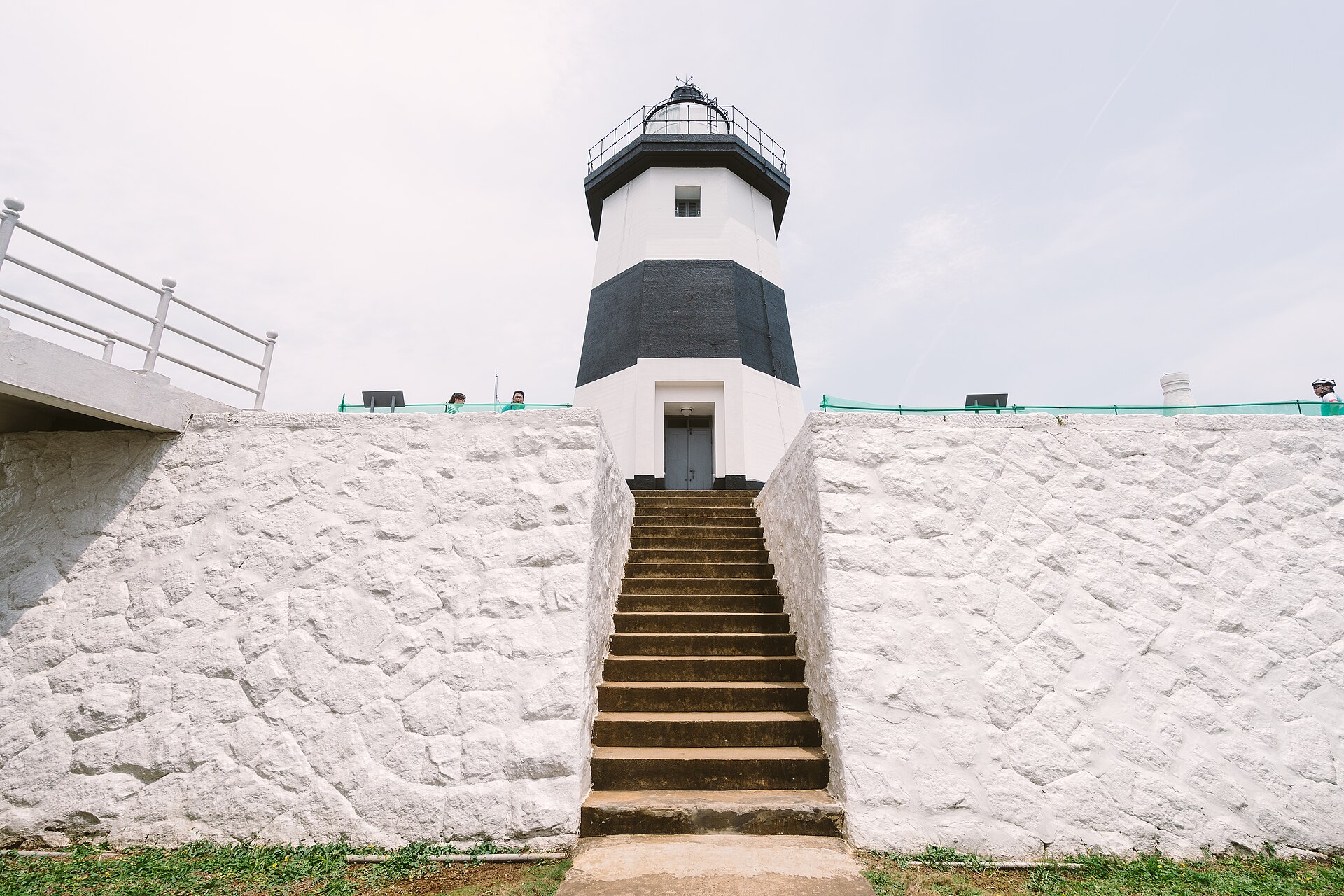
Cape Fugui is the northernmost point of Taiwan’s main island, and it feels like it: a bare, wind-scoured headland with the sea on three sides. The lighthouse, an octagonal tower painted in black and white bands, was off limits for most of its life; its grounds have been open to visitors since 2015, although the lantern room at the top stays closed. Opening hours are 09:00–18:00 from April to October and 09:00–17:00 from November to March, and it is closed on Mondays.
The best of the cape is the walking trail below the lighthouse, which loops over the headland past rocks carved into ridges and facets by the wind-blown sand. It is short and easy, but it is exposed: hold on to your hat, and in winter bring a proper layer, because the north-east monsoon hits this point first.
Laomei Green Reef
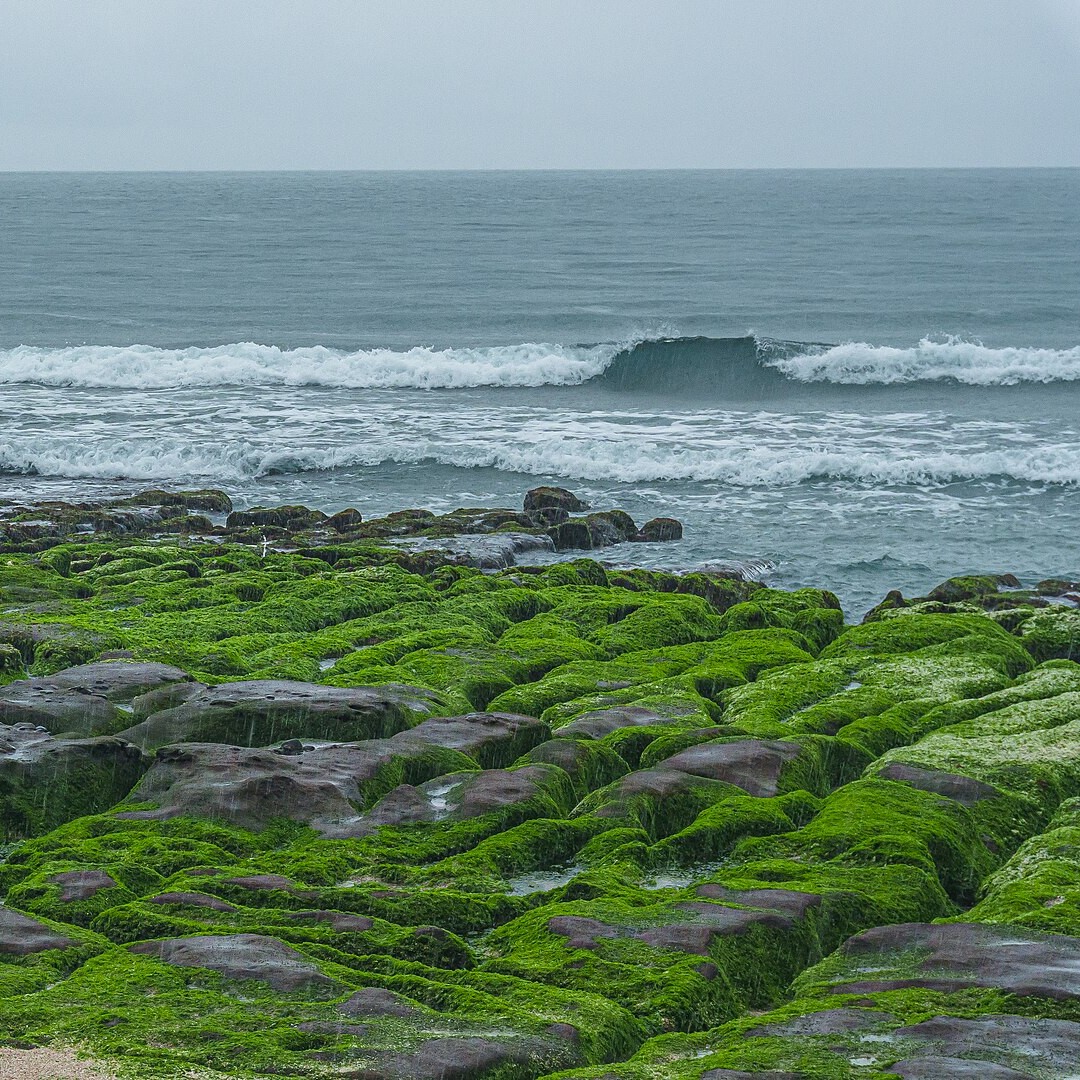
A short way east, the beach at Laomei is crossed by long parallel ridges of volcanic rock running down into the sea, carved into grooves by the waves. In spring they grow a coat of vivid green algae, and at low tide the whole beach looks like a field of green corduroy. It is one of the most photographed sights on the coast.
The timing matters. The algae is at its best in April and May; outside spring, the rocks are grey-brown and the magic is mostly gone. Go at low tide, check the tide table before you set off, and stay off the algae itself — it is slippery and it is also the attraction. Photographers arrive at sunrise and sunset in season; midday is flatter but emptier.
The Shimen Arch
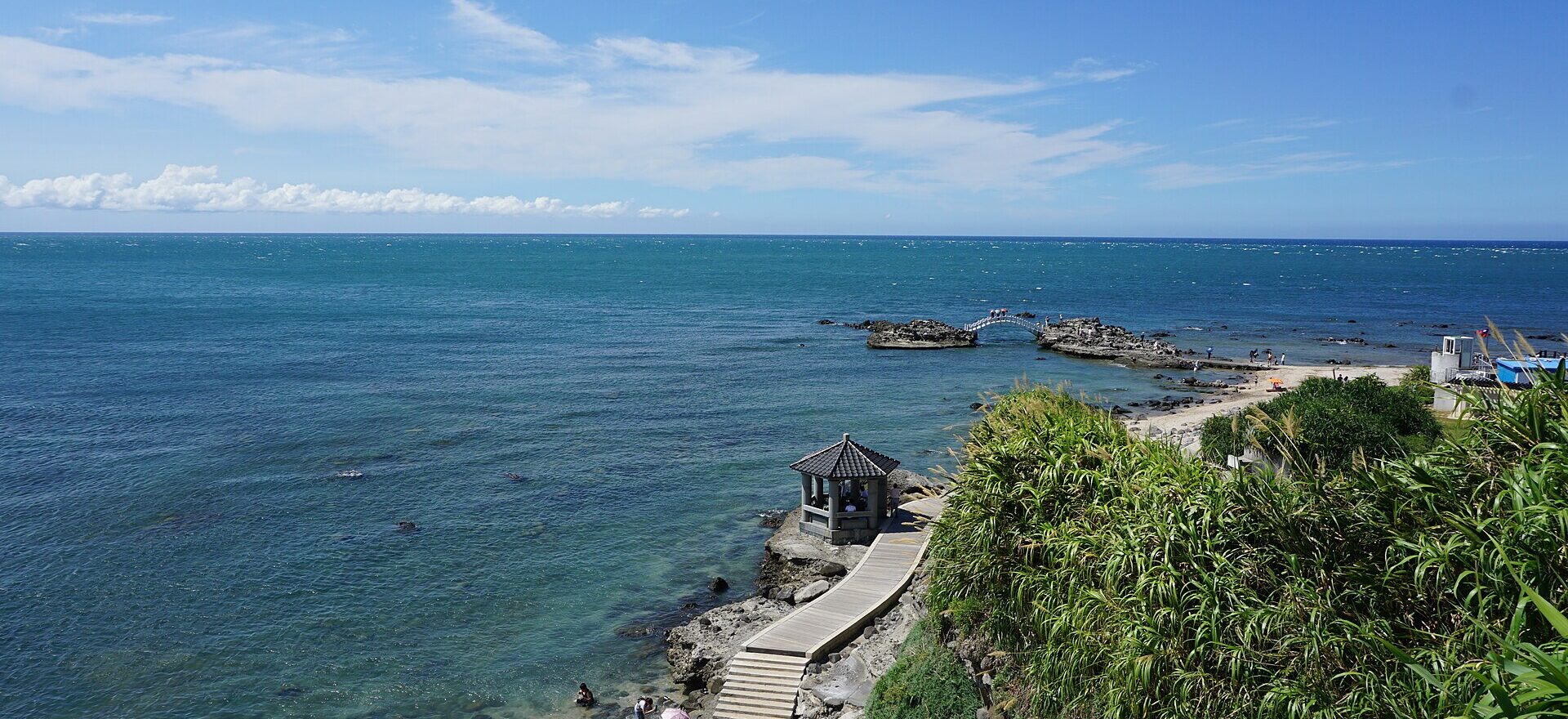
At Shimen (“stone gate”) the sea has cut a natural arch through a rocky promontory, big enough to walk through to the small cove and rocks on the other side. It takes ten minutes, and it is a good picnic stop. The stalls across the road sell the district’s other famous thing: Shimen rice dumplings, sticky rice and pork wrapped in bamboo leaves, which make an excellent lunch on the move. A few stops back towards Tamsui, the white seafront wedding plaza is where couples come for their photographs; it is pretty, and you will not need long there.
The Juming Museum
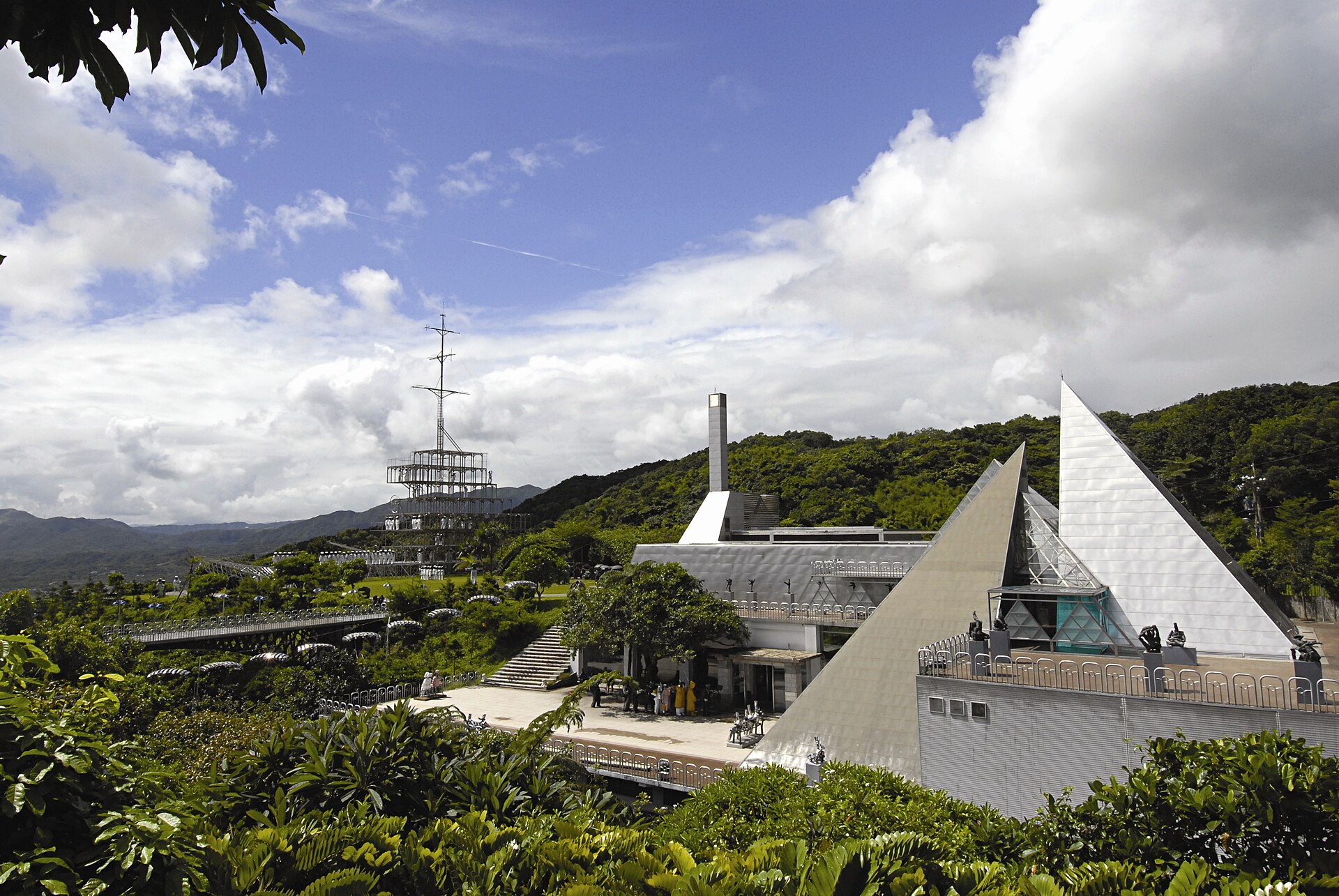
In the green hills above Jinshan, the Juming Museum is the life’s work of Ju Ming, one of Taiwan’s best-known sculptors, who built it to show his work and died in 2023. Much of it is outdoors: his massive, blocky bronze figures from the Taichi series, frozen mid-movement on the lawns, and the crowds of painted figures of his Living World series — soldiers, swimmers, people queuing — scattered around the grounds. It is surprising, often funny, and very good with children.
Admission is NT$280 (NT$250 for students and over-65s), included in the full Taipei Fun Pass. It opens 10:00–18:00 from May to October and 10:00–17:00 from November to April, with last entry an hour before closing, and it is closed on Mondays. Give it two hours. It is up a hill from the coast road; the 716 stops at the gate.
Jinshan
Jinshan is the one real town on this stretch and a good place to end the day. Its old street, Jinbaoli Street, is short and lively, and it is famous for one thing above all: Jinshan duck, sliced and eaten at plastic tables from a stall that has a queue at almost any hour. Go early or late, and order the duck, a plate of stir-fried greens and a bowl of noodles. The town also sells its sweet potatoes in every imaginable form.
Jinshan is a hot spring town as well — the volcanic hills behind it feed public baths and hotel pools with mineral-heavy water — and Zhongjiao Bay on its western edge is one of northern Taiwan’s surf beaches, with board hire along the sand. For the full picture of the hot springs around Taipei, see our Beitou guide.
Onwards: Wanli, Yehliu and Keelung
East of Jinshan, Wanli’s harbour restaurants are known for crab in autumn, and the 716 runs on to Yehliu Geopark and its famous rock formations. From there, Keelung’s night market is a short bus ride away if you want to make a full day of it. Both have their own guides; for the whole spread of options, see our day trips from Taipei.
Three ways to do it
By shuttle, in a day
| When | What |
|---|---|
| Morning | MRT to Tamsui; first 716 east. Get off at Fugui Cape Lighthouse and walk the headland. |
| Late morning | Next bus two stops to Laomei (spring, low tide) or straight to the Shimen Arch; rice dumplings for lunch. |
| Afternoon | 716 to the Juming Museum; two hours in the sculpture park. |
| Evening | Down to Jinshan for duck on the old street, then bus back to Taipei. |
In summer, swap the museum for an afternoon on the beach at Baishawan, and do the museum another day.
By car, as a loop
Taipei → Tamsui → Baishawan and Linshanbi → Cape Fugui → Laomei and Shimen → Juming Museum → Jinshan → Yangjin Highway over Yangmingshan → Taipei. Six to eight hours with stops, and the mountain road home gives you a sunset over the city on a clear evening. Combine it with our Yangmingshan day trip for the stops on the way back.
As two half-days
Baishawan and the lighthouse from Tamsui one afternoon, finishing with sunset at Qianshui Bay; Jinshan, the museum and Yehliu another morning from the Keelung side. This is the relaxed version, and it works well if you are staying in Taipei for a week.
Staying the night
The north coast is usually done as a day from Taipei, but a night in Jinshan turns it into something better. The town’s hot spring hotels pipe mineral water into their pools and rooms, the old street is quieter after the day-trippers leave, and you can be at Laomei or the lighthouse for the early light the next morning before driving home over Yangmingshan. On summer weekends, book ahead; midweek, you will have your pick.
With children
This is a good coast for families, with two caveats. The good parts — the beach at Baishawan, the sculptures at the Juming Museum, the lighthouse, the walk through the Shimen Arch, rice dumplings for lunch — are short, varied and outdoors. The caveats are the sea and the rocks: children need a hand on the slippery reef at Laomei and on the headland paths, and swimming should be strictly inside the lifeguarded area at Baishawan. The 716’s long gaps between buses are the other challenge; a car or a hired driver makes a family day far easier. For more ideas, see our Taipei with kids guide.
Swimming and safety
- Swim only at designated beaches with lifeguards on duty — on this stretch, that means Baishawan in the summer season. Rips and sudden swells are common along the whole coast, and drownings are not rare.
- Stay off wet, algae-covered rock. At Laomei and on the headlands it is as slippery as ice, and the sea is right there.
- Watch the waves on the rock platforms. Sneaker waves sweep people off the rocks on this coast, most often anglers, especially when a typhoon or the winter monsoon is pushing swell in. Keep well back from the edge when the sea is rough.
- Stay away entirely in typhoon conditions. Check the Central Weather Administration and read our typhoon guide; a coast this exposed is no place to be when a storm is near.
- Bring sun protection in summer. There is almost no shade at the cape or on the reef.
When to go
April and May are the best months overall: Laomei is green, the weather is warm without being oppressive, and the crowds have not yet arrived. From May the 716 runs every day.
Summer is beach season — Baishawan at its best, the coast road at its busiest. Go on a weekday if you possibly can, and see our guide to Taipei in summer for the heat and the typhoon risk.
Autumn brings clear days, thinner crowds and crab season in Wanli. It is an underrated time for this coast, at least until the monsoon arrives.
Winter, from about November to March, is the north coast’s hard season. The north-east monsoon blows straight onto it, bringing wind, drizzle and grey skies, and the 716 runs only at weekends. On a rare clear winter day it can be spectacular; on a typical one, the Juming Museum and a bowl of Jinshan duck are the best of it.
What we would skip
Laomei outside the algae season. From summer to winter it is grooved grey rock on a beach. Interesting to a geologist; a disappointment to everyone who has seen the spring photographs.
Riding the 716 end to end without getting off. Two and a quarter hours on a bus is not a way to see a coast. Choose three stops and do them properly.
A winter weekday by public transport. No shuttle, a cold wind and a long wait for the ordinary bus. Go at the weekend, or go in spring.
Expecting a tropical beach. Baishawan is lovely by Taiwanese standards and the water is clean, but this is a temperate-feeling coast with volcanic rock, not a palm-fringed lagoon.
Swimming anywhere without a lifeguard. It is not worth it on this coast.
Above the Yin Yang Sea and the Golden Waterfall, the rocky summit of Teapot Mountain crowns the ridge behind Jinguashi. If you are driving this stretch of coast, park in Jinguashi and give it two hours: the trail climbs from Quanji Temple to a summit you can scramble inside, with the whole coastline below. Our Teapot Mountain guide explains the route.
Related Taipei guides
- Taiwan Beyond Taipei: Where to Go Next
- Tamsui Day Trip
- Yehliu Geopark Day Trip
- Keelung Day Trip
- Yangmingshan National Park
- Yangmingshan Day Trip
- The Taipei Fun Pass
- Day Trips from Taipei
- Car Rental in Taiwan
- Taipei in Summer
- Taipei Typhoon Season
Frequently Asked Questions
How do I get to Taiwan’s north coast from Taipei?
Take the MRT Red Line to Tamsui and board the 716 Crown Northern Coast shuttle, which runs along the coast to Yehliu, stopping at Baishawan, Fugui Cape, Laomei, the Shimen Arch, the Juming Museum and Jinshan. It runs daily from May to October and at weekends and holidays from November to April. By car, follow Highway 2 from Tamsui.
How much is the 716 shuttle bus?
NT$15 per section, with the route divided into six sections, or NT$90 for the full journey from Tamsui to Yehliu. Pay by EasyCard, mobile payment or exact cash. The Taipei Fun Pass – Transportation one-day pass, NT$180, covers it along with the city’s buses and MRT.
Does the 716 bus run in winter?
Only at weekends and on public holidays from November to April. On winter weekdays there is no 716 service; ordinary New Taipei buses from Tamsui still run along the coast road, more slowly.
Where is the northernmost point of Taiwan?
Cape Fugui, in Shimen District on the north coast, is the northernmost point of Taiwan’s main island. Its black-and-white lighthouse grounds are open 09:00–18:00 from April to October and 09:00–17:00 from November to March, closed on Mondays.
When is the best time to see Laomei Green Reef?
April and May, at low tide, when the algae covering the rock grooves is at its brightest green. Outside spring the rocks are mostly grey. Check a tide table before you go and stay off the slippery algae.
Can you swim at Baishawan?
Yes, in the designated area when lifeguards are on duty in the summer season. Baishawan is the north coast’s best swimming beach; elsewhere along this coast the currents make swimming dangerous.
Is the Juming Museum worth it?
Yes, especially with children or on a day when the weather is fine. It is an open-air sculpture park of Ju Ming’s work in the hills above Jinshan. Admission is NT$280, it is closed on Mondays, and two hours is about right.
What is Jinshan famous for?
Its duck, served at a much-queued stall on Jinbaoli Old Street, along with sweet potatoes, hot springs fed by the volcanic hills behind the town, and the surf beach at Zhongjiao Bay.
Can I do the north coast and Yehliu in one day?
Yes. The 716 ends at Yehliu Geopark, so a day that starts at Tamsui and hops off at two or three stops can finish at Yehliu in the late afternoon. You will not see everything; choose your stops in advance.
Is it worth renting a scooter for the north coast?
Only if you hold the right licence. Scooters are the local way to do this coast, but most visitors’ licences do not cover them, which leaves you uninsured. A car, the 716 or a hired driver are the honest options.
Is the north coast worth visiting in winter?
On a clear day, yes; on a typical one, less so. The winter monsoon brings wind, drizzle and grey skies from about November to March, and the 716 runs only at weekends. Spring and autumn are far better.
How long do you need for the north coast?
A full day for the highlights — the lighthouse, Laomei or the Shimen Arch, the Juming Museum and Jinshan — or two half-days if you want to add an afternoon on the beach at Baishawan.
Are there hot springs on the north coast?
Yes — Jinshan, at the eastern end of this stretch, is a hot spring town, with public baths and hotels drawing mineral-rich water from the volcanic hills of Yangmingshan behind it. A soak there makes a good end to a day on the coast, or a reason to stay the night.
The Bottom Line
Go in spring if you can, take the MRT to Tamsui and the 716 east, and choose three stops rather than eight: the lighthouse at Cape Fugui, the green grooves of Laomei at low tide, and the sculptures at the Juming Museum, with duck in Jinshan to finish. In summer, swap one of them for an afternoon on the sand at Baishawan; with a car, come home over Yangmingshan.
It is a coast that rewards a slow day and punishes a rushed one. It also sits an hour from the middle of Taipei, which is exactly why most visitors race past it to Yehliu — and exactly why it is worth stopping.
Photo Credits
The coast near the Shimen Arch: Beautiful blue sea near Shimen Cave by Felix Filnkoessl, CC BY-SA 2.0, via Wikimedia Commons.
Fugui Cape Lighthouse: Fugueijiao Lighthouse 20160423 by 翁維德 (Wei-Te Wong), CC BY-SA 2.0, via Wikimedia Commons.
Laomei Green Reef (cropped): 202605 A large tire on Laomei Green Reef 01 by Junyu-K, CC BY 4.0, via Wikimedia Commons.
The Juming Museum: Juming Museum by Juming museum pr, CC BY-SA 4.0, via Wikimedia Commons.