
This article contains advertising. Our booking links are routed through a partner that adds commission tracking automatically, so if you book through one we earn a commission from the provider, at no extra cost to you. It never affects what we recommend. Affiliate disclosure
Stand at any intersection in central Taipei and you can usually see two convenience stores, sometimes three, occasionally two branches of the same chain facing each other across the road. There are roughly 13,764 of them on an island of 23 million people — one for every 1,500 to 2,000 residents, a density beaten only by South Korea — and they are not a fallback for when the shops are shut. They are infrastructure. That is why taiwan 7-eleven food has a reputation that genuinely puzzles visitors from countries where the equivalent shop sells warm sandwiches and regret.
This guide covers what to eat, what the stores can do beyond selling things, how to use the counter without speaking Chinese, and which of the famous items are actually worth trying. Prices were checked in September 2026 and are in New Taiwan dollars — they move slightly, but convenience-store pricing in Taiwan is remarkably stable.
The four chains
| Chain | Stores | Known for |
|---|---|---|
| 7-Eleven (統一超商) | ~7,021 | The biggest by a distance; best ready meals and hotel collaborations; City Café |
| FamilyMart (全家) | ~4,251 | Strong own-brand desserts, soft serve, good seating areas |
| Hi-Life (萊爾富) | ~1,590 | Smaller, often in residential streets; decent hot counter |
| OK Mart (OK超商) | ~902 | The rarest of the four; broadly similar offer |
7-Eleven and FamilyMart between them account for the overwhelming majority, and you will rarely walk more than three minutes without passing one. The two are genuinely competitive on food, which is the main reason the standard is as high as it is: they release new items constantly and copy each other within weeks.
The first Taiwanese convenience stores opened in 1979. What they have become since is a national utility that happens to sell crisps.
What to eat
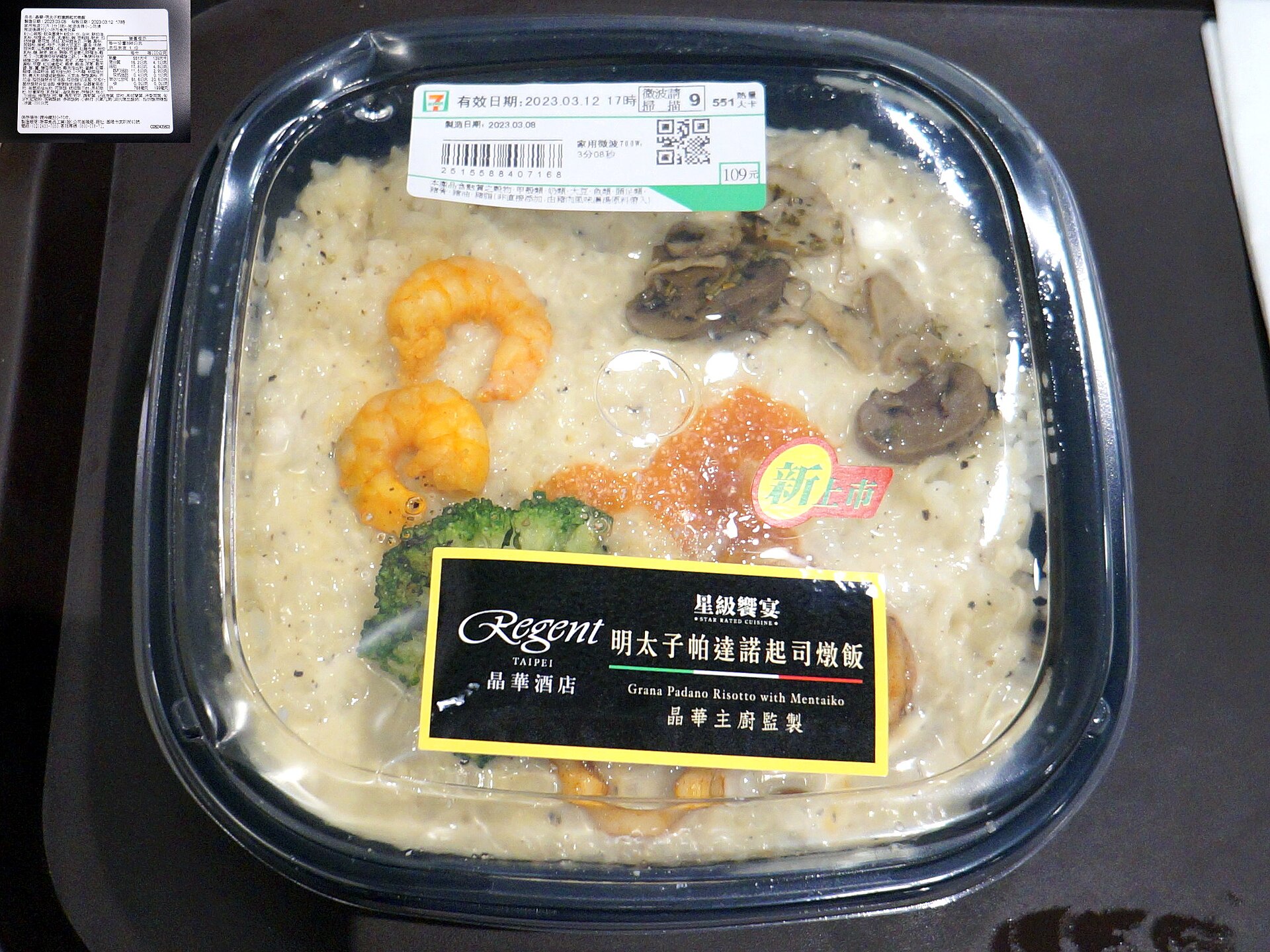
Start with the fact that the ready meals are made in collaboration with actual restaurants and hotels. The photograph above is a Grana Padano and mentaiko risotto sold at 7-Eleven for NT$109, developed with the Regent Taipei’s chefs. That is not a marketing curiosity; it is a normal thing to find on the shelf on a Tuesday.
The hot counter
- Tea eggs (茶葉蛋), NT$13–15, simmering in a spiced soy and tea broth in a pot by the register. The smell is the smell of Taiwanese convenience stores. Take the tongs, help yourself, tell the cashier how many.
- Roasted sweet potatoes (烤地瓜), NT$30–60 depending on weight, sold from a warming cabinet. Genuinely excellent in winter and one of the great cheap foods of the country.
- Oden (關東煮), from around NT$20 a piece — fish cakes, daikon, konjac, tofu, quail eggs — served from a hot broth bath. Point at what you want; the staff will ladle broth over it.
- Buns and hot dogs from the steamer, plus fried chicken at the larger branches.
The chilled shelves
- Onigiri and rice rolls, NT$30–50. The pork floss (肉鬆) and tuna versions are the standards; the seaweed wrapper is engineered to stay crisp until you open it.
- Bento boxes, NT$70–130. Hand them to the cashier and they will microwave them for you without being asked.
- Sandwiches and salads, reliably fresh, priced NT$40–90.
- Dessert. FamilyMart’s own-brand puddings and the seasonal soft serve have a following that is not entirely ironic.
Drinks
The tea wall is the thing to explore. Bottled oolong, jasmine, black and green teas — unsweetened is labelled 無糖 — plus every soft drink you know and several you do not. Fresh milk, soy milk, and the ubiquitous City Café counter at 7-Eleven, which does an entirely decent latte for NT$45–65 and outsells most chains in the country.
For the real thing, though, go to a proper tea shop. Our bubble tea guide covers where, and the Taipei food guide covers everything else.
Everything else they do
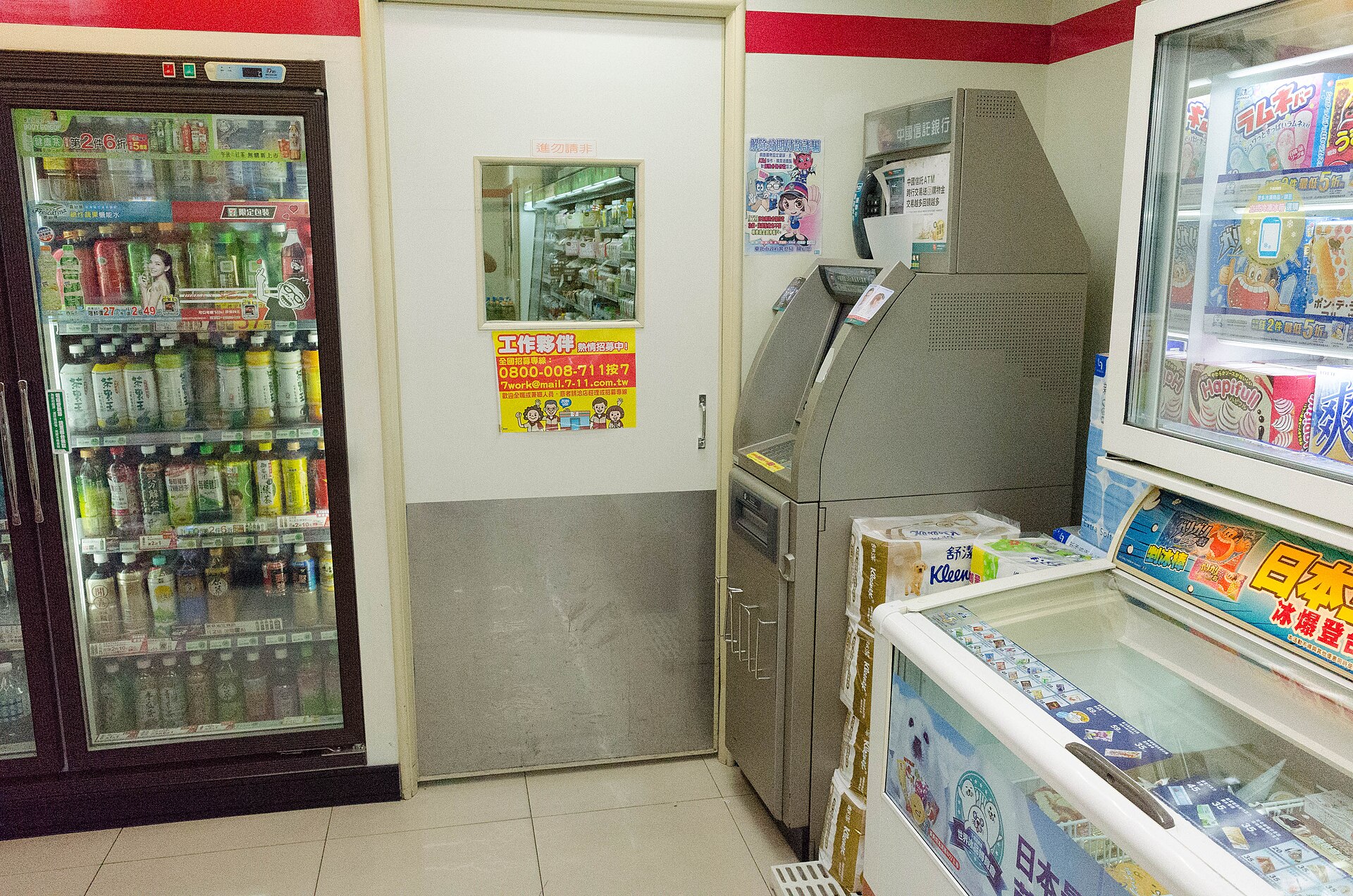
This is the part that surprises visitors most. A Taiwanese convenience store is a post office, a bank branch, a ticket agency and a parcel depot with a snack aisle attached.
- ATM. Almost every branch has one, most accept foreign cards, and they are open when banks are not. See our money in Taipei guide for the fee traps.
- EasyCard top-up. Hand the card and a note over the counter and say “加值” (jiāzhí). Faster than the station machines and available at 4am. Our EasyCard guide has the rest.
- Bill payment. Utilities, parking fines, traffic tickets, phone bills, taxes. Residents pay almost everything here.
- Ticket collection. Concert tickets, event tickets, high-speed rail bookings and attraction vouchers are collected from the in-store kiosk terminal.
- Parcel send and collect. The island-wide store-to-store network is cheap and quick, and it is how a lot of Taiwanese online shopping is delivered. Useful if you want to send a bag ahead — see our luggage storage guide.
- Printing, scanning and photocopying from the multifunction terminal.
- Free Wi-Fi and seating. Most branches have a counter or a few tables, and nobody will move you on.
- Clean toilets at the larger branches, which is worth knowing in a city where public conveniences are otherwise mostly in MRT stations.
The practical upshot: when something goes wrong at two in the morning — you need cash, a charger, a plaster, a plug adapter, an umbrella, a hot meal, somewhere to sit down — the answer is the nearest convenience store, and the nearest convenience store is a hundred metres away.
The traveller’s first-hour checklist
There is a version of your arrival in Taipei that goes through a convenience store, and it is the efficient one. Within an hour of reaching your accommodation, one branch can sort out most of the practical odds and ends:
- Cash. The in-store ATM takes foreign cards and is open when the banks are shut. Withdraw enough for a few days and decline any offer to convert to your own currency.
- EasyCard. Buy one over the counter for NT$100 and load NT$500 onto it in the same transaction.
- Water. A bottle for now and, better, the knowledge that every MRT station has a free filtered dispenser to refill it.
- An umbrella, if it is raining or if the forecast says it will be, at NT$150–300.
- A plug adapter, if you forgot yours, at NT$100–200.
- A meal. Whatever hour you have landed at, the hot counter is running.
None of this needs Chinese, a queue or a plan. It is the reason experienced visitors to Taiwan stop packing so carefully — almost everything on a conventional packing list is available within a hundred metres of wherever you end up standing. Our Taipei packing list takes that logic to its conclusion.
How to use one without speaking Chinese
You do not need any Chinese at all, but four things make it smoother.
Barcodes do the talking. Everything is scanned. Put items on the counter, tap or hand over cash, done.
Heating is automatic if you ask. Hand a bento or a bun to the cashier and mime a microwave, or say “加熱” (jiārè). They will do it without being asked at most branches.
You will be asked two questions. Whether you want a bag (袋子, dàizi — bags carry a small charge, so bring your own) and whether you have a mobile invoice carrier for the receipt lottery. Shaking your head to both is fine.
The receipt is a lottery ticket. Taiwan’s uniform invoice system runs a bi-monthly draw on receipt numbers with real prizes. Keep them if you like a long shot; the bins by the door are for donating them to charity, which is what most people do.
A few phrases go a long way generally — see our Mandarin phrases guide.
What a convenience-store day costs
| Item | Price |
|---|---|
| Tea egg | NT$13–15 |
| Onigiri | NT$30–50 |
| City Café latte | NT$45–65 |
| Bottled tea | NT$25–35 |
| Bento box, microwaved | NT$70–130 |
| Oden, three pieces | NT$60–80 |
| Roasted sweet potato | NT$30–60 |
| Ice cream | NT$35–60 |
| Plug adapter | NT$100–200 |
| Folding umbrella | NT$150–300 |
Breakfast, lunch and a coffee from a convenience store comes to about NT$200. That is not a recommendation to eat this way — Taipei’s actual food is one of the reasons to come — but it is a useful floor for a budget trip, and a genuine relief on a travel day.
Late night, and the 24-hour question
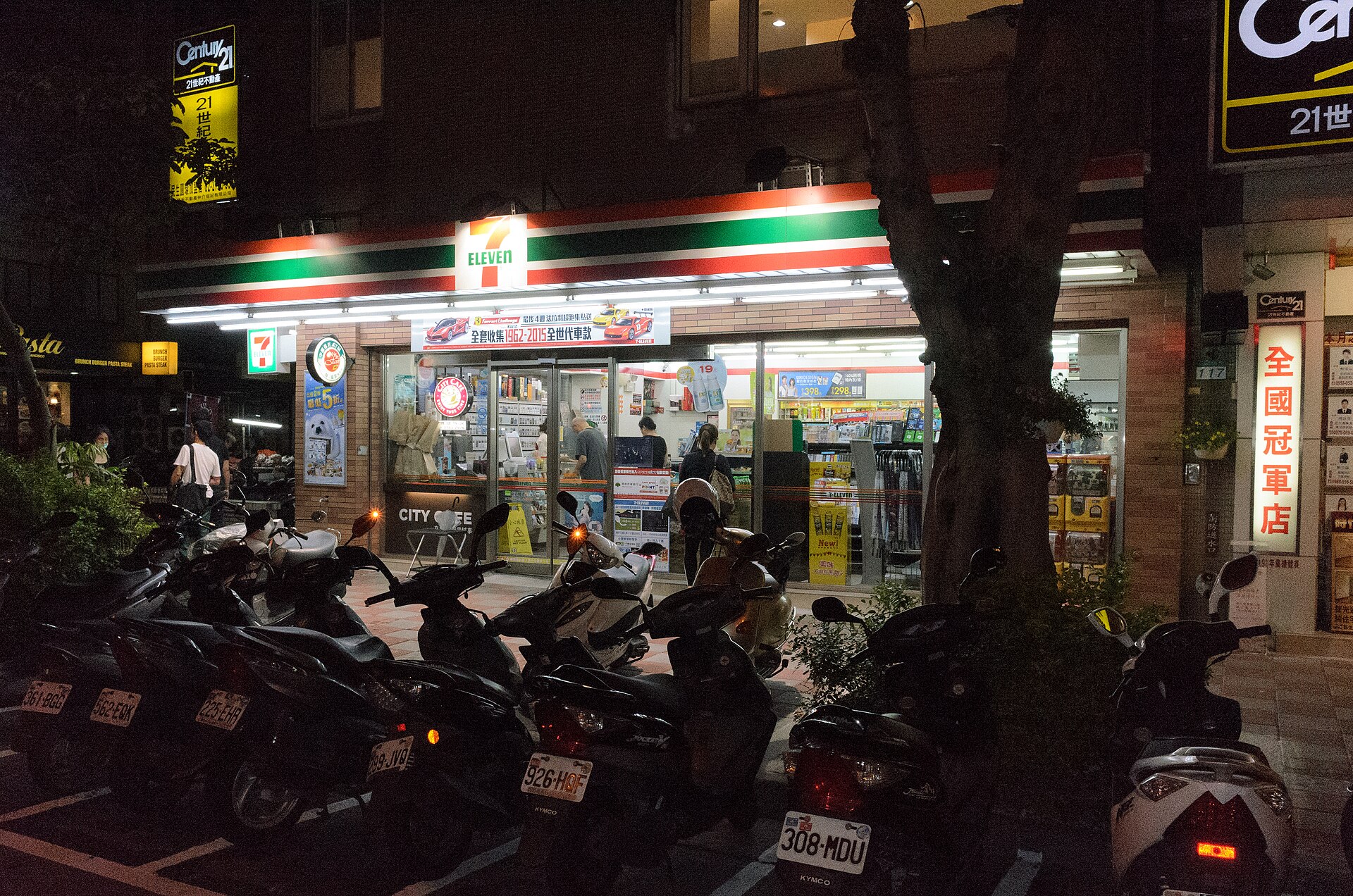
The large majority of urban branches never close. In practice this means a 2am flight arrival is not a problem, a 5am start for a day trip does not mean skipping breakfast, and jet lag at four in the morning has somewhere to go.
Rural and small-town branches sometimes close overnight, and a few in office districts shut at weekends, so do not assume on a day trip. In Taipei proper, assume open.
For actual late-night eating rather than a stopgap, our late-night food guide is the better read — Taipei has 24-hour beef noodle shops and dumpling houses that are considerably more rewarding than a microwave bento.
How they became this
The first Taiwanese convenience stores opened in 1979, when President Chain Store Corporation licensed the 7-Eleven brand and, for several years, lost money steadily. The turnaround came from localisation rather than imitation: tea eggs and oden instead of American snacks, and — crucially — the decision to become a payment and logistics point rather than only a shop.
That second move is what separates the Taiwanese and Japanese convenience store from every Western equivalent. Once you can pay a parking fine, collect a parcel, print a document and buy a train ticket in the same building, the store stops competing with supermarkets and starts competing with the post office, the bank and the local government office — all of which keep shorter hours and are much further away.
Density did the rest. When a chain has 7,000 branches on an island the size of the Netherlands, it can negotiate with any supplier in the country, run a national cold chain, and turn a new product over fast enough to justify developing it with a hotel kitchen. The food quality is a consequence of the scale, not a marketing decision.
The side effects are visible everywhere. Taiwan’s small independent grocers have largely disappeared from urban streets, and there is an ongoing domestic conversation about packaging waste and about what it means for a country’s daily life to run through four private chains. Visitors do not have to resolve that, but it is worth noticing that the convenience is not free.
The collaboration culture
The other thing that catches visitors off guard is how fast the shelves change and how seriously the limited editions are taken.
Both major chains run constant tie-ups: with animation studios, with Taiwanese and Japanese character brands, with musicians, with individual restaurants. Spend enough at a participating branch and you collect points towards a plush toy, a set of dishes, a magnet or a piece of licensed homeware, and the good ones sell out within days and reappear on resale sites at multiples of their nominal value.
This is not a niche hobby. Queues form. Social media tracks which branches still have stock. It is one of the more legible windows into Taiwanese consumer culture available to a visitor, and it costs nothing to watch.
The practical version for a traveller: if you see a snack, a drink or a dessert with a seasonal label — mango in summer, taro and sweet potato in autumn, strawberry in winter — buy it then rather than planning to come back. It will genuinely be gone.
What to buy to take home
Convenience stores are an underrated souvenir shop, mostly because the prices are honest and the range rotates.
- Crisps in flavours that do not exist elsewhere — oyster omelette, fish skin, seaweed, salted egg yolk.
- Koloko pea crackers and the other Taiwanese snack-aisle staples.
- Bottled and bagged teas, which are better value here than in the tourist tea shops, though not better quality — for that, see buying tea in Taipei.
- Instant noodles of a standard that embarrasses most of what is sold in the West.
- Limited-edition character collaborations, which are a genuine cultural phenomenon here and change every few weeks.
For the things actually worth packing, our souvenirs guide and pineapple cake guide go further.
What we would skip
Eating every meal here. The food is good for a convenience store and cheap, and it is still a microwave meal in a city with some of the best street food on earth. Use it for breakfast, travel days and 3am; do not let it replace a night market.
The coffee, if you care about coffee. City Café is fine and it is not why Taipei has one of Asia’s best café scenes. Our Taipei cafés guide is a better use of NT$150.
Buying an umbrella before you need one. You will end up with three. Buy the first time it rains.
Assuming every branch has everything. Small branches have no seating, no toilet, no hot counter and sometimes no ATM. The large corner stores near MRT stations have all four.
The one thing worth not buying here is bottled water. A week of it runs to NT$300–500 for something Taipei gives away, filtered and tested, from fountains in every MRT station — and the store will happily sell you a reusable bottle instead. We go through the whole question, including why nobody local drinks from the tap despite the water being perfectly good, in our guide to Taipei’s tap water.
Related Taipei guides
- Taipei Travel Essentials: the pre-trip checklist
- The Taipei Food Guide
- Taiwanese Breakfast in Taipei
- Late-Night Food in Taipei
- The EasyCard: how it works and where it pays
- Money in Taipei: Cash, Cards and ATMs
- Taipei on a Budget
- The Best Taipei Souvenirs
- Bubble Tea in Taipei
- The Best Cafés in Taipei
Frequently Asked Questions
Is 7-Eleven food in Taiwan actually good?
Genuinely, yes — the ready meals are developed with restaurants and hotels, the hot counter is fresh, and the standard is far above what the same brand sells in Europe or North America. It is still a microwave meal, so use it for breakfast and travel days rather than instead of a night market.
How many convenience stores are there in Taiwan?
Around 13,764 — roughly 7,021 7-Elevens, 4,251 FamilyMarts, 1,590 Hi-Lifes and 902 OK Marts. That is one store per 1,500 to 2,000 people, the second highest density in the world after South Korea.
What should I eat at a Taiwanese convenience store?
Tea eggs from the pot by the register, roasted sweet potatoes in winter, oden from the hot broth, an onigiri or a hotel-collaboration bento, and something from the tea wall. The seasonal soft serve at FamilyMart is worth the NT$50.
Are Taiwanese convenience stores open 24 hours?
Most urban branches are, which makes late arrivals and pre-dawn starts much easier. Rural branches and a few in office districts do close overnight or at weekends, so do not rely on it outside the cities.
Can I top up my EasyCard at a convenience store?
Yes, at all four chains. Hand the card and a note across the counter and say “加值” (jiāzhí). It is faster than the machines in MRT stations and available around the clock.
Do Taiwanese convenience stores have ATMs?
Almost all of them, and most accept foreign Visa, Mastercard, Cirrus and PLUS cards. They are the easiest way to get New Taiwan dollars in a city where night markets and small restaurants are cash-only.
Can I pay by card at a convenience store in Taiwan?
Yes, including contactless, and EasyCard works as a payment method too. This is one of the few places in Taipei where the payment question genuinely never arises.
Do I need to speak Chinese to use a convenience store?
No. Everything is scanned, staff are used to visitors, and pointing works. You will be asked whether you want a bag and whether you have an invoice carrier; shaking your head to both is a complete answer.
What is the receipt lottery in Taiwan?
Every official receipt carries a number entered into a bi-monthly government draw with substantial cash prizes. Keep them if you fancy the odds, or drop them in the donation boxes by the door, which is what most people do.
Can I use the toilet in a Taiwanese convenience store?
At larger branches, yes, and they are generally clean. Small branches often have no public toilet. MRT stations are the other reliable option in central Taipei.
Which convenience store chain is best in Taiwan?
7-Eleven for range, ready meals and coffee; FamilyMart for desserts, soft serve and seating. The two are close enough that the right answer is whichever one you can see, which in Taipei is usually both.
Can convenience stores send parcels in Taiwan?
Yes — the store-to-store network is cheap, island-wide and heavily used. It is a good way to send clothes or shopping ahead to another city or to your hotel, though the terminals are mostly in Chinese and it takes a few minutes with staff help.
Is convenience store food a cheap way to eat in Taipei?
Very. Breakfast, lunch and a coffee come to around NT$200. But night market dinners run NT$200–350 for far better food, so the saving is smaller than it looks and the trade-off is worse than it sounds.
The Bottom Line
Taiwan’s convenience stores are the most quietly impressive thing about daily life here: 13,764 of them, open around the clock, doing the work of a bank, a post office, a ticket agency and a decent canteen. Learn to use one properly in your first hour — top up the EasyCard, take cash from the ATM, buy a tea egg — and a great deal of friction disappears from the rest of your trip.
Eat the tea eggs, the sweet potatoes and one hotel-collaboration bento out of curiosity. Then go and eat at a night market, because that is what you came for. The convenience store is the best supporting act in Asia, not the headliner.
Photo Credits
ATM inside a Taiwanese 7-Eleven: Coca-Cola advertisement and CTBC Bank ATM at 7-Eleven Zhengtang Store by 玄史生, CC0, via Wikimedia Commons.
A 7-Eleven hotel-collaboration ready meal: Grana Padano Risotto with Mentaiko at 7-Eleven Rye Field Store 20230312 by Solomon203, CC BY-SA 4.0, via Wikimedia Commons.
7-Eleven Chaofu Store at night: 7-Eleven Chaofu Store at Night 20160525 by 玄史生, CC0, via Wikimedia Commons.