This article contains advertising. Our booking links are routed through a partner that adds commission tracking automatically, so if you book through one we earn a commission from the provider, at no extra cost to you. It never affects what we recommend. Affiliate disclosure
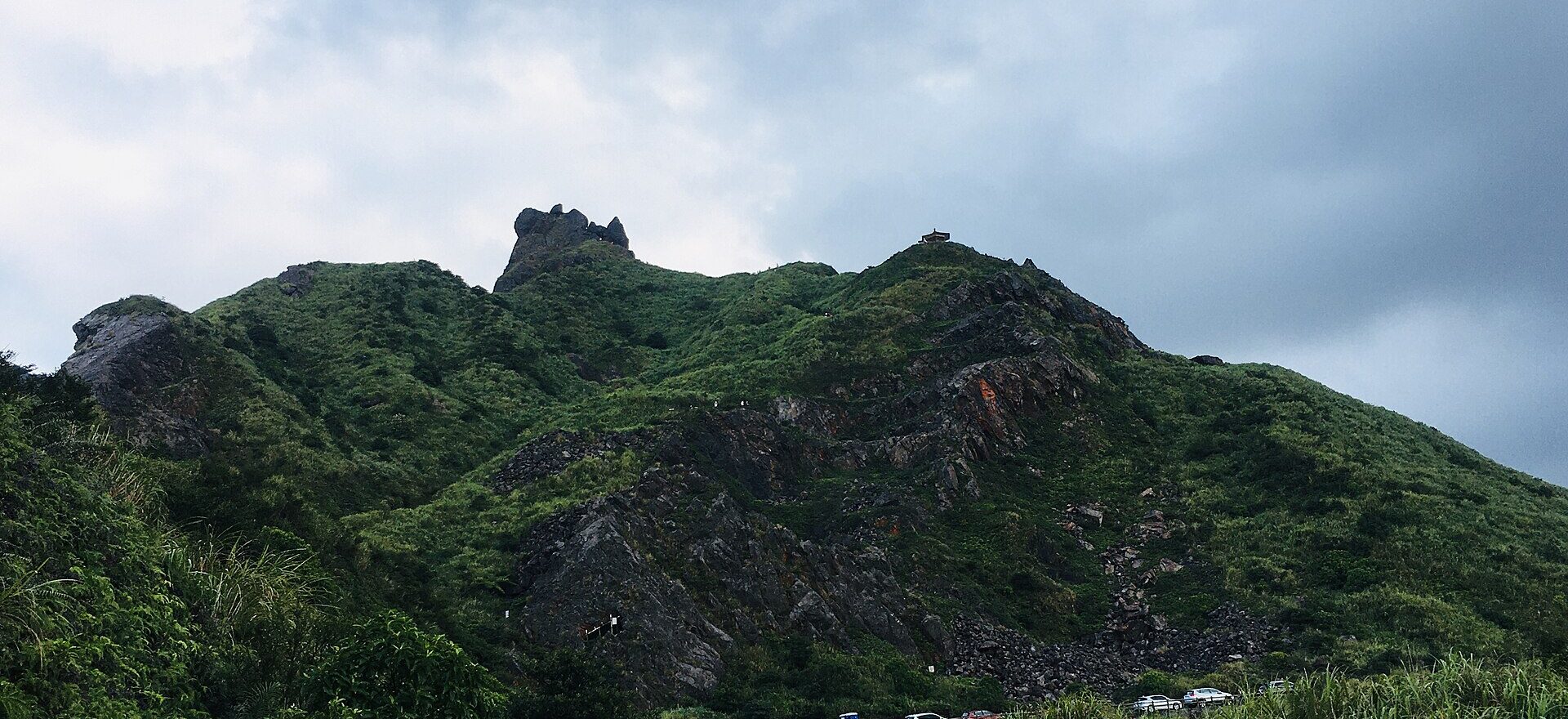
From the lanes of Jiufen, look east on a clear afternoon and you will see it: a knuckle of dark rock on the skyline above the next valley, shaped — if you squint and are feeling generous — like a teapot with its handle knocked off. That is Teapot Mountain (茶壺山), and the short, steep climb to it from the old gold-mining village of Jinguashi is one of the most rewarding hours on Taiwan’s north-east coast. The trail climbs past a temple with a giant golden statue, up open grassy slopes with the Pacific at your back, to a rocky summit where you scramble into the teapot’s “lid” and look down on Jiufen’s rooftops, the humpbacked bulk of Keelung Mountain, and a bay stained yellow by the minerals of the old mines.
This guide covers the whole walk: getting to Jinguashi by bus, the trail from Quanji Temple to the summit, the scramble at the top, the longer ridge beyond for experienced hikers, the Gold Museum and the mining ruins below, when to go, and how to fit it all into a day with Jiufen. Details were checked in October 2026; confirm times and prices with the operators before you go. For more walks, see our guide to hiking in Taipei; for the village below, our Jiufen day trip.
Teapot Mountain at a glance
| The short version | |
|---|---|
| Where | Above Jinguashi, Ruifang District, New Taipei — the next village along from Jiufen |
| Trailhead | Quanji Temple (勸濟堂) on Qitang Road, a short walk above the Gold Museum |
| Time | An hour and a half to two hours for the round trip |
| Difficulty | Moderate: steady steps, then a short hands-on scramble at the top |
| Getting there | Keelung Bus 1062 from Zhongxiao Fuxing, or a train to Ruifang and a bus up the hill |
| Best time | A clear, dry, calm morning; autumn and early winter |
| Cost | Free; the Gold Museum below is NT$80 |
What things cost
| Item | Typical cost (September 2026) |
|---|---|
| Keelung Bus 1062 from Taipei to Jinguashi | A little over NT$100 each way with an EasyCard — check the fare on board |
| Train to Ruifang, then a local bus | Tap your EasyCard; Taiwan Railways fares rose in 2025, and the bus up the hill is a short local fare |
| Teapot Mountain trail | Free |
| Gold Museum | NT$80; the free entry for children 12 and under and for seniors applies to R.O.C. citizens with ID; hands-on activities cost extra |
| Lunch in Jinguashi or Jiufen | Roughly NT$100–300 |
| Taxi between Jinguashi and Ruifang station | Roughly NT$200–300 |
Why the teapot has no handle
Teapot Mountain’s full Chinese name is 無耳茶壺山, “Earless Teapot Mountain” — the “ears” being the handles of a Chinese teapot. From the right angle, the rocky summit really does look like a squat pot with a lid on top and no handle, sitting on the ridge above Jinguashi. It is a knot of hard rock that has weathered more slowly than the grassy slopes around it, which is why it stands proud of the ridge, and it is the most recognisable landmark on the whole of this stretch of coast.
The hills around it are riddled with history. Gold was found in the river below in the late nineteenth century, and under Japanese rule Jinguashi and Jiufen became two of the richest gold and copper mining towns in Asia. The mines closed in the second half of the twentieth century, and the hillsides are still scarred with their remains: tunnel entrances, tramways, the ruined terraces of a great smelter, and long stone flues running up the slopes. Walking up Teapot Mountain, you look down on all of it.
Gold, copper and prisoners of war
The rush began in 1890, when workers building the railway near Keelung found gold in the river, and prospectors followed the traces upstream to the hills of Jiufen and Jinguashi. When the gold ran thin, copper kept the mines going.
The hills also hold a darker story. During the Second World War, Allied prisoners of war, including British soldiers captured in Southeast Asia, were held at a camp at Jinguashi, known to them as Kinkaseki, and forced to work in the copper mine in brutal conditions. Many died. A memorial park near the village now remembers them, and a remembrance service is held there each November. It is a short walk from the Gold Museum and a moving place to pause before or after the hike.
Getting to Jinguashi
The trail starts in Jinguashi (金瓜石), one stop further up the road from Jiufen. You have two main options from Taipei:
- Keelung Bus 1062 runs from near Zhongxiao Fuxing station (Exit 1) in central Taipei, through Ruifang and Jiufen to Jinguashi. It is the simplest way to go, but it takes over an hour, more in traffic, and at weekends it fills up and can be standing-room only through the winding mountain roads.
- Train to Ruifang, then a bus up the hill. Taiwan Railways trains from Taipei Main Station reach Ruifang in under an hour on most services; from there, buses 1062, 788 and 825 climb through Jiufen to Jinguashi. A taxi from Ruifang to Jinguashi is a sensible alternative for a group.
From the Gold Museum bus stop at Jinguashi, walk up through the museum park and the lanes behind it to Quanji Temple on Qitang Road (祈堂路), uphill. If you are coming from Keelung, bus 788 also serves Jinguashi. Our Taipei bus guide explains how to pay and when to tap your card.
The trail, from temple to teapot
Quanji Temple and the giant Guan Yu
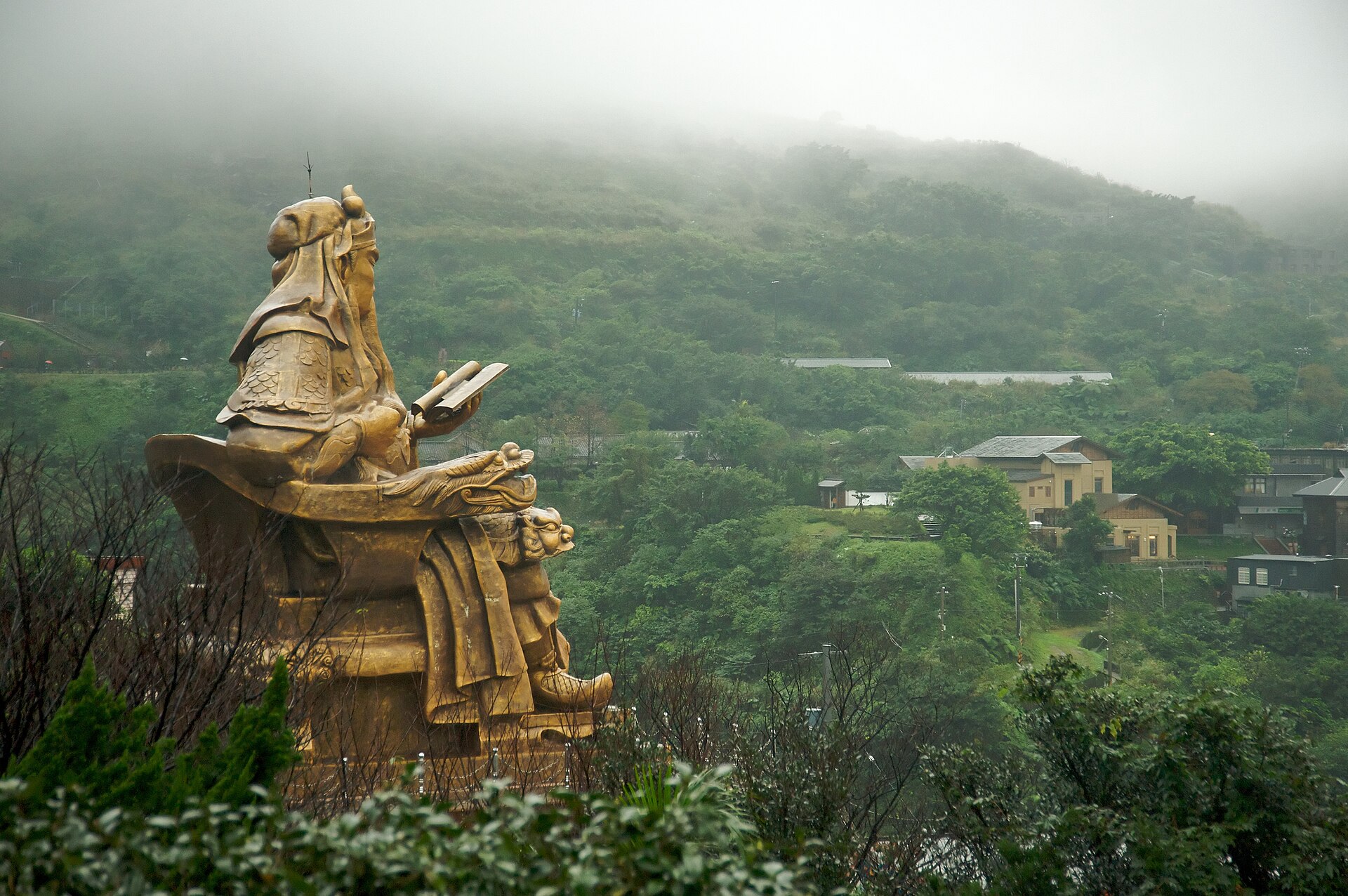
The walk starts at Quanji Temple (勸濟堂), a temple to Guan Yu, the red-faced general of the Three Kingdoms period who is worshipped across Taiwan as the god of loyalty and righteousness — and, fittingly for a mining town, as a patron of business. On its roof sits a colossal golden bronze statue of Guan Yu, seated and reading, as he is often shown, and the terrace in front of it is a fine viewpoint over the valley and the old mining settlement. Step inside if the doors are open, and then look for the signposted path to Teapot Mountain (茶壺山步道) behind the temple.
The climb
From the temple, the trail climbs steadily on stone steps and short gravel sections up the open, grassy flank of the ridge. There is almost no shade: the slopes are covered in silver grass and low shrubs, and on a sunny day the steps are hot and bright. The compensation is that the view is with you all the way, widening with every rest stop — the Gold Museum’s buildings below, the Pacific beyond, and on the far side of the valley the green dome of Keelung Mountain rising above Jiufen.
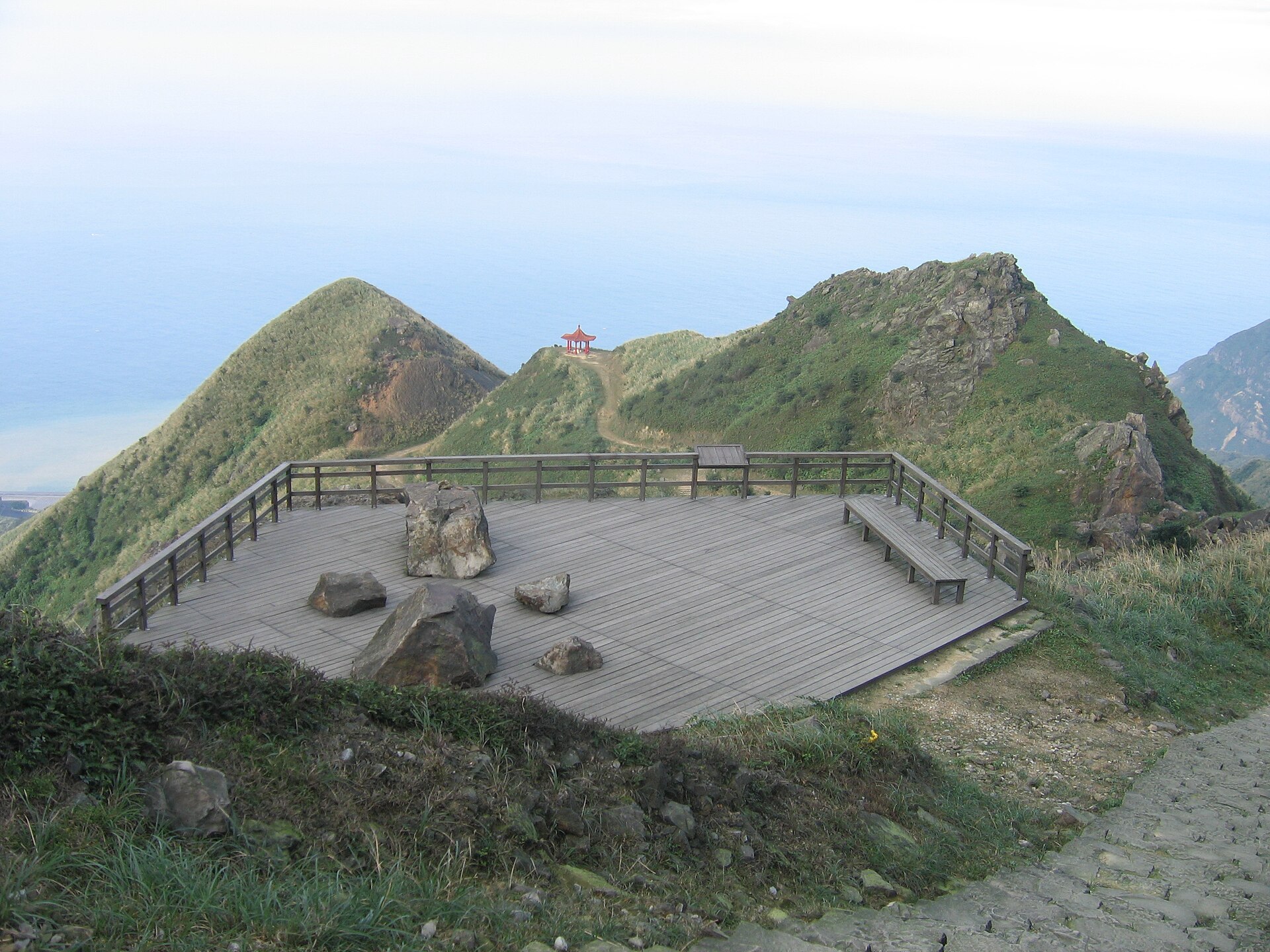
Partway up, a wooden viewing deck set with boulders makes a natural stopping point. From here you can see down to the coast and along the ridge ahead, where a small red pavilion sits on a saddle below the summit rocks. The final stretch of steps leads past the pavilion to the foot of the teapot itself.
The scramble into the teapot
The last part is the fun part. To reach the top of the teapot, you leave the steps and scramble up the rock using your hands and feet, and then squeeze through a gap in the rocks into the teapot itself — the space between the pot and its lid — a small, rocky hollow with openings looking out over the coast. It is short and not especially high, but it is a proper scramble: you need both hands free, shoes that grip, and a little confidence.
If scrambling is not for you, stop at the base of the rocks. The view from the pavilion and the ridge just below the summit is almost as good, and there is no shame at all in skipping the last few metres. In wet weather, or when the wind is strong, everyone should skip them.
The view from the top
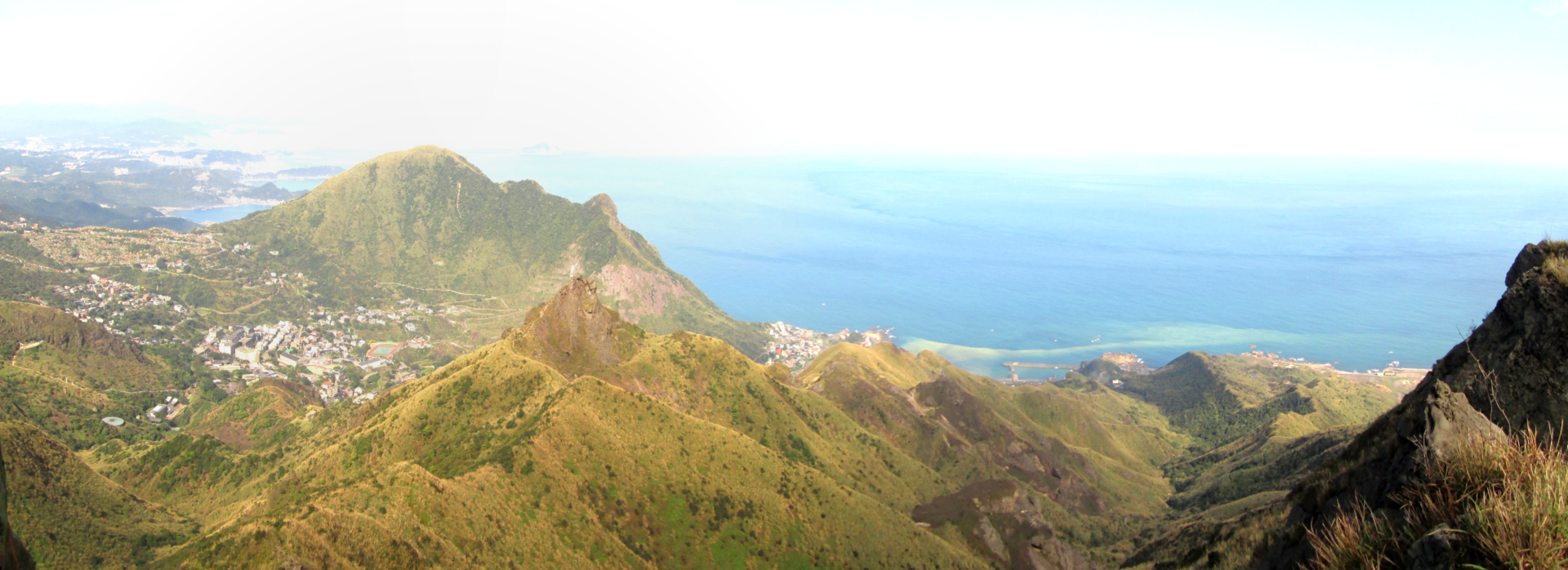
From the teapot, the whole of this dramatic coast is laid out below you. You can pick out Jiufen’s rooftops, the bulk of Keelung Mountain and the Pacific, and below them the famous Yin Yang Sea (陰陽海), where the bay shows yellow against the blue. On the slopes between you and the sea, look for the ruined terraces of the old smelter known as the Thirteen Levels (十三層遺址) and the long stone smoke flues that climb the hillside from it.
Beyond the teapot: Banpingshan and the high ridge
The trail does not end at the teapot. A path continues along the ridge behind it to Banpingshan (半屏山), a higher, narrower and more exposed crest, and beyond that to Canguangliao Mountain (燦光寮山), one of the high points of these hills. The views from the ridge are even bigger — the panorama above was taken from higher up it — but this is a different kind of walk: steep, rocky, windswept, with drops to either side and no shelter. It is for experienced hikers in settled weather only, with a map downloaded and plenty of water, and it adds several hours. Most visitors should turn round at the teapot.
How long does it take?
| Route | Time (approx.) | Suits |
|---|---|---|
| Quanji Temple to the viewing deck and back | About an hour | Families, and anyone who wants the view without the scramble |
| Quanji Temple to the summit and back | An hour and a half to two hours | Most walkers |
| Add the walk up from the Gold Museum bus stop | Allow extra time, each way | Everyone arriving by bus |
| On along the ridge to Banpingshan and beyond | Several extra hours | Experienced hikers in good weather only |
The Gold Museum and the mining heritage below
Give yourself time either side of the hike for Jinguashi itself, which is far quieter and more atmospheric than Jiufen. The Gold Museum (黃金博物館) is not a single building but a park of restored mining-era buildings on the hillside, including Japanese-style wooden houses, a mining tunnel you can walk into, and a museum hall with the history of the mines — and a very large bar of gold you can reach in and touch.
- Hours: check the day’s opening hours on the museum’s official website before you go.
- Closed: the first Monday of each month (the following day if that Monday is a public holiday), Lunar New Year’s Eve and Day, and natural-disaster closure days.
- Admission: NT$80; the free entry for children 12 and under and for seniors applies to R.O.C. citizens with ID. Hands-on experiences such as gold panning, and the mine tunnel, may carry separate charges.
Opening hours and prices are published on the museum’s official website. Nearby, the Crown Prince Chalet, a Japanese-style residence built in the 1920s for a royal visit that never happened, is closed for restoration, with the museum estimating completion by the end of 2029, and our Jiufen day trip guide covers the rest of the area.
On the road down to the coast, the Golden Waterfall (黃金瀑布) tumbles over rocks stained gold and orange by the same minerals, and the Yin Yang Sea is at the bottom of the valley. Both are roadside stops rather than destinations, best seen from a bus or taxi on the way to the north coast, or from the top of Teapot Mountain.
When to go
- Autumn and early winter (October–December): the best season, with clearer air, silver grass on the slopes and cooler walking. Pick a calm day between cold fronts.
- Winter (January–February): this is one of the wettest corners of northern Taiwan in winter, when the north-east monsoon brings days of drizzle and cloud to Jiufen and Jinguashi. The rocks get slippery and the view vanishes; wait for a dry spell.
- Spring (March–May): changeable, often misty, occasionally glorious.
- Summer (June–September): hot, humid and completely exposed. Start early in the morning, carry plenty of water and be off the mountain before the afternoon thunderstorms.
Morning is best in every season: the light is softer, the bus is less crowded and the clouds that often gather over the ridge in the afternoon have not yet arrived. Sunset is spectacular but leaves you coming down steep steps in the dark, so carry a torch. For forecasts, check the Central Weather Administration’s English site.
Staying safe
- Wind. The ridge is fully exposed, and strong winds are common on this coast. Do not attempt the scramble, or the ridge beyond, in high wind.
- Wet rock. The summit rocks are slippery after rain. If it has been raining, stop below the teapot.
- Heat and sun. There is no shade on the whole climb. Wear a hat, use sun cream and carry at least a litre of water.
- Lightning. The summit is an open viewpoint over Jinguashi, the coast and the Pacific. At the first sound of thunder, head down.
- Fog. Cloud can roll over the ridge in minutes. Stay on the path, which is easy to follow.
- Emergencies. Dial 119. Mobile coverage is generally good on the ridge.
What to bring
- Shoes with a good grip — essential for the scramble.
- Gloves, if you have them, for gripping the rough rock.
- Water and snacks, bought before you start; there is nothing on the trail.
- A hat, sun cream and a windproof layer.
- A small backpack rather than a shoulder bag, so both hands are free on the rocks.
- A torch if you plan to stay for sunset.
Where to eat
Jinguashi has far fewer places to eat than Jiufen, which is part of its charm. Around the Gold Museum you will find a handful of cafés and simple restaurants, and a well-known local lunch is the miner’s lunch box, a boxed meal of rice, pork chop and vegetables inspired by what the miners once carried underground, often sold wrapped in a cloth you can keep. Buy water and snacks before you start the hike, as there is nothing on the trail. For a wider choice, Jiufen’s old street is one stop down the hill, with taro balls, fish balls, peanut ice-cream rolls and teahouses with views over the coast.
Photographing Teapot Mountain
- The classic shot is from below. The teapot shape reads best from the trail and the pavilion below the summit, and from across the valley in Jiufen, rather than from on top of it.
- Morning light is kindest. In the afternoon the sun sits behind the summit from many viewpoints, and clouds often gather over the ridge.
- Look for the Yin Yang Sea. The yellow-and-blue bay shows best on a sunny day, from high on the trail, with a longer lens.
- Mind the wind. Keep a firm grip on phones and cameras on the summit rocks, and do not stand near the edges for a photograph.
If the weather turns
This coast changes fast, and a clear morning in Taipei can mean drizzle and cloud in Jinguashi. If the ridge is hidden or the rocks are wet, the day is not lost. Spend longer in the Gold Museum’s buildings and mine tunnel, walk the lanes of Jinguashi and the memorial park, and drop down to Jiufen for a long pot of tea in a teahouse with a view — which is, after all, what Jiufen is best for in the rain. Save the mountain for a dry morning; it is not going anywhere.
A day with Teapot Mountain, Jinguashi and Jiufen
| Time | Plan |
|---|---|
| 08:00 | Bus 1062 from Zhongxiao Fuxing, or the train to Ruifang and a bus up the hill |
| 09:30 | Walk up from the Gold Museum stop to Quanji Temple |
| 09:45–11:45 | Teapot Mountain and back |
| 12:00 | Lunch in Jinguashi |
| 13:00 | The Gold Museum and the mine tunnel |
| 15:30 | Bus one stop down to Jiufen for the old street, tea and taro balls |
| 17:00 | Jiufen’s lanterns at dusk, then the bus or a taxi back to Ruifang and Taipei |
Doing it this way round means you climb in the cool of the morning, see Jinguashi before the crowds, and reach Jiufen just as its lanterns come on. If you have another day, the Pingxi Line from Ruifang leads to the Sandiaoling waterfall trail and Shifen, and Keelung is a bus ride away for its night market.
Teapot Mountain with children
Children who are used to walking can manage the steps to the viewing deck and the pavilion, and the views and the giant statue at the start make it an exciting outing. The final scramble into the teapot needs both hands and a steady head, and younger children are better stopping below it. With toddlers, the Gold Museum park and its mining tunnel are a better use of the day. Pushchairs cannot be used on the trail. For more ideas, see our guide to Taipei with kids.
What we would skip
- The scramble in wind or rain. The view from the pavilion is nearly as good, and the rocks are no place to slip.
- The ridge to Banpingshan unless you are an experienced hiker with a map, good weather and the whole afternoon.
- Climbing in the midday summer sun. There is no shade at all.
- A special trip to the Yin Yang Sea or the Golden Waterfall. They are roadside stops; you see both better from the top of the mountain.
- A coach tour that squeezes Jiufen, Jinguashi, Shifen and Yehliu into one day. You will not have time for the mountain, and the mountain is the best part.
Related Taipei guides
- Hiking in Taipei: Best Trails, Beaches & Outdoor Escapes
- Jiufen Day Trip
- Keelung Day Trip
- Sandiaoling Waterfall Trail
- Shifen Day Trip
- Houtong Cat Village
- Taiwan’s North Coast
- Qixing Mountain
- Day Trips from Taipei
Frequently Asked Questions
Where is Teapot Mountain?
Teapot Mountain rises above Jinguashi, the old gold-mining village next to Jiufen in Ruifang District, New Taipei, on Taiwan’s north-east coast. The trail starts at Quanji Temple, a short walk uphill from the Gold Museum.
How do I get to Teapot Mountain from Taipei?
Take Keelung Bus 1062 from near Zhongxiao Fuxing station to the Gold Museum stop at Jinguashi, or a train to Ruifang and a bus up the hill. From the bus stop, walk up to Quanji Temple, where the trail begins.
How long is the Teapot Mountain hike?
The round trip from Quanji Temple takes an hour and a half to two hours, plus the walk up from the bus stop.
Is the Teapot Mountain hike difficult?
It is moderate. Most of the way is steep stone steps with no shade. Trail conditions can change after typhoons, so check the trail’s status with the Ruifang District Office or on newtaipei.travel before you go.
Why is it called Teapot Mountain?
Its rocky summit looks like a squat teapot with a lid and no handle, which is why its full Chinese name, 無耳茶壺山, means “Earless Teapot Mountain”.
What can you see from Teapot Mountain?
Jiufen and Jinguashi, Keelung Mountain, the Pacific coast, and the Yin Yang Sea, where mineral-laden water stains the bay yellow. You also look down on the ruins of the old smelter terraces and smoke flues.
Can I combine Teapot Mountain with Jiufen?
Yes, and it is the best way to do it. Climb Teapot Mountain in the morning, visit the Gold Museum after lunch, then take the bus one stop down to Jiufen for the old street and the lanterns at dusk.
How much is the Gold Museum?
Admission is NT$80; the free entry for children 12 and under and for seniors applies to R.O.C. citizens with ID, and hands-on activities may cost extra. Opening hours are on the museum’s official website. It closes on the first Monday of each month, or the following day when that Monday is a public holiday.
When is the best time to hike Teapot Mountain?
On a clear, calm, dry morning, ideally in autumn or early winter. Winter brings frequent drizzle and cloud to this coast, and summer middays are hot with no shade.
Is Teapot Mountain suitable for children?
The steps to the viewing deck and the pavilion suit children used to walking. The final scramble into the teapot needs both hands and a steady head, so younger children are better stopping below it.
Can I continue from Teapot Mountain to Banpingshan?
Experienced hikers can follow the ridge behind the teapot to Banpingshan and beyond, but it is narrow and exposed. Only attempt it in settled weather, with a map, water and several spare hours.
What is the Yin Yang Sea?
A bay at the foot of the valley below Jinguashi where the sea shows yellow against the surrounding blue. It is best seen from above, on the Teapot Mountain trail.
The Bottom Line
Teapot Mountain packs a lot into two hours. You climb past a giant golden Guan Yu, up an open ridge with the Pacific at your back, to a rocky summit where you can squeeze inside the pot and look down on Jiufen, Keelung Mountain and the yellow-and-blue Yin Yang Sea. Pair it with the Gold Museum and Jiufen at dusk and it is one of the finest days out from Taipei. Go on a clear morning, wear shoes that grip, skip the final scramble if the rock is wet or the wind is up, and leave the ridge beyond to experienced hikers.
Photo Credits
Teapot Mountain’s rocky summit: Soft feeling of Teapot mountain-Queen shufang by Queen shufang, CC BY-SA 4.0, via Wikimedia Commons.
The statue of Guan Yu on Quanji Temple: Taiwan 2009 JinGuaShi Historic Gold Mine Valley View Left Page FRD 8822 Giant Statue of GuanYu by Fred Hsu on en.wikipedia, CC BY-SA 3.0, via Wikimedia Commons.
The viewing deck on the trail: Observation deck on the trail to the top of Teapot Mountain by wei-ren, CC BY-SA 2.0, via Wikimedia Commons.
Panorama from the ridge above Teapot Mountain: Teapot mountain pano by Kuanyui, CC BY-SA 3.0, via Wikimedia Commons.